Semantic observability vs. AI observability: what changes in the GenAI era?
August 25, 2026/7 min read/Team Dataiku
A generative AI (GenAI) system can pass every infrastructure check and still be wrong in the way that matters most: The response arrives on time and the token budget holds, the logs show nothing unusual, and yet the answer cites a policy that expired six months ago.
Traditional monitoring catches system failures. But it has no mechanism for catching semantic failures: outputs that are technically produced but substantively wrong. In production GenAI, those are often the failures that create compliance exposure and end up in board reports.
AI observability and semantic observability address different layers of this problem. Most organizations conflate them. This article draws the distinction clearly: what each approach monitors, what failures each catches, when to use one versus the other, and how to implement both.
AI observability monitors system-level performance: latency, token usage, error rates, cost, and model health. It answers "Is the system running correctly?"
Semantic observability monitors output-level quality: reasoning coherence, intent alignment, factual accuracy, and meaning preservation. It answers "Is the system producing correct and appropriate outputs?"
The two are complementary, not competing. Semantic observability extends AI observability rather than replacing it.
GenAI-specific failure modes—including hallucination, reasoning drift, agent loops, retrieval misalignment—require semantic-layer checks that traditional performance metrics cannot detect.
Start with AI observability as the foundation. Layer semantic observability when outputs directly affect end users, business decisions, or regulated workflows.

Observability has to change because GenAI systems can fail while every traditional signal still reads normal, producing an output that is confidently wrong in a way infrastructure monitoring was never built to catch.
Deterministic software either works or it does not. A function returns the expected value, or it throws an error. Observability for deterministic systems is relatively straightforward: monitor inputs, outputs, error codes, and latency.
GenAI systems fail differently. The failure is often invisible at the infrastructure level because the system continues to operate within normal technical parameters while producing outputs that are semantically wrong.
Consider two scenarios:
A customer asks an AI-powered support agent about a refund policy. The agent responds in 180 milliseconds with a confident, grammatically correct answer that cites a policy the company discontinued six months ago. Every infrastructure metric is green, yetthe output is still wrong.
In a second scenario, a cost-optimization agent queries a pricing database and hallucinates a decimal point shift, recommending a vendor contract at $50,000 instead of $500,000. Latency is normal and token usage is within budget, but the financial impact of that one misplaced decimal is significant.
Traditional KPIs (uptime, latency, error rate, throughput) cannot catch these failures because the system is performing correctly at the technical layer. The output is the problem, and detecting output-level problems requires a different observability approach.
Neither failure registers at the system level. Both require semantic observability at the output layer.
AI observability is the practice of monitoring, tracing, and analyzing the operational behavior of AI systems to ensure they perform reliably, efficiently, and within defined cost and compliance boundaries.
AI observability operates across four layers:
Infrastructure layer: GPU utilization, memory consumption, API endpoint health, and service availability; these metrics confirm that the compute infrastructure supporting the AI system is operating within expected parameters.
Model performance layer: Accuracy, precision, recall, and drift metrics that track whether the model's predictions or generations are maintaining quality over time; for GenAI, this extends to response quality scores and retrieval relevance metrics.
Cost and efficiency layer: Token usage per request, cost per interaction, cache hit rates, and throughput; these metrics ensure that the system's operational costs remain within budget as usage scales.
Compliance and audit layer: Request logging, access control verification, and policy adherence checks that confirm the system is operating within governance boundaries.
The core goals of AI observability are:
Performance optimization: Is the system fast and accurate enough?
Cost control: Is the system efficient?
Compliance: Is the system operating within policy?
Reliability: Will the system keep working under load?
Illustrative failure example
A production LLM endpoint experiences a latency spike from 200 milliseconds to 3.2 seconds during peak hours. AI observability detects the spike, traces it to GPU memory contention from concurrent requests, and triggers auto-scaling. The failure is technical, the detection is operational, and the resolution is infrastructure-level. AI observability handles this well.
AI observability covers operational health. Determiningwhether a response was accurate, appropriate, or aligned with user intent requires the semantic layer.
Semantic observability is the practice of surfacing how an AI system arrives at an answer, whether its outputs align with user intent, and whether the meaning of its responses is accurate, appropriate, and trustworthy.
AI observability asks "Did the system respond?", whereas semantic observability asks "Did the system respond correctly and for the right reasons?"
Semantic observability operates across three layers:
Step-by-step records of the model's observable reasoningpath: which documents were retrieved, how they were ranked, what intermediate conclusions were drawn, and how the final output was assembled. These traces make the model's thought process inspectable rather than opaque.
Automated quality checks that score outputs against defined criteria:
Factual accuracy: Does the response match verified source material?
Intent alignment: Does the response address what the user asked?
Completeness: Does the response cover all relevant aspects of the query?
Safety: Does the response comply with content policies?
Structured channels for users and reviewers to flag outputs that are technically correct but semantically wrong: a response that answers a different question than the one asked, a summary that omits the most important finding, or a recommendation that is factually accurate but contextually inappropriate.
Semantic observability is particularly critical in regulated environments. A financial advisory chatbot that produces a technically fluent but factually incorrect recommendation creates liability that AI observability alone cannot detect. A knowledge assistant built on retrieval-augmented generation (RAG) that retrieves the right documents but synthesizes them into a misleading conclusion creates risk that only semantic-layer evaluation catches.
This isn't an abstract concern for CIOs, either. According to “7 career-making AI decisions for CIOs in 2026,” based on a Dataiku/Harris Poll survey of 600 CIOs, 85% say explainability gaps have already delayed or stopped AI projects from reaching production.
GenAI-specific concern: bias amplification in RAG answers. When the retrieval step surfaces documents with embedded bias, and the generation step synthesizes that bias into a confident response, the output carries the authority of the AI system while reflecting the limitations of its source material. Semantic observability detects this through evaluation loops that assess output fairness alongside accuracy.
The key differences are in what each layer watches and what it catches: AI observability monitors system health and performance, while semantic observability monitors output meaning and reasoning quality.
Teams frequently conflate these terms because both involve monitoring AI systems in production, both rely on telemetry and alerts, and both aim to keep AI systems reliable. That overlap in mechanics is exactly why the distinctionmatters: The difference is not primarily the tooling; it is what each approach monitors and which failures it catches.
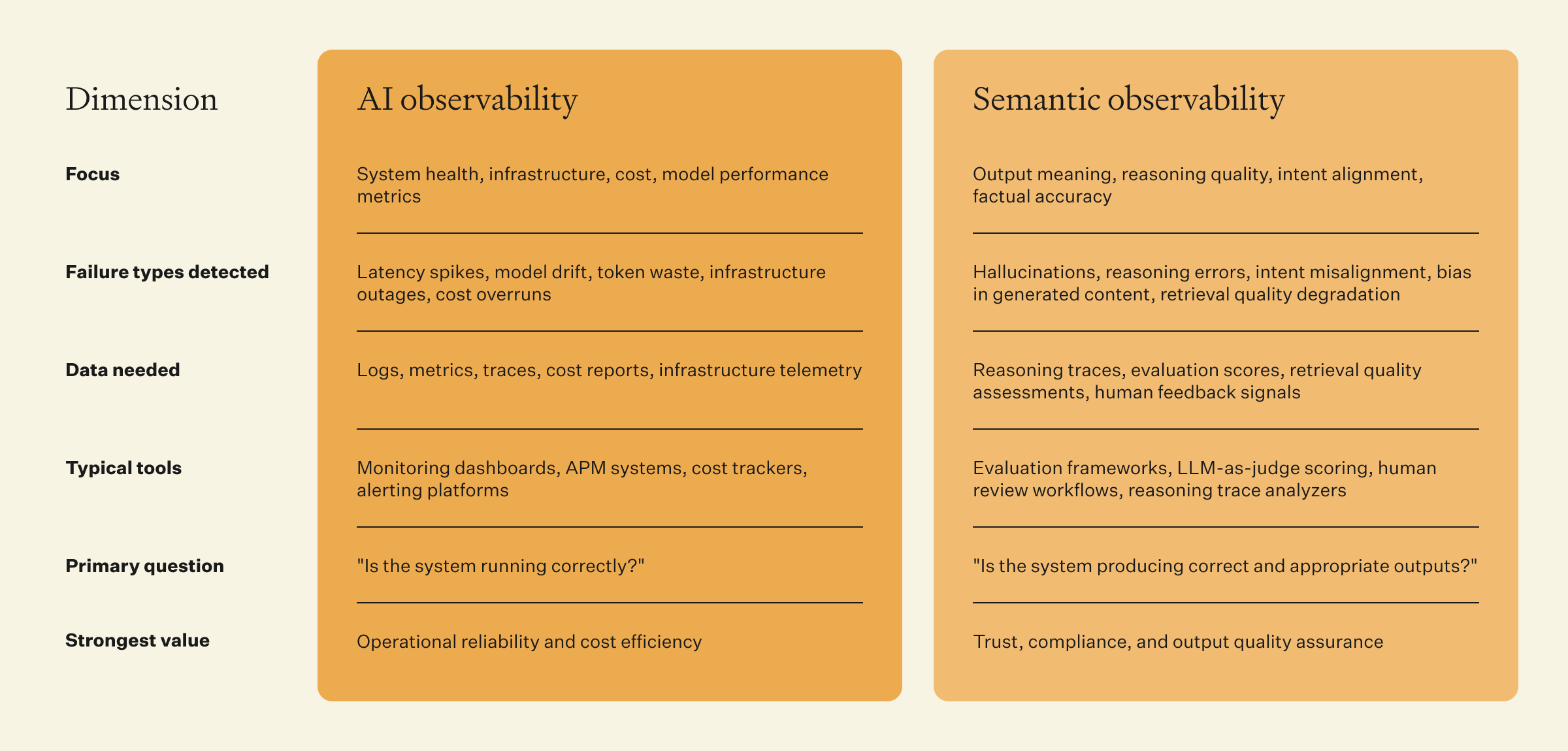
Click on the image above to zoom into full PDF
There are three key takeaways from this comparison:
Semantic observability extends AI observability rather than replacing it, which means a system must be operationally healthy before semantic evaluation adds any value. Monitoring output quality on a system with 30% infrastructure-level error rates issolving the wrong problem first.
The failure modes each layer catches are complementary. AI observability catches failures that prevent the system from responding. Semantic observability catches failures where the system responds when it should not, or responds incorrectly.
Production-ready GenAI requires both. An AI system that is fast, cheap, and reliable but produces hallucinated outputs is not production-ready. An AI system that produces excellent outputs but costs three times its budget and crashes under load is not production-ready either.
Use AI observability alone for early prototypes. Useboth once outputs reach customers or inform regulated decisions, and emphasizesemantic checks most heavily for autonomous agents acting without a human in the loop.
The following decision matrix maps observability approach to deployment context.
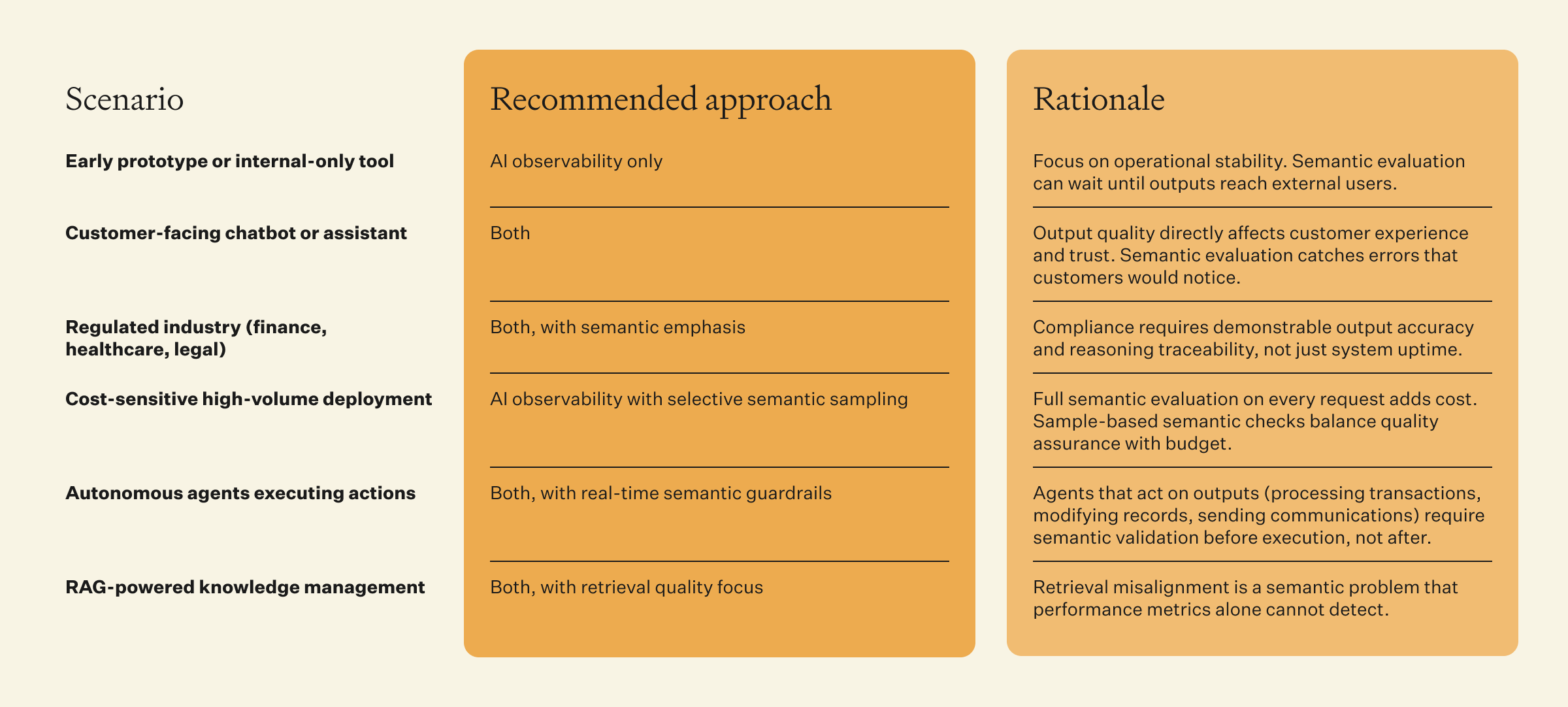
Click on the image above to zoom into full PDF
Forteams starting from zero: Build the AI observability foundation first (telemetry, logging, cost tracking, basic alerting), then layer semantic observability once any of these conditions are true:
Outputs reach end users directly.
Outputs inform regulated decisions.
Agents act on outputs autonomously.
Retrieval quality directly affects answer accuracy.
Hybrid tooling is increasingly available. Platforms that combine infrastructure monitoring with evaluation frameworks and guardrails reduce the integration overhead of running separate AI and semantic observability stacks.
The following five-step checklist sequences the implementation from foundational telemetry through continuous governance.
Instrument every LLM call with structured logging: input prompt, output response, model version, token counts (input and output), latency, and cost. This is the raw data layer that both AI and semantic observability depend on. Without it, neither layer functions.
Implement automated quality checks on model outputs: factual accuracy scoring (LLM-as-judge or reference-based evaluation), intent alignment checks, safety screening (content policy compliance), and output format validation. For high-stakes workflows, add pre-execution guardrails that block outputs from reaching users or triggering actions until they pass semantic validation.
Persist reasoning traces (the full chain from input through retrieval through generation to output) in a searchable store. When an output is flagged as incorrect, the trace provides the forensic evidence to diagnose whether the failure was in retrieval, reasoning, or generation.
Build channels for human reviewers and end users to flag outputs that pass automated checks but are semantically wrong. Route flagged outputs to evaluation queues. Use feedback data to refine evaluation criteria, update guardrails, and identify systematic failure patterns.
Generate compliance reports from the telemetry, evaluation, and feedback data. Ensure that audit trails meet regulatory requirements for the applicable jurisdiction. Review and update evaluation criteria quarterly as the system's use cases, data sources, and model versions evolve.
Latency and cost caution: Full semantic evaluation on every request adds processing time (evaluation scoring) and cost (additional LLM calls for LLM-as-judge patterns). For high-volume systems, implement tiered evaluation: full semantic evaluation on a representative sample, lightweight checks on every request, and full evaluation triggered automatically when anomaly detection flags a potential issue.
Dataiku LLM Mesh, part of Dataiku, the Platform for AI Success, connects to any model provider with monitoring, cost controls, and governance built into the routing layer, providing a foundation for AI observability. The LLM Mesh applies governance controls at inference time, screening prompts and responses before they reach production.
AI observability handles performance and infrastructure, answering whether the system is running, fast enough, and within budget. Semantic observability adds reasoning visibility on top of that, answering whether the output is accurate, aligned with intent, and traceable enough to defend.
Neither layer alone constitutes production readiness. A phased approach works best: Start with the AI observability foundation (telemetry, cost tracking, alerting), then layer semantic checks (evaluation scoring, reasoning traces, human feedback) where outputs affect users, business decisions, or regulated workflows.
Dataiku brings both layers together with governance across models and agents, ensuring that what AI systems produce is monitored as rigorously as how those systems perform.
Deliver AI agents
Deliver AI agents
AI observability alone cannotdetect hallucinations because system metrics like latency and error rate stay normal when a model hallucinates. Semantic observability catches them through evaluation loops, reasoning trace analysis, and human feedback. For high-stakes GenAI systems, it's the essential detection layer.
Industries where AI outputs drive consequential decisions benefit most: financial services, healthcare, legal, and customer service. In each case, an operationally healthy system that produces semantically incorrect outputs can createliability that AI observability alone cannot prevent.
Start with AI observability as the foundation: telemetry, cost tracking, and operational alerting. Layer semantic observability once outputs reach end users, inform regulated decisions, or trigger autonomous actions. This phased approach keeps both layers ready before production affects customers.
AI observability costs are mostly infrastructure: log storage, dashboards, and alerting. Semantic observability adds evaluation compute: LLM-as-judge calls, trace storage, and human review. Full evaluation on every request adds real cost, so tiered evaluation balances quality against budget.
The two scale differently. AI observability scales with infrastructure: more models, more endpoints, more metrics. Semantic observability scales with interaction complexity: More agents createmore handoff points where meaning can drift. Check each handoff, not just the final output.
Tags