Agentic AI tools in 2026: how to choose an enterprise solution
June 18, 2026/10 min read/Team Dataiku
Most vendors claim their agentic AI platform is enterprise-grade. In a market where the term has lost almost all meaning, the real test is not the demo. It is what happens after, when agents meet real data, real governance requirements, and the organizational complexity that no sandbox can simulate.
According to "Global AI confessions report: data leaders edition," based on a Dataiku/Harris Poll survey of 800 global data leaders, 75% say trust in their AI agent deployments is a concern. That number reflects the gap between what these tools promise and what enterprises experience in production: agents that drift from intended behavior, act on ungoverned data, or execute decisions that no one can audit after the fact.
This guide is an evaluation framework for enterprise buyers: what to look for in agentic AI tools, what to pressure-test during vendor evaluations, and how to move from pilot to production without governance becoming an afterthought.
Agentic AI tools let enterprises deploy AI agents that plan, act, and adapt autonomously, but enterprise readiness depends on governance, integration depth, and scalability, not just agent capabilities.
A structured evaluation across governance, API flexibility, and performance benchmarks reduces vendor risk and accelerates procurement cycles.
The market spans developer-first frameworks, no-code automation builders, and end-to-end platforms. The right choice depends on organizational maturity, technical depth, and compliance requirements.
Moving from pilot to production requires phased implementation with governance checkpoints at every stage, not a single deployment event.
Agentic AI tools are critical because they enable enterprises to automate complex, multi-step workflows that traditional rule-based systems cannot handle. Unlike conventional automation, AI agents reason through ambiguity, use tools dynamically, and adapt their approach based on outcomes.
The market momentum is substantial. According to "Global AI confessions report: data leaders edition," based on a Dataiku/Harris Poll survey, 86% of organizations now rely on AI agents in daily operations. Fortune Business Insights values the agentic AI market at $9.14 billion in 2026, projecting growth to $139.19 billion by 2034.
The enterprise case is straightforward. In supply chain operations, agents monitor supplier risk indicators, cross-reference inventory data, and trigger procurement actions without waiting for manual review cycles. In customer service, agents triage tickets, pull account history, diagnose issues, and resolve or escalate based on context rather than keyword matching.
But adoption without governance creates risk. According to "7 career-making AI decisions for CIOs in 2026", based on a Dataiku/Harris Poll survey, 92% of CIOs have been asked at least once to defend AI outcomes they could not fully explain. For agentic systems that act autonomously, explainability is a prerequisite.
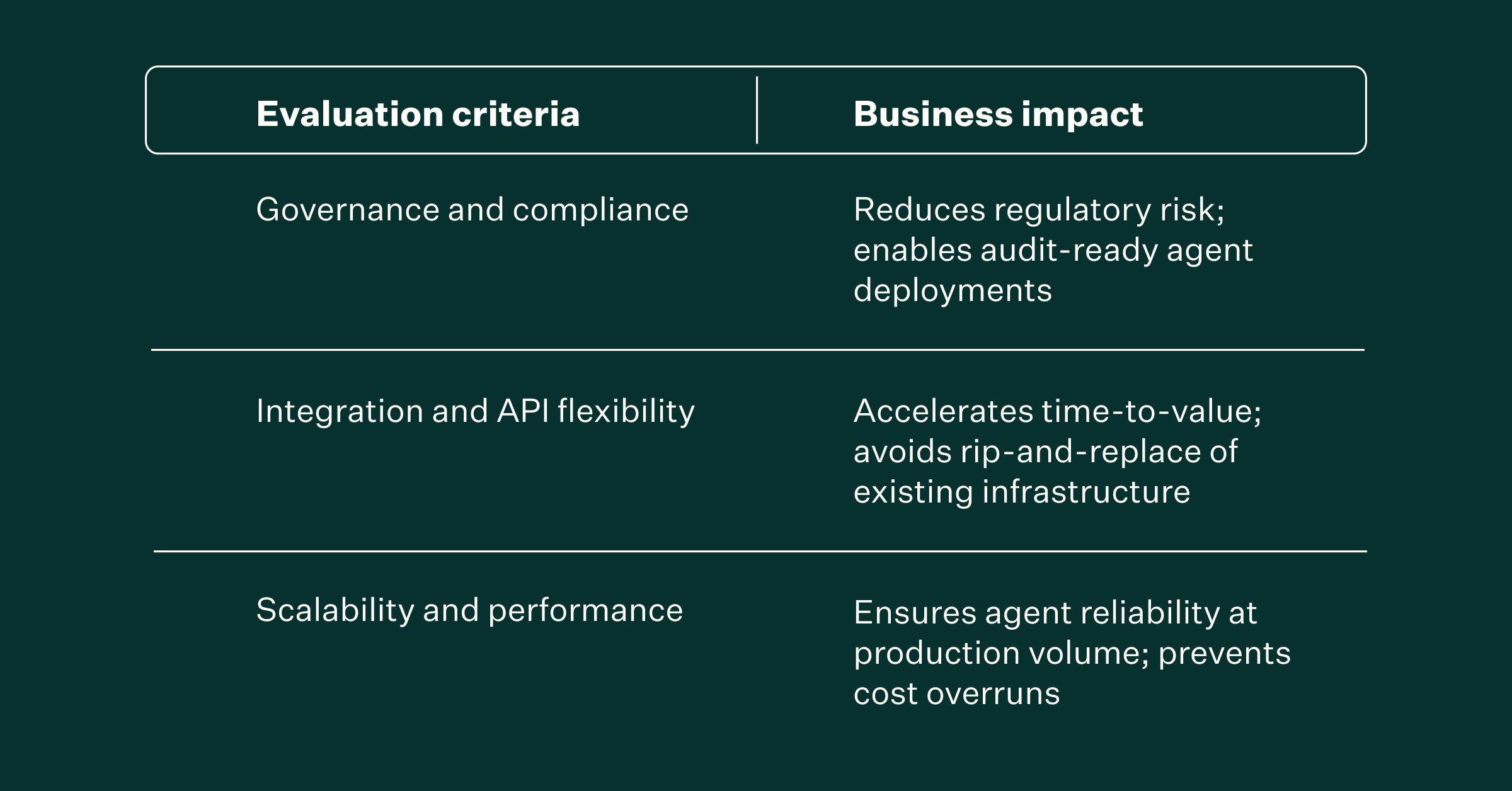
The checklist below reduces vendor risk and accelerates buying cycles by structuring the evaluation around three core domains that determine whether an agentic AI platform will hold up in production.
Governance is the most common failure point in enterprise agent deployments:
Evaluate whether the platform provides SOC 2 Type II, GDPR, and HIPAA compliance certifications.
Verify that role-based access control (RBAC) extends to agent-level permissions, not just user-level access.
Confirm that every agent action is logged in an immutable audit trail.
Questions to ask vendors:
Does the platform support multi-level approval gates for high-stakes agent actions?
Can you demonstrate audit trail completeness for a production agent over a 90-day period?
How does the platform handle agent drift detection and automated guardrails?
Enterprise agents are useful only if they can operate across the systems where work actually happens:
Evaluate MCP server support, REST API availability, and webhook capabilities.
Assess whether the platform is LLM-agnostic and supports multi-model orchestration, so you are not locked into a single provider's pricing or capability trajectory.
Questions to ask vendors:
How does the platform integrate with our existing ERP, CRM, and ITSM stack?
What is the quality of API documentation and developer support?
Can agents be connected to internal data sources without moving data out of our environment?
Production agentic AI tools must handle concurrent execution at scale without degrading performance: Evaluate run limits, concurrent agent execution capabilities, and deployment options (cloud, on-premises, VPC).
Questions to ask vendors:
What are the platform's SLAs for agent execution latency and uptime?
Can you provide benchmarks from deployments at comparable enterprise scale?
What happens when an agent exceeds its execution budget or enters a recursive loop?
The following table compares the platforms covered in this guide across enterprise-critical dimensions.
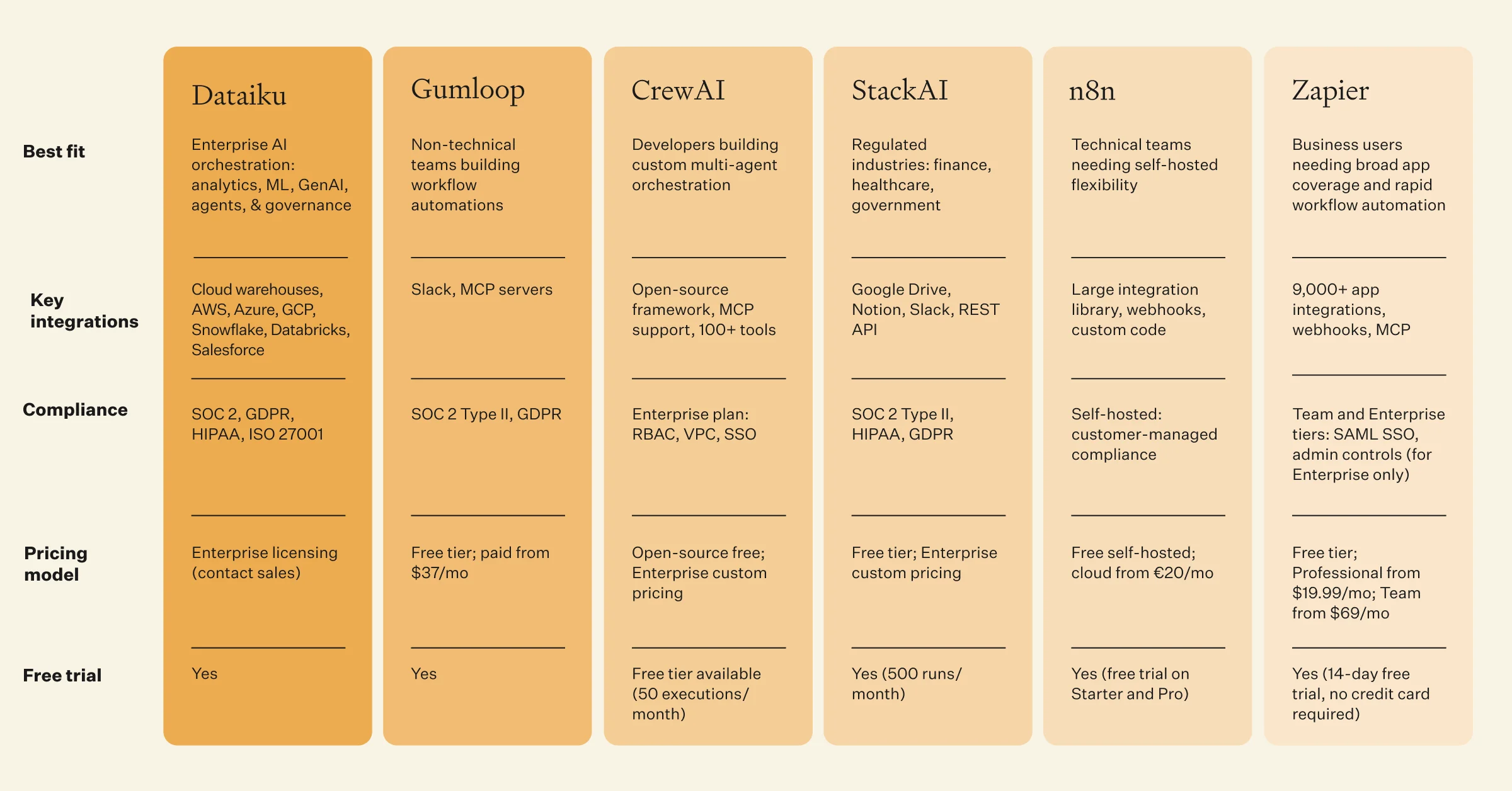
The pattern across this comparison is clear. Platforms like Gumloop, Zapier, and n8n excel at accessible workflow automation and broad integration coverage. CrewAI and StackAI serve developer and regulated-industry niches, respectively.
Dataiku occupies a different position in this comparison. In our assessment, it is the platform most comprehensively designed to connect agent deployment to the underlying data infrastructure, ML models, and governance controls that enterprise agents depend on.
The following reviews are structured consistently: standout features, ideal use cases, limitations, and pricing. Selection was based on market presence, enterprise feature availability, and relevance to the CIO and CDAO audience.
Dataiku, the Platform for AI Success, approaches agentic AI differently from every other platform on this list. Where most agentic AI tools focus on building and running agents, Dataiku connects agent behavior to the data, models, and governance infrastructure that agents depend on.
Dataiku's agentic capabilities provide a unified environment to build, deploy, and manage agents alongside existing ML and GenAI workflows. Agent Hub in Dataiku serves as the central orchestration layer for managing and coordinating agents across complex workflows. Dataiku Agent Management, currently in early access and GA later this year, evaluates agent performance against business KPIs, not just technical uptime metrics. This is the core differentiator: the platform measures whether agents are achieving business outcomes, not just whether they are running.
This is the core differentiator: The platform measures whether agents are achieving business outcomes, not just whether they are running.
Governance is built in. RBAC, audit logging, approval workflows, and VPC/SSO support satisfy SOC 2, GDPR, and HIPAA requirements. Agents operate on the same governed data layer as every other AI asset in the platform, which eliminates the fragmentation that occurs when agent tooling operates separately from the data and model infrastructure.
Ideal fit: Enterprises with existing data infrastructure that need governed, outcome-evaluated agents integrated with ML, generative AI, and analytics workflows. Limitation: steeper onboarding than no-code alternatives; designed for organizations with data maturity, not teams starting from scratch.
Limitation: Designed for organizations with existing data infrastructure and governance processes in place; teams at the earliest stages of AI maturity may find the platform's breadth requires more initial configuration than lighter-weight, single-purpose automation tools.
Pricing: Enterprise licensing (contact sales); free trial available
Gumloop is a no-code AI automation platform that enables non-technical users to build agents through natural language instructions and a drag-and-drop visual builder. The platform supports MCP server integration, multi-model selection without requiring separate API keys, and Slack-based agent interaction. Gumloop raised $50 million in a Series B led by Benchmark in March 2026, with participation from Nexus VP, First Round Capital, Y Combinator, and Shopify Ventures. Customers include Shopify, Instacart, Gusto, Ramp, Samsara, and Opendoor.
Ideal fit: Business teams in marketing, sales, and operations that need to automate workflows without engineering support
Limitation: Enterprise governance features, including VPC, RBAC, SAML, audit logs, and custom data retention, are available but restricted to the Enterprise plan, placing them out of reach for teams on lower tiers.
Pricing
Free tier available (5,000 credits/month, one seat, one active trigger)
Pro plan starts at $37/month (20,000+ credits, unlimited seats).
Enterprise pricing is custom through sales (source).
CrewAI is an open-source Python framework for multi-agent orchestration. Its core abstraction, defining agents with roles, goals, and tools that collaborate as a "crew," makes it a widely adopted framework for building multi-agent workflows. CrewAI offers first-class support for the Model Context Protocol (MCP) and the Agent-to-Agent (A2A) protocol, giving developers standardized ways to connect tools and coordinate between agents. The enterprise offering adds a visual studio, real-time tracing, managed deployment, and RBAC. CrewAI is backed by a community of more than 100,000 developers, and its enterprise customer base includes DocuSign, Experian, PepsiCo, IBM, and Johnson & Johnson.
Ideal fit: Development teams building custom multi-agent systems that need fine-grained control over agent orchestration
Limitation: According to “CrewAI Review: Multi-Agent Framework for AI Teams (Pricing, Pros, Cons)”, the framework is Python-only, which limits accessibility for teams without Python expertise; complex crews can also be slow and token-intensive, making it less suited to real-time or cost-sensitive deployments
Pricing
Open-source framework is free.
Basic cloud plan is free (50 executions/month).
Enterprise pricing is custom.
StackAI is a no-code platform built for enterprises in regulated industries. Its compliance infrastructure, including SOC 2 Type II, HIPAA, and GDPR, along with on-premises and VPC deployment options and dedicated solution engineering support, is designed for finance, healthcare, and government use cases. StackAI was acquired by Asana in 2026, with the combined platform targeting human-agent workflow management. The platform connects to enterprise knowledge bases, including Google Drive and Notion, and deploys agents through Slack and custom REST API endpoints.
Ideal fit: Enterprises in regulated industries that need agents operating on sensitive internal data with strict compliance and audit requirements
Limitation: The platform offers only two pricing tiers — a free plan and enterprise custom pricing — with no mid-market option; this makes cost evaluation difficult for organizations that have not yet engaged the sales team.
Pricing
Free tier available (500 runs/month, two projects, one seat)
Enterprise pricing is custom.
n8n is an open-source workflow automation platform with full self-hosting capability. It raised $180 million in a Series C at a $2.5 billion valuation in October 2025, led by Accel with participation from NVIDIA's venture arm NVentures and Meritech, among others. The self-hosted option gives organizations complete control over data residency and compliance, but places the full burden of security, scaling, and maintenance on internal teams.
Ideal fit: Technical teams that want maximum flexibility and are willing to manage infrastructure in exchange for cost control and customization.
Limitation: Enterprise-grade security controls, including SSO, SAML, and LDAP, are restricted to the Business plan and above, while external secret store integration and log streaming are reserved for the Enterprise tier; lower plans lack the access controls and observability that most enterprise deployments require.
Pricing
Open-source self-hosted
Community Edition is free
Cloud plans start at €20/month billed annually (€24/month billed monthly);
Enterprise pricing is available through sales.
Zapier's agent capabilities layer on top of its marketplace of 9,000+ app integrations. The platform's strength is breadth of connectivity: if a tool has an API, Zapier likely has a connector for it, and users can build private integrations for internal tools that are not in the marketplace.The Agents product lets users build specialized agents, equip them with company knowledge, and have them complete tasks across 9,000+ connected apps on command.
Ideal fit: Business teams in marketing, sales, IT, and customer support who need to automate workflows quickly and already operate within the Zapier ecosystem
Limitation: Agents are a separate add-on, not part of Zapier's core platform architecture, and are explicitly not compatible with Enterprise accounts out of the box; SSO and advanced admin controls are available but only on higher-tier plans.
Pricing
Free tier available (100 tasks/month on core platform; 400 agent activities/month)
Professional plan from $19.99/month billed annually
Team from $69/month billed annually
Enterprise pricing custom through sales
Moving from pilot to production requires five phases with governance checkpoints between each.
Phase 1: Needs assessment (two to four weeks) Inventory existing workflows, identify high-value automation candidates, and define success KPIs.
Deliverable: Prioritized use case shortlist with estimated business impact
Phase 2: Pilot scope definition (two weeks) Select one workflow, one team, and one measurable outcome. Design the pilot with clear boundaries: what the agent can and cannot do, what data it can access, and what decisions require human approval.
Deliverable: Signed pilot charter with KPIs, timeline, and governance requirements
Phase 3: Data engineering preparation (two to six weeks) Ensure the agent has access to clean, governed data. This is where most pilots stall. If the data is not ready, the agent will not perform, regardless of how capable the platform is.
Deliverable: Agent-ready data pipeline with quality checks and access controls
Phase 4: Governance setup (two to four weeks) Configure RBAC, audit logging, approval workflows, and monitoring dashboards. Define escalation paths for when agents encounter situations outside their confidence threshold.
Deliverable: Governance framework with documented controls
Phase 5: Full rollout (four to twelve weeks) Extend the pilot to adjacent workflows with centralized oversight. Widen agent autonomy gradually as trust builds.
Deliverable: Production deployment with ongoing monitoring against business KPIs
Enterprise agentic AI tools require governance controls that address three specific risks:1. Data leakage (agents accessing or exposing data beyond their scope)2. Agent drift (agents deviating from intended behavior over time)3. Rogue autonomous actions (agents executing high-impact decisions without appropriate oversight)
Mandatory controls include RBAC scoped to the agent level, audit trails for every agent action and tool call, multi-level approval gates for high-stakes decisions, and sandbox environments for testing agents before production deployment.
Dataiku addresses this differently from other platforms on this list. Dataiku Agent Management gives enterprises visibility into whether agents are doing their jobs, not just whether they are running. Technical uptime monitoring is table stakes.
The differentiator is evaluating agents against business KPIs: Are they making accurate decisions, reducing cycle times, and operating within governance boundaries?
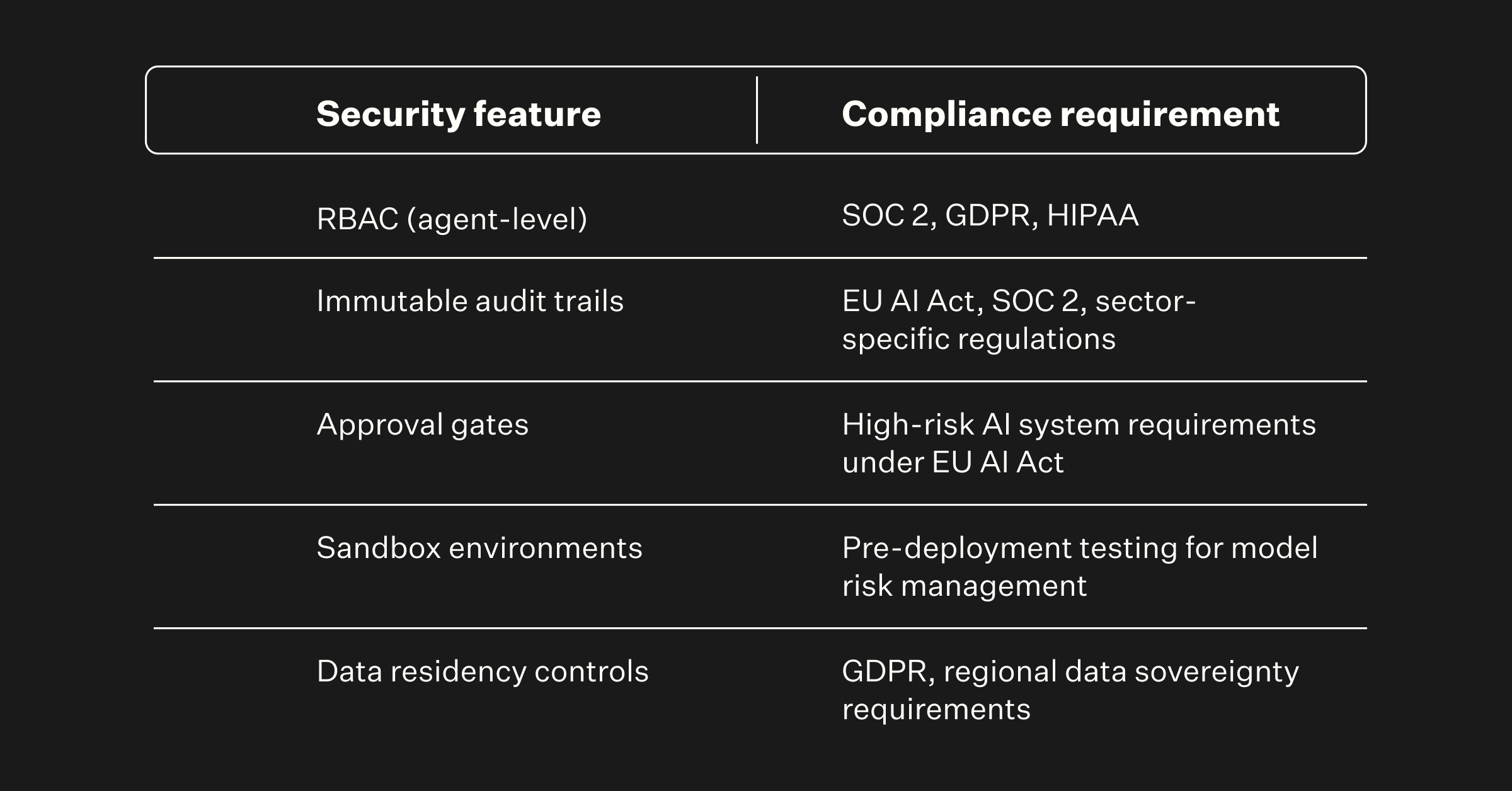
Alignment with the NIST AI Risk Management Framework provides a structured foundation for ongoing governance. Organizations should also establish incident response plans specific to agent failures, defining who responds, what gets shut down, and how the root cause is investigated.
ROI measurement starts with distinguishing direct benefits from indirect ones.
Direct benefits are quantifiable: hours saved per workflow, error reduction rates, cost per agent execution versus cost per human equivalent.
Indirect benefits are harder to measure but often more valuable: faster decision cycles, improved customer satisfaction from reduced response times, and new revenue opportunities enabled by agent-driven processes.
A practical ROI formula: (Total benefit from agent deployment minus total cost of platform, implementation, and maintenance) divided by total cost. Apply this per workflow, not across the entire agent program, to identify which use cases justify continued investment.
Core KPIs to track over a six-month pilot:
Task success rate (percentage of agent executions that achieve the defined outcome)
Mean time to decision (how long agents take versus human baselines)
Cost per execution (infrastructure plus API costs per completed task)
Accuracy metrics (output quality benchmarked against human review)
The right agentic AI platform depends on three alignment factors:
1. Organizational maturity: Do you have the data infrastructure and governance processes to support autonomous agents?2. Technical depth: Does your team need no-code accessibility or developer-grade control?3. Compliance requirements: Does your industry demand SOC 2, HIPAA, or EU AI Act readiness?
Use the evaluation checklist from earlier in this guide to structure vendor conversations. Run fast pilots scoped to a single workflow with clear KPIs. And prioritize governance from day one, because retrofitting it after agents are in production is more expensive and more disruptive than building it in from the start.
For enterprises that need agents connected to their data infrastructure, evaluated against business outcomes, and governed at every step, Dataiku is built for exactly that use case.
Deliver AI agents
Deliver AI agents
Licensing ranges from free open-source frameworks (CrewAI, n8n) to tiered subscriptions (Gumloop, Zapier) and custom enterprise contracts (Dataiku, StackAI). Total cost of ownership matters more than the license fee alone; factor in implementation, integration, governance, and ongoing maintenance.
Expect two to six weeks for a focused pilot integration and three to six months for enterprise-wide deployment. Broad connector libraries reduce initial effort but may lack depth for complex enterprise systems. Purpose-built platforms require more upfront configuration but deliver more governed integration.
The strongest platforms use RBAC to control data access, audit logging to track every interaction, and data residency controls to keep data within approved boundaries. Verify retention policies, whether the platform trains on your data, and whether VPC or on-premises deployment is available.
Lock-in risk is highest with proprietary agent definitions, closed ecosystems, or single-LLM dependencies. Evaluate whether agents can be exported, whether multiple LLM providers are supported, and whether orchestration uses open standards. Open-source frameworks minimize lock-in but shift maintenance responsibility to internal teams.
Look for investment in governance capabilities, plans for multi-model and multi-provider support, and evidence of enterprise customer traction. A platform investing heavily in builder tools but not in audit trails or compliance certifications may not be building for the enterprise use case.
Tags