What is an AI orchestration layer? Architecture, benefits, and enterprise use cases
June 14, 2026/10 min read/Jed Dougherty
AI investments are multiplying, but coordination between models, agents, and data pipelines remains an afterthought in most enterprises. The result is predictable: duplicated workflows, inconsistent outputs, ungoverned decisions, and AI initiatives that never graduate from pilot to production.
The AI orchestration layer is what closes that gap. It is the infrastructure that sits between your AI assets — models, agents, LLMs, data pipelines — and the business applications they serve, coordinating how everything works together as a governed system.
According to "7 career-making AI decisions for CIOs in 2026," based on a Dataiku/Harris Poll survey of 600 enterprise CIOs, 74% regret at least one major AI vendor or platform selection made in the past 18 months. A common driver of that regret: choosing tools that solved one piece of the AI stack but left the orchestration and governance gaps that prevent production deployment.
This guide covers what the AI orchestration layer is, where it sits in the stack, its core components, measurable benefits, and the enterprise use cases it enables.
The AI orchestration layer is the coordination infrastructure between AI models, agents, data pipelines, and business applications.
Five core components define the layer: integration hooks, automation and scheduling, state and memory management, monitoring and observability, and governance controls.
Benefits are measurable: faster scaling, higher reliability, lower governance risk, and improved cross-team collaboration.
Use cases span customer service hand-offs, fraud detection chains, supply chain optimization, and retrieval-augmented generation (RAG)-powered knowledge management.

The AI orchestration layer is the middleware that coordinates how AI models, agents, data pipelines, APIs, and infrastructure work together to deliver business outcomes. It sits between the AI compute layer — where models and agents execute — and the application layer, where business users interact with AI-powered tools.The components it touches include ML models, LLMs, AI agents, data ingestion and transformation pipelines, API endpoints, vector databases, and compute infrastructure.The terminology can be confusing:
"Layer" refers to the architectural position in the stack.
"Platform" refers to a product that provides orchestration capabilities.
"Framework" refers to a developer toolkit for building orchestration logic.
An enterprise typically needs all three: the layer as an architectural concept, a platform or framework to implement it, and governance controls to govern what flows through it.
Without a distinct orchestration layer, AI tools operate in silos. Two chatbots built by different teams may produce contradictory answers to the same question because they pull from different knowledge bases with different update cycles.A fraud model and a customer risk model may score the same transaction differently because they run on different data snapshots. An agent may trigger a workflow that another agent has already completed, duplicating work and confusing downstream systems.
They are the default outcome when AI assets scale without coordination.
Five components define how the AI orchestration layer operates: integration hooks and data pipelines, automation and scheduling, state and memory management, monitoring and observability, and governance controls.
They are commonly decomposed this way across enterprise implementations, though specific architectures vary by platform. Each component is described below, and the final section on governance explains how they work together as a unified system rather than a stack of separate controls.
Integration hooks are the connectors that link the orchestration layer to everything it coordinates: LLM APIs, ML model endpoints, databases, SaaS applications, and internal systems via representational state transfer (REST) APIs, function calling, and webhooks.
Data pipelines handle the flow of information through the system. For structured data, this includes extraction, transformation, and loading from transactional systems. For unstructured data, this includes document ingestion, chunking, and embedding for vector stores.
Retrieval-augmented generation (RAG) is a cross-cutting runtime pattern that spans multiple integration points. The orchestration layer coordinates the full RAG cycle: retrieving relevant documents from a knowledge base, ranking them by relevance, assembling context, and routing the enriched prompt to the appropriate LLM. RAG is not a pipeline component but a runtime orchestration pattern.
A practical checklist for integration readiness covers four areas: connector coverage across your data sources, schema management and versioning, latency handling for real-time versus batch flows, and data lineage tracking from source to output.
The orchestration layer sequences and triggers AI workflows. Directed acyclic graphs (DAGs) define fixed workflow sequences where each step depends on the previous one. Event triggers initiate workflows based on external signals — a new customer ticket, a data refresh, and an anomaly alert. Retry logic handles failures gracefully rather than silently dropping tasks.
But not all AI workflows follow fixed sequences. Agentic execution patterns involve agents that loop, reflect on outputs, and re-plan steps dynamically. The orchestration layer must support both: deterministic DAGs for predictable workflows and iterative agent loops for tasks requiring autonomous reasoning.
Human-in-the-loop checkpoints sit within both patterns. Approval gates pause execution at defined points — before a model decision is implemented, before an agent takes a high-stakes action — and route the decision to a human reviewer before proceeding.
Multi-step AI workflows need to carry context between steps. Session memory holds context within a single workflow execution. Persistent memory retains knowledge across workflow runs. Episodic memory records sequences of actions and outcomes for debugging and learning.
Memory management is what enables agents to carry context across multi-step workflows without starting from scratch at each step. Without it, every agent invocation is stateless, and the orchestration layer cannot coordinate workflows that span minutes, hours, or days.
Production AI orchestration requires real-time visibility into every component's health and performance.
Core metrics fall into two categories: operational health (end-to-end latency, error rates by component, model drift alerts) and business outcomes (task completion quality, decision accuracy, cost per resolution). For LLM-specific workflows, add prompt and response quality scores, token usage per model, and tool call success rates.
The gap between operational monitoring and business outcome monitoring is where most orchestration observability programs fall short. A system can show green on every infrastructure metric while producing outputs that are confident, fluent, and wrong.
Governance controls in the AI orchestration layer operate at two levels, and the distinction matters for architecture decisions.
Policy enforcement prevents non-compliant actions before they execute: prompt filtering, output validation, tool restrictions, and access controls that operate at request time. Policy detection identifies violations after the fact: audit logs, model versioning, and compliance reporting for regulatory submissions. Most governance failures happen when organizations implement detection without enforcement — they document problems instead of preventing them.
Runtime guardrails sit between the two. Dataiku, the Platform for AI Success, embeds these controls natively through Dataiku LLM Guard Services (Safe Guard, Cost Guard, Quality Guard), which screen prompts and responses for safety, cost, and quality at inference time.
These terms overlap but describe different things. The orchestration layer is infrastructure. The others are capabilities or disciplines that run on or alongside it. The table below compares them across four dimensions to clarify when each applies.
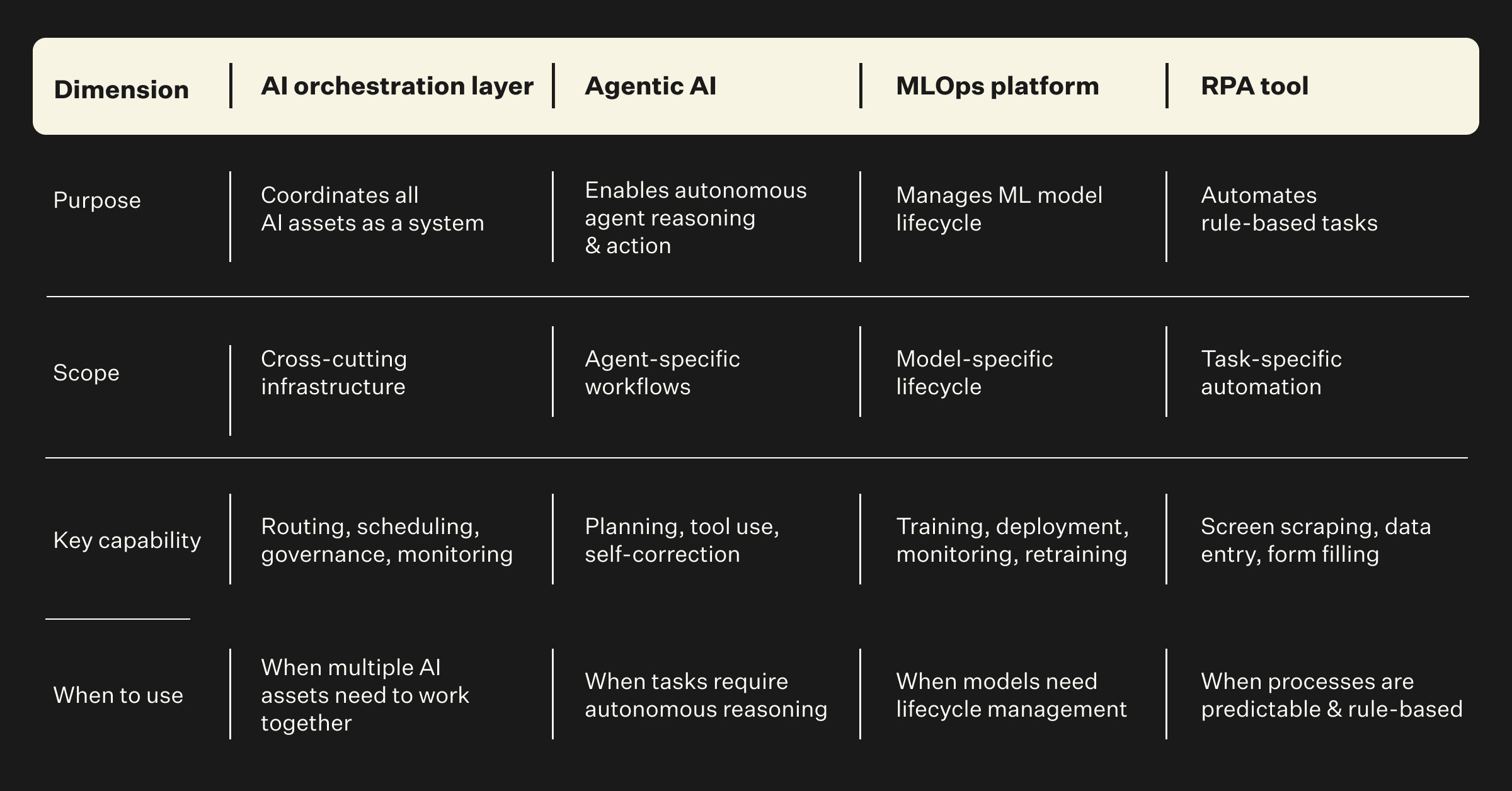
In practice, agentic AI runs on the orchestration layer, MLOps tools integrate with it, and RPA may be triggered by it. The orchestration layer is the connective tissue that holds all three together.
The pain points, such as siloed tools, inconsistent outputs, governance gaps, and duplicated workflows, point directly to four measurable benefits that an AI orchestration layer delivers. Each benefit maps to a category of production AI risk that enterprises consistently encounter.
The orchestration layer enables dynamic resource allocation: scaling compute up during peak demand and down during quiet periods without manual intervention. A retailer managing holiday traffic spikes can orchestrate model scaling automatically, routing overflow to lighter models when primary endpoints reach capacity, rather than over-provisioning infrastructure year-round.
Retries, circuit breakers, and graceful degradation patterns prevent individual component failures from cascading across the system. When an LLM provider experiences an outage, the orchestration layer fails over to an alternative provider automatically.
When a model returns low-confidence outputs, the workflow escalates to human review rather than delivering unreliable results. According to IBM’s 2026 "AI in motion" study, organizations adopting an orchestration-led AI governance layer are around 13 times more likely to scale AI successfully compared to peers without such orchestration.
Audit trails, explainability controls, and human override capabilities are embedded in the orchestration layer rather than bolted on afterward. Dataiku Govern and Dataiku LLM Guard Services enforce policy at runtime. That is the difference between governance that prevents production incidents and governance that documents them after they occur.
A centralized orchestration layer gives data scientists, ML engineers, business analysts, and compliance teams a shared workspace with visibility into the same workflows, the same models, and the same governance controls. Cross-team hand-offs that previously required meetings, documentation, and manual coordination happen within the platform. The result is reduced time-to-production for new AI workflows and fewer communication failures between technical and business teams.
A reference architecture for the AI orchestration layer follows a four-tier stack, with security boundaries and monitoring touchpoints at each level.
The four tiers work as follows.
Tier 1: UI and applications
Business applications, dashboards, chatbots, and internal tools that consume AI-powered outputs
Security checkpoint: Authentication and authorization before any user request reaches the orchestration layer
Tier 2: Orchestration layer
Routing engine, workflow scheduler, state management, governance controls, and monitoring; this is where the coordination logic lives.
Security checkpoint: Role-based access control (RBAC) enforcement, prompt filtering, and cost controls at every request
Tier 3: Models and agents
LLMs, ML models, AI agents, and vector databases; the compute layer where reasoning and inference happen.
Security checkpoint: Model access controls, output validation, and guardrail enforcement
Tier 4: Data and infrastructure
Data warehouses, data lakes, transactional systems, APIs, and compute infrastructure
Security checkpoint: Data access controls, encryption at rest and in transit, and data lineage tracking
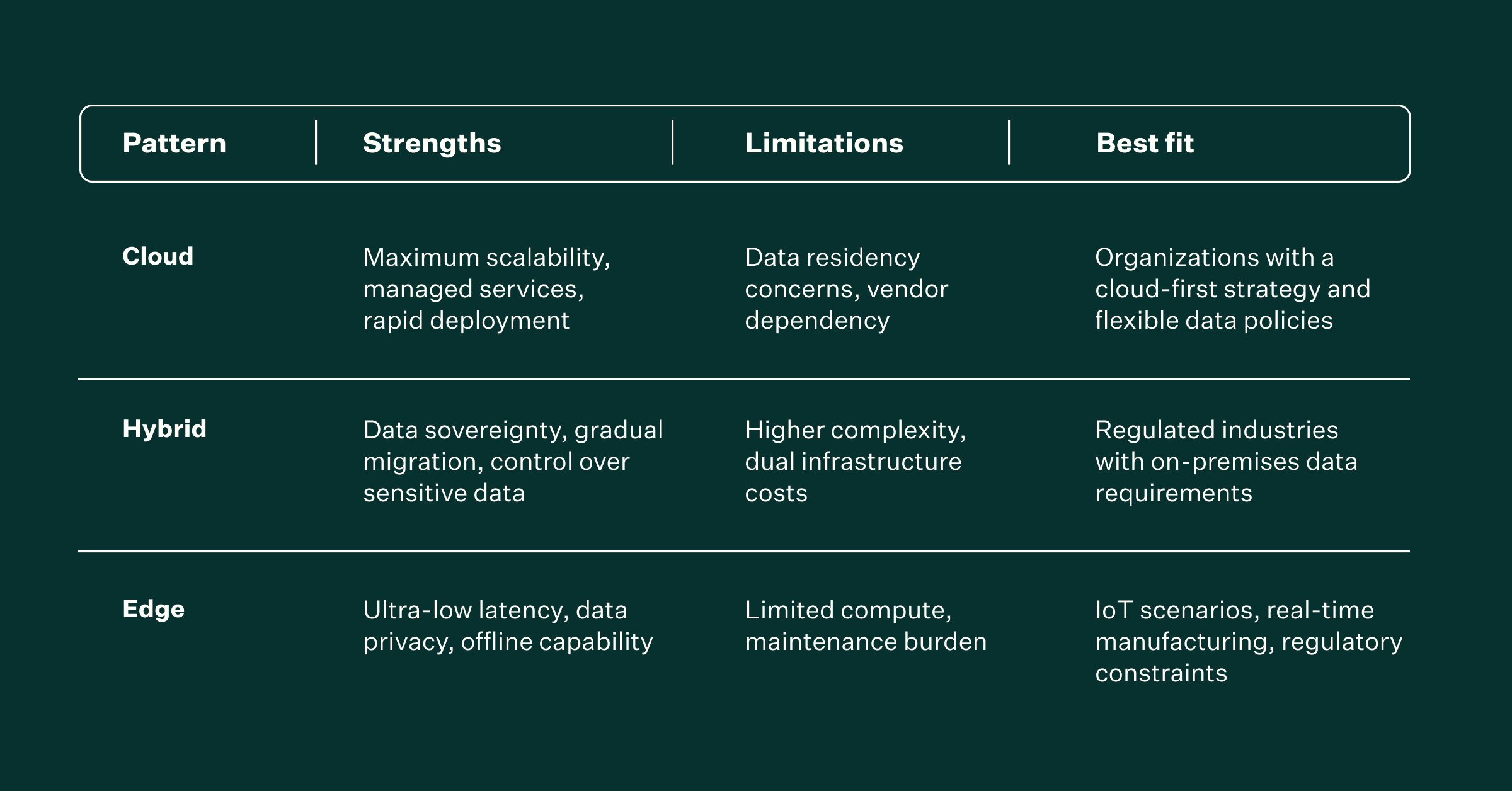
Three deployment patterns cover the range of enterprise infrastructure needs. The right choice depends on data residency requirements, latency constraints, and infrastructure maturity.
AI agent orchestration use cases cluster around four functional patterns that transfer across industries. Rather than mapping these to a single sector, the examples below are structured around workflow type so readers can map the pattern to their specific domain.
The orchestration layer routes between triage, specialist, and escalation agents with scoped data access and human-in-the-loop checkpoints for complex cases. Hand-off logic determines when a general triage agent passes context to a specialized agent (billing, technical support, compliance) and when the workflow escalates to a human reviewer.
Orchestrated workflows coordinate an anomaly scoring model, a rules engine, an analyst approval routing step, and a model retraining feedback loop as a single governed sequence. Real-time triggers fire on suspicious transactions. The orchestration layer ensures each step receives the correct data snapshot and that analyst decisions feed back into model improvement cycles.
Route planning agents integrate with IoT sensor feeds, using edge deployment for latency-sensitive decisions and the orchestration layer for dynamic re-routing when conditions change. Value metrics include reduced delivery delays and fuel cost savings. The orchestration layer manages the handoff between sensor data, planning logic, and dispatch systems.
RAG pipeline orchestration covers the full retrieval cycle: query interpretation, document retrieval, relevance ranking, context assembly, LLM generation, and output validation. Compliance safeguards screen queries based on user access level. Document refresh cycles are managed within the orchestration layer to keep the knowledge base current without manual intervention.
The build-vs-buy decision is the most consequential choice in implementing an AI orchestration layer. Before evaluating platforms, clarify your requirements across the criteria below.
Dataiku provides the orchestration layer where enterprises build, deploy, and govern analytics, ML models, agents, and LLM-powered applications across any infrastructure. Dataiku connects to data wherever it lives, runs on any cloud or on-premises environment, and embeds governance at every step.
Unlike point tools that solve one piece of the stack, it serves every expert in the organization, from fraud analysts and demand planners to data scientists.
Eight criteria matter most when evaluating AI orchestration platforms. Weight each based on your organization's priorities; a regulated enterprise will score governance controls more heavily, while a team prioritizing speed to market will weight ease of use and deployment speed higher.
API and connector breadth: Does the platform connect to your existing data sources, LLM providers, and enterprise systems?
Monitoring depth: Does it provide both technical observability and business outcome metrics?
Governance controls: Are RBAC, audit trails, guardrails, and approval workflows built in or custom-built?
Scalability options: Does it support cloud, hybrid, and edge deployment?
User interface: Can both technical and non-technical users work within the platform?
Documentation quality: Is the documentation detailed enough for enterprise adoption?
Community and support: Is enterprise-grade support available?
Total cost of ownership: What are the full costs, including implementation, integration, governance, and maintenance?
Two axes define the decision: speed to production and control over the stack.
Build when you have:
Unique IP requirements that no platform addresses
Strong in-house engineering talent
Specific compliance needs that require custom implementation
Buy when:
You need compliance and governance out of the box.
You prioritize speed to production over maximum customization.
You have limited engineering capacity for infrastructure.
A four-phase approach reduces implementation risk and builds organizational confidence at each stage.
Phase 1 — Assess: Audit current AI assets, identify coordination gaps, and document governance requirements.
Phase 2 — Pilot: Select one workflow with clear KPIs and implement orchestration end to end.
Phase 3 — Scale: Extend to adjacent workflows with centralized governance and onboard additional teams.
Phase 4 — Optimize: Tune performance, refine cost controls, and establish continuous improvement cycles.
The critical success factor: Establish data quality gates and observability infrastructure before scaling. Orchestrating poor-quality data faster does not produce better outcomes.
Three implementation pitfalls appear consistently across enterprise AI orchestration deployments: data quality and integration debt, over-automation without human oversight, and cost management surprises from unmonitored agent behavior. Each has a specific mitigation path.
Schema drift, duplicate data sources, and stale connections are the most common causes of orchestration failures. A quick audit checklist covers four areas:
1. Verify data lineage for every source feeding the orchestration layer.
2. Confirm refresh frequencies match business requirements.
3. Validate schemas against expected formats.
4. Test connector health under production load.
Chaining agents without human oversight creates systems that are fast but ungoverned. The fix is not to avoid automation but to design escalation policies:
1. Define which decisions require human approval.
2. Set confidence thresholds that trigger escalation.
3. Build override mechanisms that let humans intervene at any point in the workflow without breaking the chain.
Chatty agents that make excessive API calls, recursive loops that consume tokens without producing value, and GPU provisioning that scales up but never scales down are the most common cost surprises.1. Monitor token usage, GPU hours, API call volumes, and data transfer costs from day one.2. Set budget alerts at 70% of projected spend and review cost reports weekly during the first 90 days.
The AI orchestration layer is the infrastructure that determines whether an enterprise's AI investments operate as a coordinated system or as a collection of disconnected tools. Dataiku provides that layer — connecting data, models, agents, and governance controls across any infrastructure so teams can build and deploy AI at scale without starting from scratch on every new workflow.
The components, architecture, and governance controls covered in this guide provide the blueprint. The path forward starts with three actions: Audit your current AI stack to identify coordination and governance gaps, select a pilot workflow with clear, measurable KPIs, and evaluate whether to build or buy the orchestration layer based on your team's capacity and compliance requirements. Start small. Prove value on one workflow. Scale from results.
Not always. A single model serving one use case may not justify full orchestration overhead. The layer becomes necessary when multiple models, agents, or data pipelines need to work together — a threshold most enterprises reach quickly as AI adoption expands.
An API gateway manages routing, authentication, and rate limiting for API calls. An AI orchestration layer manages the full workflow: which model to call, with what data, in what sequence, with what governance controls, and what to do with the output. An API gateway is one component within the orchestration layer, not a substitute.
Partially. MLOps tools manage model lifecycle — training, deployment, monitoring, retraining — but typically do not orchestrate multi-model workflows, agent coordination, or cross-pipeline governance. They are a component of the orchestration stack, not the orchestration layer itself.
Building requires proficiency in distributed systems, workflow orchestration frameworks, API design, and DevOps practices. Operating requires data engineering, ML engineering, and governance skills. Most enterprises find that buying and configuring a platform is faster and more reliable than building from scratch unless specific requirements go unmet.
The most common AI agent orchestration use cases include customer service hand-offs between triage and specialist agents, fraud detection chains linking anomaly scoring to analyst workflows, supply chain optimization integrating sensor data with planning agents, and RAG-powered knowledge management coordinating retrieval, ranking, and generation across a document corpus.
Tags