
Data and IT leaders are under increasing pressure to accelerate the delivery of AI results while maintaining airtight governance. Data volumes are exploding, models are more complex, and business teams expect real-time, self-service capabilities. Traditional, siloed analytics systems built for batch processing and static reporting can no longer support the speed and scale of today’s enterprise.
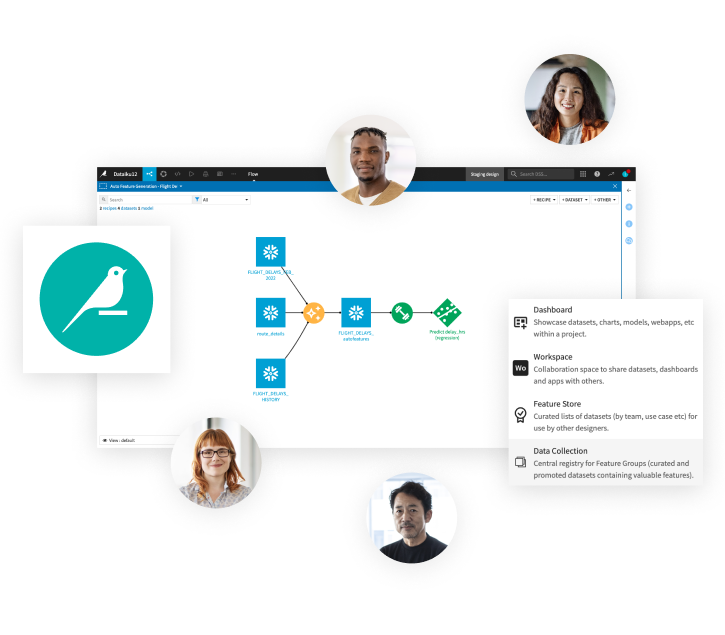
Dataiku, The Universal AI Platform™, and the Data Intelligence Platform redefine what modern analytics looks like. Dataiku provides a collaborative, governed workspace where analytics and AI (including GenAI and AI agents) are designed, automated, and monitored. Databricks delivers the Data Intelligence Platform, democratizing access to data and AI.
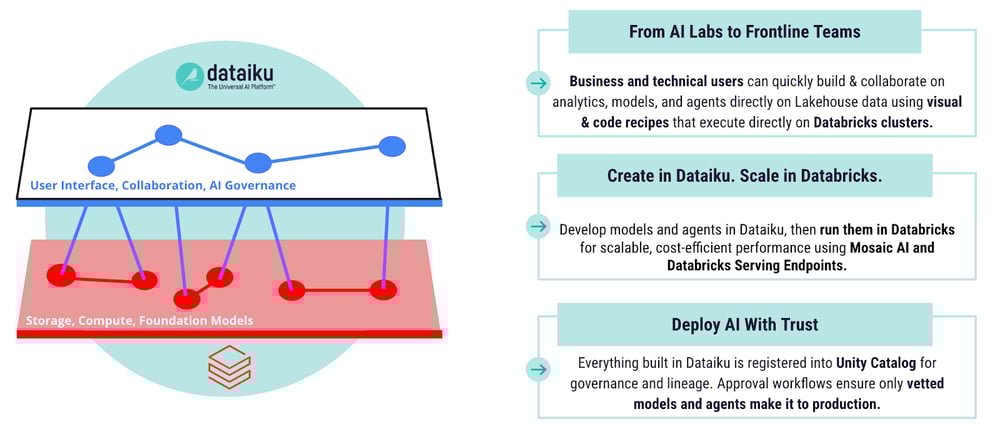
Together, they form one integrated data and AI ecosystem where intelligence is built and orchestrated in Dataiku and executed on Databricks, without moving data outside its secure environment. This transforms analytics from a fragmented process into a continuously governed operation that supports everything from dashboards to AI agents.
A Unified Foundation That Scales
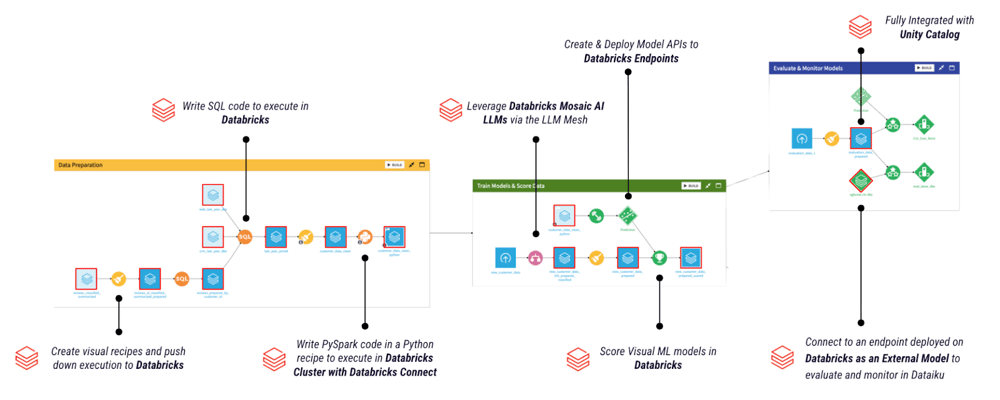
The Dataiku and Databricks integration is designed for scale, elasticity, and trust. Through native Delta Lake connectivity and pushdown compute, teams can process massive datasets directly on Databricks while orchestrating visual or code-based workflows in Dataiku. Computation happens where the data lives, eliminating duplication and minimizing risk.
Databricks Unity Catalog centralizes permissions, lineage, and auditing for data and models. Dataiku Govern layers on structured approvals, end-to-end lineage, and documentation across projects. Together, they ensure that scalability never compromises accountability.
This architecture lets enterprises expand AI operations without increasing operational overhead, giving IT the visibility and control required while allowing business and data teams to work independently within approved guardrails. The result is a scalable, governed approach to enterprise AI.
Collaboration Without Bottlenecks
Effective modernization requires collaboration between technical teams and business experts, without obstacles or dependencies. With Dataiku and Databricks, that collaboration is built in.
Business analysts build visual flows in Dataiku using trusted Databricks data. Data scientists and engineers extend and productionize those same projects in Databricks Notebooks and libraries. Workflows, code, and data remain interoperable across both environments, removing rework and translation effort.
But this is not the same old “collaboration” story of years past. What makes this partnership unique is how collaboration becomes operational. Business-built assets scale automatically to Databricks clusters for training, optimization, and deployment. Data scientists refine and extend those assets within the same governed framework, then publish reusable components back to Dataiku. The result is an organization where analytics moves at the speed of the business, not the speed of dependencies.
Operationalizing AI With Confidence
Real impact is driven by a foundation of reliable, governed operations. The Dataiku and Databricks partnership is designed to manage the full AI lifecycle from training to deployment to monitoring.
Teams train large-scale models in Databricks using distributed compute and MLflow, then manage them through Dataiku External Models. Models are versioned, retrained, and deployed in batch or real time via Dataiku’s automation and APIs. Performance, drift, and cost are monitored centrally; approvals and sign-offs flow through Dataiku Govern; and access control remains consistent via Unity Catalog. This way, enterprises gain agility without loss of control.
GenAI and the Rise of AI Agents
GenAI and AI agents have redefined what it means to “do analytics.” Executives no longer just want insight, they seek autonomous systems that can summarize, act, and learn safely. But scaling these capabilities demands far more than model access; it requires governance, transparency, and compute that can handle unstructured, high-volume workloads.

Through Databricks Mosaic AI and the Dataiku LLM Mesh, organizations can develop enterprise-grade generative applications and AI agents with full control. Teams can build retrieval-augmented generation (RAG) pipelines, connect to Databricks LLMs, and monitor usage within governed, auditable workflows. The Dataiku LLM Guard Services automatically detect sensitive data, enforce policy-based moderation, and manage cost thresholds. Leaders gain confidence that every generative system or AI agent built on enterprise data remains safe, explainable, compliant, and cost-efficient.
Customer Proof: Modern Analytics in Action
Emirates Global Aluminium (EGA) demonstrates how Dataiku and Databricks together democratize trusted analytics. By combining Dataiku’s collaborative workflows with Databricks’ scalable lakehouse, EGA gives engineers, process experts, and managers secure access to curated data for daily decisions. Business users design no-code flows in Dataiku that run on Databricks clusters, boosting safety, efficiency, and responsiveness across manufacturing, sales, and supply chain.
EGA is also piloting GenAI through the Dataiku LLM Mesh integrated with Databricks Mosaic AI, enabling document summarization and technical search with automated cost and compliance controls.
Furthermore, Morgan Stanley Wealth Management built a unified analytics and machine learning (ML) platform powered by Databricks and Dataiku. Thousands of business users leverage Dataiku’s low-code environment to automate workflows and build models, while Databricks provides distributed compute, including GPU clusters for unstructured data.
The firm reports a 50% reduction in time-to-insight and faster model approvals through automated documentation in Dataiku Govern. Role- and attribute-based access controls managed through Unity Catalog keep compliance aligned with scale, a blueprint for responsible AI in financial services.
Enterprise-Ready AI Operations
AI programs fail more often on operations than on algorithms. The Dataiku-Databricks unified AI foundation addresses these real pain points:
- Data gravity and cost: Training and pipelines run in Databricks against lakehouse data, orchestrated by Dataiku without replication, reducing copy sprawl and exposure.
- Lifecycle control: Unity Catalog and Dataiku Govern provide a unified view of data, model versions, and approval status; audits become quick reviews, not reconstructions.
- Organizational bandwidth: Dataiku’s visual development broadens participation without diluting standards, while Databricks clusters deliver on-demand elasticity.
Together, they enable AI operations that are transparent, compliant, and fast.
Why This Partnership Is Different
Many technology partnerships involve a handoff; this one creates a shared operating environment. Intelligence is built in Dataiku, executed at Databricks scale, and governed seamlessly across both. With a single lineage, permissions model, and approval workflow spanning analytics, ML models, GenAI, and AI agents, leaders can accelerate innovation while minimizing risk, the foundation of truly intelligent analytics.