



Each year, AWS re:Invent takes place at roughly the same time and in roughly the same place as the National Finals Rodeo. The result is a uniquely Vegas blend of Patagonia tech vests, oversized hoodies, and wranglers over cowboy boots, which makes the Cosmo Chandelier Bar game of “which conference does this guy belong to” all too easy.
Over a period of five days, everyone's caffeine intake has doubled, if not tripled. Expo halls start to look the same, and at some point, you've wondered when the last time you went outside and saw the sun.
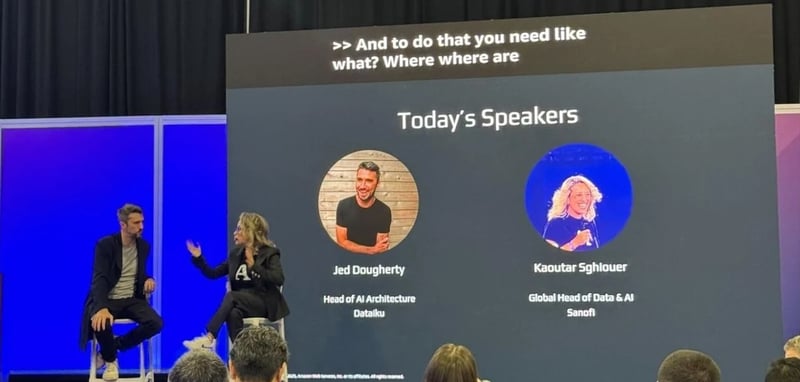
The weeks after re:Invent, and let's be honest, it's actually about a month, tend to consist of reacclimating your brain to things like “the sun,” “fresh air,” and adjusting to the quiet after days of frenzy. But even with a little distance — and a slight recovery — the lessons from re:Invent and the customers I met with still feel important. Not because the conference itself was groundbreaking, but because the conversations are becoming increasingly consistent across industries. One of the clearest examples of this came from my conversation on stage with Sanofi, specifically, Kaoutar Sghiouer, Global Head of Data & AI. Their approach cuts through a lot of the noise, and it reinforced what I heard repeatedly throughout the week: agentic AI doesn’t scale without strong foundations.
Agentic AI Is Growing Up (and Enterprises Are Getting Serious)
The first clear theme is that organizations are becoming increasingly wary of the "1,000 monkeys at 1,000 typewriters" approach to agentic development.
Early enthusiasm for "deploying agents" often resembled giving everyone access to tools and hoping someone would build something valuable. However, the bellwether companies are shifting toward a controlled deployment strategy — one where a core group of advanced designers builds reusable agents and tools that the rest of the organization can safely consume in a governed manner.
That shift isn't about slowing innovation. It's about giving it a fighting chance to survive contact with production, regulation, and the next quarter's priorities.
Shadow AI Is the New Shadow IT
The second theme I heard in almost every serious conversation: governance — and the fear of unmanaged proliferation of agents. People are building and using agents across a wide variety of tools, with no centralized system to track what's being done, what data agents are accessing, who built them, how they'll be maintained, or whether they're duplicating efforts already underway somewhere else. We've had shadow IT for years. Now we have shadow AI.
Organizations are looking for an agnostic, centralized governance layer on top of a fragmented ecosystem of third-party agent systems. The question is what that layer becomes: yet another catalog that needs to be manually updated (and inevitably becomes stale and useless), or a shared protocol that allows for discoverability and traceability across platforms.
Enterprises have the opportunity to shape what “good” looks like — by establishing a shared foundation that makes agents discoverable, traceable, and governable across various tools. The organizations that succeed here will be the ones that treat governance as a product: something that enables scale and reuse, rather than a hindrance to innovation. And for many, that means combining internal platform ownership with partners who can help accelerate standardization and operational readiness.
Sanofi's North Star: AI at Scale With Governance Built In
These themes were highlighted in one of the most "real" moments of re:Invent for me: my on-stage conversation with Kaoutar at Sanofi. Sanofi's ambition is to shorten the timeline between therapy discovery and getting a treatment to market — a process that can take about 15 years. AI isn't a side project. It's a strategic lever across the entire value chain: R&D, manufacturing and supply, commercial operations, and employee experience.
What stood out immediately is that they're not treating AI as a synonym for GenAI. Some problems are best solved with classical AI. Some benefit from GenAI. Agents may be suitable for specific workflows. However, the organizing principle remains the same: Technology should serve the objective, not the trend.
"AI-Ready Data" Isn't a Dataset, It's a Trust System
One of the most important concepts Kaoutar emphasized was what she calls AI-ready data.
In Sanofi's definition, AI-ready data starts with shared accountability between business and IT/digital teams. Data must be accessible (people can find it), shareable (usable across functions), and secure. It must also be high quality, unbiased, trusted, and safe.
AI-ready data starts with shared accountability between business and IT … The data must be known, shareable, secured, high-quality, unbiased, trusted, and safe.
— Kaoutar Sghiouer, Global Head of Data & AI at Sanofi
This framing matters because it reflects something many enterprises are learning the hard way: AI at scale is less about models and more about trust — and trust requires end-to-end traceability, guardrails, and accountability.
Governance as a Filtering Mechanism (Not a Bureaucracy)
Sanofi’s governance model is one of the clearest examples I’ve heard of what it looks like to operationalize seriousness. They have top-level AI governance led by ExCom members, and a “front door” process that requires high-level business sponsorship, digital sponsorship, and a commitment to demonstrate tangible value within three months in a sandbox environment. This approach filtered 56 commercial use cases down to only two. That’s not a failure of creativity — that’s a success of prioritization. It’s the opposite of “1,000 monkeys,” and that’s precisely the point.
A Month Later, the Lesson Still Holds
It’s been a few weeks since re:Invent ended, and everyone has scattered back to their respective time zones, inboxes, and their everyday routines. And what’s clear is that the next phase of AI adoption won’t be defined by who builds the most agents. It will be defined by who intentionally builds the right ones: with AI-ready data, strong governance, and a clear north star that keeps experimentation aligned with measurable value.
Vegas will always be Vegas. However, the work that truly matters begins when you return home.
.png)