How One Acre Fund cut document review effort with governed AI workflows
July 30, 2026/5 min read/Julia Berman
One Acre Fund uses Dataiku, the Platform for AI Success, to streamline document validation, improve data reliability, and support decentralized teams.
Up to 70%
fewer man-days per cycle by shifting from double to single manual entry & from data entry to comparison and correction
80,000+
forms processed in 2–3 weeks in the Burundi program
One Acre Fund operates across seasonal, document-heavy agricultural workflows, supporting smallholder farmers with processes that depend on accurate information from farmer records, warehouse registration documents, truck registrations, contracts, receipts, and operational systems.
Historically, much of this validation work was manual. Field officers and operational teams collected and entered information across different systems, while additional staff were needed to compare records, identify mismatches, and confirm that documents aligned with source data.
The scale of that manual burden was clearest in One Acre Fund's Burundi program, which processes roughly 80,000 physical input delivery forms each year inside a 2–3 week seasonal window. Each form was transcribed twice by separate data entry teams, with discrepancies escalated to a third team for auditing.
Meeting that window meant hiring, training, and releasing up to 100 seasonal staff every cycle, and forms often arrived from the field damaged, making accurate manual entry even harder. As enrollment grew to half a million farmers, this approach could not scale sustainably.
One Acre Fund set out to create a more streamlined and governed foundation for document validation. With Dataiku, the Platform for AI Success, One Acre Fund saw an opportunity to put the AI Success Formula — People, Orchestration, and Governance — to work in a real operational setting:
People: Enabled decentralized, non-technical teams, such as field officers, to participate in validation workflows without relying on a large technical build team.
Orchestration: Connected document processing, Optical Character Recognition (OCR) outputs, KoboToolbox/SAP data, dashboards, and web apps into a more centralized workflow.
Governance: Kept humans in the loop, comparing AI-assisted outputs against source data, surfacing discrepancies, and measuring performance before broader production use to make sure that AI was used responsibly.
Together, these three elements form the connective layer that turns isolated AI experiments into AI that actually runs the business, the shift at the heart of the Platform for AI Success.
Using Dataiku, One Acre Fund built AI-assisted workflows to process and validate operational documents across several use cases. For warehouse and truck registration, Dataiku helps process documents, compare extracted information against table and form data, and surface mismatches through a web application.
The Burundi input-delivery workflow runs on two connected layers built in Dataiku. The first is the Burundi BizOps pipeline — a Dataiku Flow that ingests incoming KoboToolbox digital survey data, consisting of up to two million rows from roughly 31 sources on a scheduled basis, then cleans and routes it to dashboards and into the OCR verification pipeline. The second layer is the "OCR Validation Tool" itself.
Reviewers see the original scanned form side-by-side with a color-coded data grid: green where the OCR and Kobo values align, yellow for a quantity mismatch, red where a value is missing in one source, and grey for entries already confirmed.
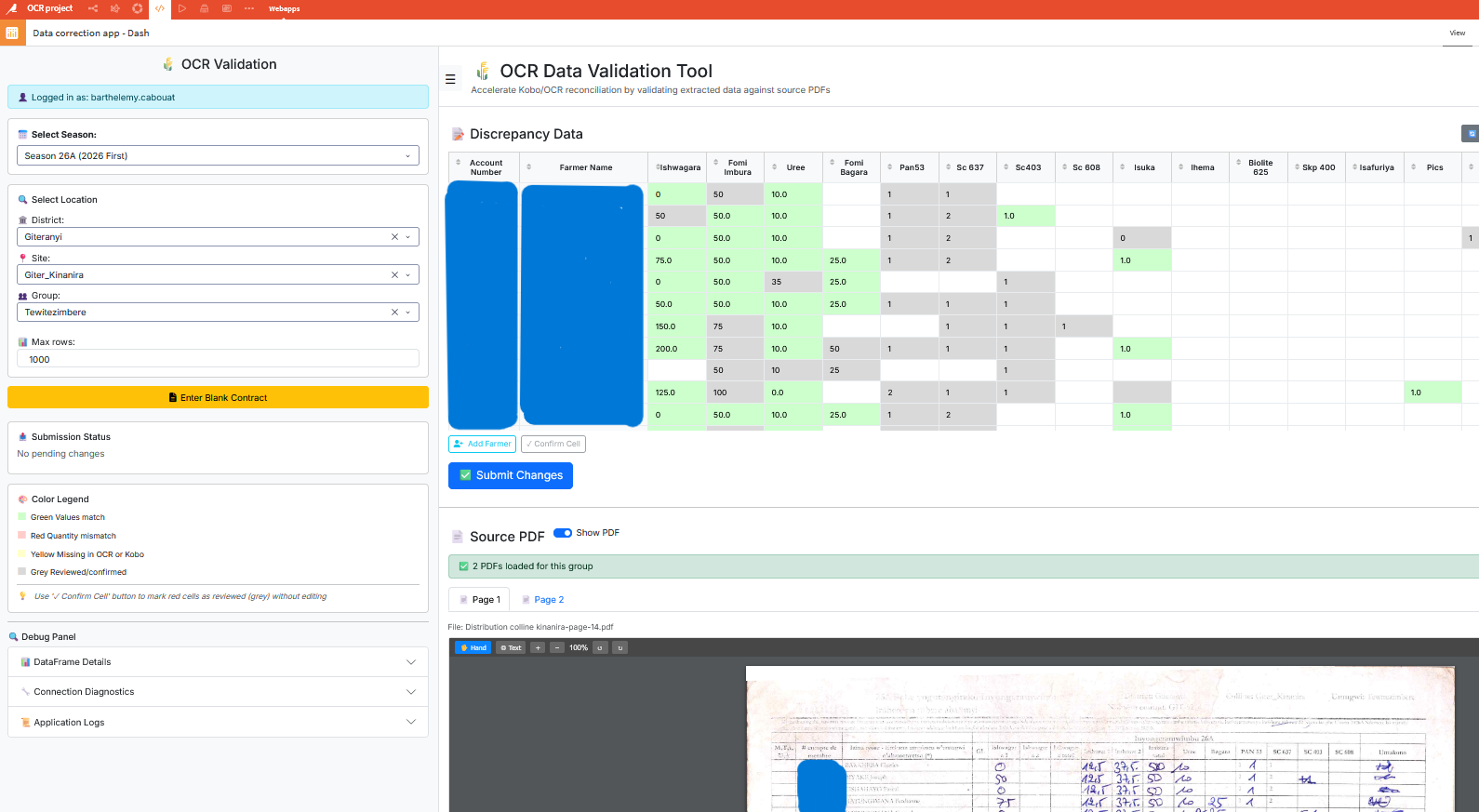
Built quickly inside Dataiku, the tool moved from prototype to pilot in about two weeks and reached steady state within six weeks. In that steady state, the workflow that once required more than 1,000 man-days per cycle now runs on an estimated 300–500: a 50–70% reduction, achieved by shifting from double to single manual entry which enabled the team to spend more time on comparison and correction.
To keep improving the tool in production, One Acre Fund collected user feedback through in-app forms and categorized it using Dataiku-powered text classification, letting solution owners focus on the largest and fastest-growing areas of feedback. This feedback loop let solution owners prioritize the highest-impact improvements, which unlocked higher staff productivity compared with business as usual
The Orchestration layer is central to the story. Instead of managing disconnected document checks manually, teams can use Dataiku to consolidate inputs, process OCR outputs, compare results against source data, and review exceptions through dashboards and web apps.
The People element is just as important. One Acre Fund is decentralized, and many users involved in these workflows do not have deep technical expertise. Dataiku makes it possible for teams to work with these validation processes without requiring several technical roles to build, deploy, and manage a custom application.
The Burundi-based OCR initiative was conceptualized and executed by Country Director Barthelemy Cabouat—a domain expert rather than a technical specialist. By leveraging Dataiku, the solution was delivered through business operations teams, bypassing the need for a dedicated engineering unit and empowering decentralized leadership to drive operational success. A business operations team built and maintains the complementary Dataiku pipelines that process incoming digital survey data.
The roughly 120 review staff who use the tool shifted from transcribing every value twice to confirming or correcting only the entries that the system flags as uncertain. Daily performance reports, generated from the corrections data and measured against individual targets, give reviewers direct feedback on their progress, and high performers earn weekly bonuses based on that data.
In Burundi, this human-in-the-loop discipline is enforced in the interface itself: No flagged discrepancy can be silently accepted, since each one must be explicitly confirmed or corrected. Underneath that review layer, Git integration within Dataiku tracks every change to pipeline and web app code, giving the team logging, auditability, and version control around the workflow that humans review.
"To reach our ambitious goal of scaling services to 1 million farm families in Burundi by 2030, One Acre Fund must embrace step-changes in our foundational systems to ensure scalability in a low-infrastructure environment. Because seasons vary, building modular, highly automated workflows are becoming a cornerstone of our data operations. With these systems, we move from dreaming of higher service levels to making them a reality."
Barthelomy Cabouat, Burundi Country Director, One Acre Fund
One Acre Fund is continuing to test and refine these workflows as they move further into trial and production. The organization is exploring how OCR performance can improve and whether more specialized models, and eventually agents, could support document processing in the future to support the smallholder farmers.
The downstream impact reaches the farmers themselves: By shifting from manual validation to AI-assisted workflows, the organization ensures that the right inputs reach the right farmers exactly when they are needed for the planting season. Accurate, reliable data processing eliminates ordering discrepancies, ensuring every farmer receives their full, correct package without delay. Ultimately, this operational precision directly supports the planting timeline, helping smallholder farmers start their season with the confidence and resources required to increase their productivity and build long-term resilience.
It is exactly the kind of connected, governed AI operation that the Platform for AI Success is built to power.
Govern AI everywhere
Govern AI everywhere