Enterprise AI transformation: how leading organizations are redesigning operations around AI
June 9, 2026/10 min read/Team Dataiku
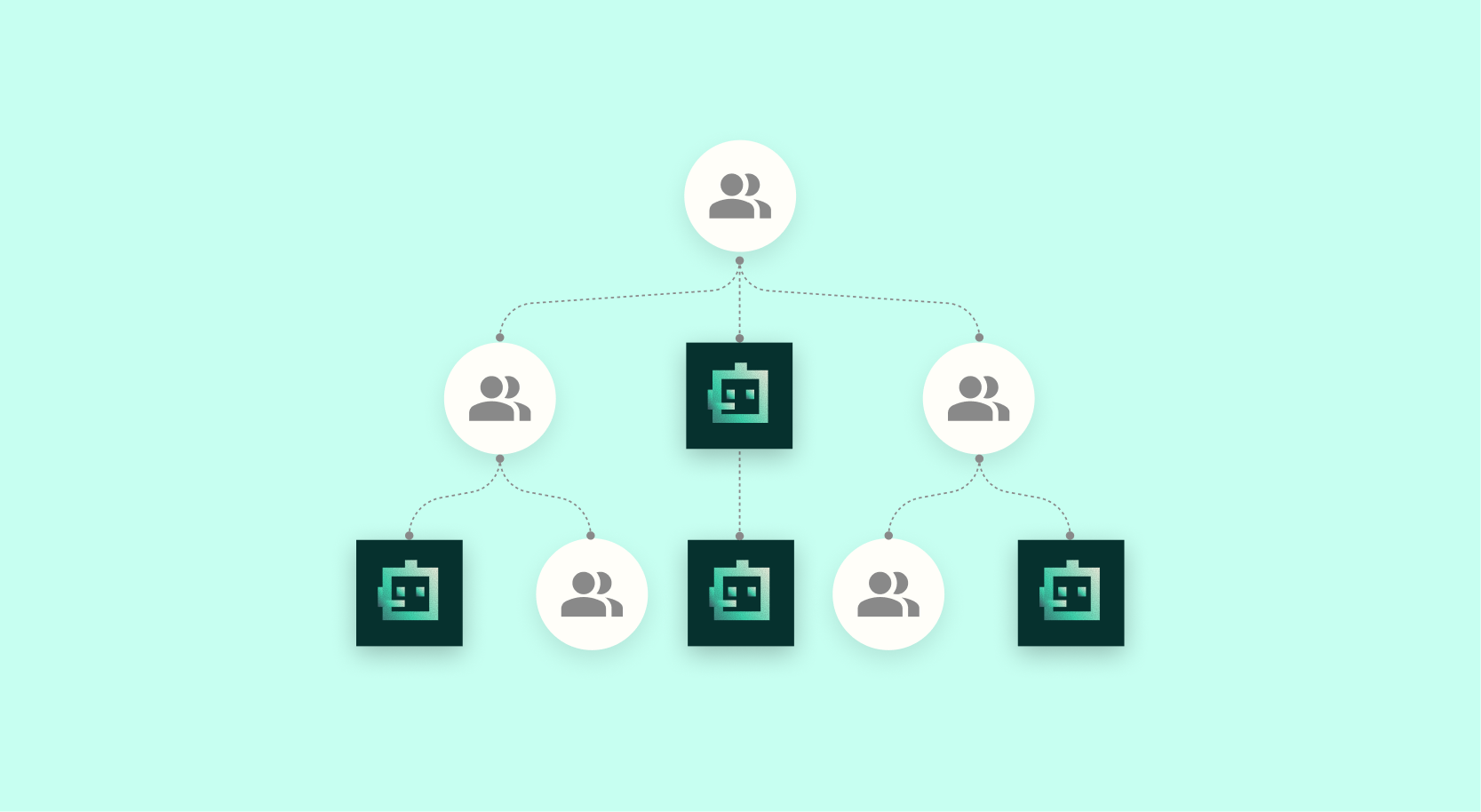
Most enterprises have run AI pilots. But few have transformed their operations with AI at scale. What separates them is organizational design, not technology: disconnected people, disconnected systems, disconnected governance.
According to "Global AI confessions report: data leaders edition," based on a Dataiku/Harris Poll survey, 77% of data leaders say at least one competitor has deployed a superior AI strategy. That pressure shapes enterprise AI transformation in 2026.
This guide lays out the operating patterns that separate sustained transformation from stalled pilots, plus a five-phase roadmap you can apply within your own organization.
The gap between AI pilots and enterprise-wide AI is an organizational design problem: disconnected people, systems, and governance stall programs that have the right technology.
The AI Success Formula, People + Orchestration + Governance, is the operating model behind enterprises that scale AI successfully.
Governance embedded from day one is what makes AI scale. Organizations that add controls after deployment accumulate risk debt that compounds across every use case they ship.
Agentic AI is changing what enterprise scale means. Managing it requires a centralized registry, lifecycle controls, and orchestration across teams, not just better models.

Enterprise AI transformation is the deliberate redesign of how your organization decides, operates, and serves customers, with AI, machine learning (ML), agents, and human judgment working as one system. It is broader than AI adoption. Adoption layers tools on top of existing processes. Transformation reshapes the processes themselves.
The scope spans four things simultaneously: strategy, culture, the tech stack, and governance. The hallmark traits are recognizable. AI is predictive, where it used to be reactive. Workflows are partly autonomous instead of fully manual. Data and models are integrated, not siloed. Every system is governed by default.
This guide is written for executives and AI transformation leaders who already own the budget and the mandate, and need a practical sequence, not another definition. Understanding what AI transformation is helps define what it replaces, and why digital transformation, the previous default, is no longer sufficient.
Digital transformation moved manual processes onto cloud and SaaS platforms. AI transformation is a different category. It rebuilds decision-making around models and agents that reason in real time.
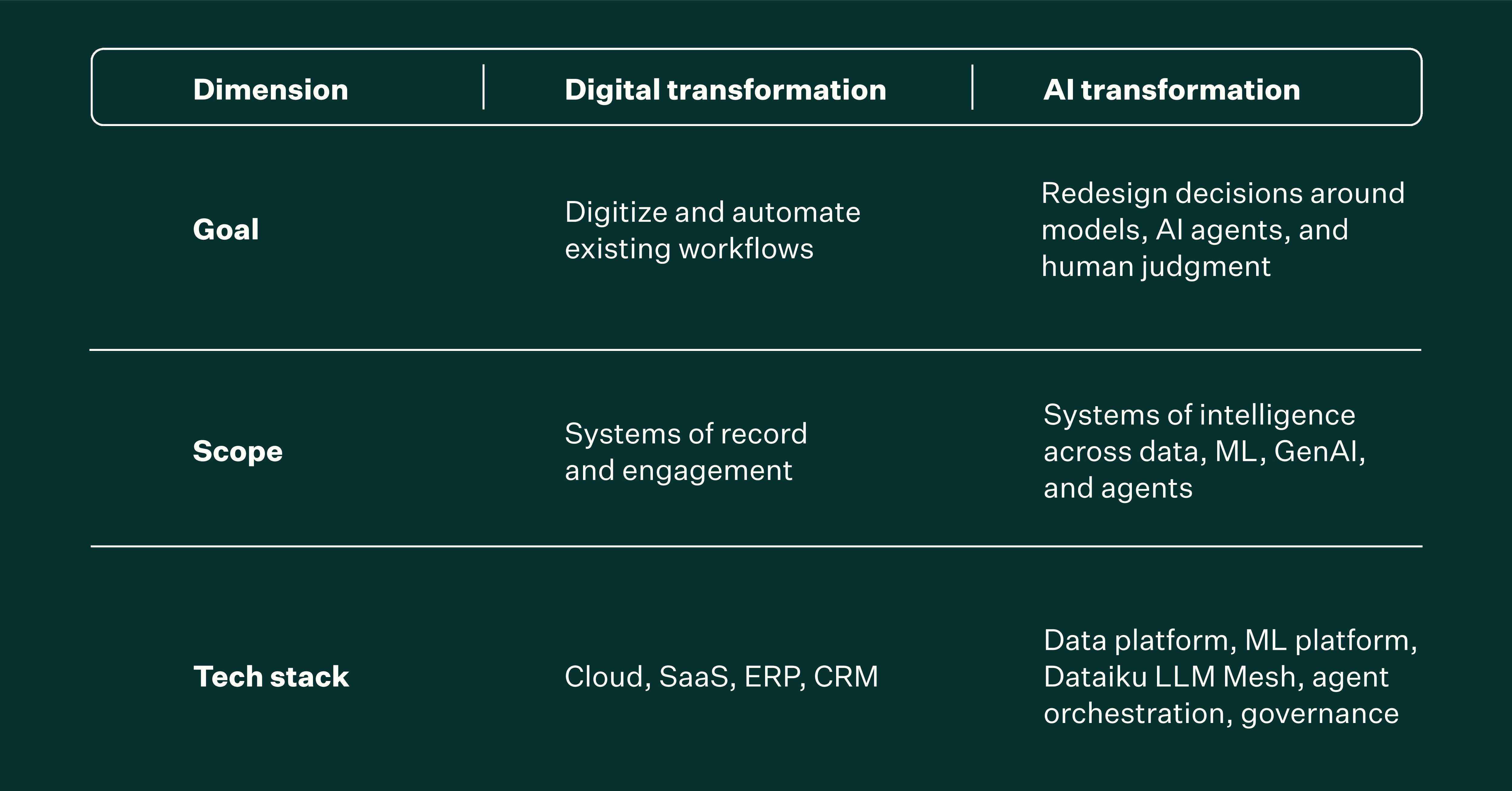
An AI transformation platform has to support reasoning across data and tools, autonomous workflows, and real-time decisions, with governance threaded through every step.
With the scope clear, the business case becomes the pressing question: What happens to organizations that get this right, and what happens to those that do not?
Enterprise AI transformation matters because adoption alone produces no return. Most organizations have deployed AI, yet few capture value from it at scale. The gap is a people, orchestration, and governance problem, and it decides whether AI shows up on your P&L.When AI transformation lands, three categories of benefit materialize:
1. Financial outcomes include lower cost-to-serve, faster cycle times, and new revenue from AI-driven products.
2. Operational gains include fewer manual handoffs, faster decisions, and higher capacity per team.
3. Talent outcomes include domain experts building directly on governed enterprise data instead of waiting in engineering backlogs.
Two risks define what happens when transformation stalls. The first is governance debt: agents and models in production with no central inventory, no risk scoring, and no audit trail. The second is competitive lag: Your peers shorten decision cycles while yours remain flat.
The competitive risk is what boards now ask about by name. The 77% figure above reflects that pressure. Getting the benefits while avoiding the risks comes down to getting the foundations right before anything is scaled.
Foundations dictate the speed of value delivery. Three building blocks decide whether transformation accelerates or stalls: data and infrastructure readiness, the AI transformation platform you choose, and the talent model that puts it to work.
Production AI runs on data that is API-ready, observable, and refreshed in real time. Most enterprises do not start there. Two legacy hurdles appear almost every time.
The first is fragmented data ownership. Each business unit holds its own datasets with different definitions and no central lineage. The fix is standing up a governed catalog with clear owners and quality scoring before you scale any AI workflow.
The second is brittle pipelines that break when source schemas drift. The fix is adding pipeline monitoring and contract-style schemas at ingestion.
Legacy debt slows enterprise AI more than any modeling problem does. Privacy and security cannot be an afterthought either. Embed access controls, PII handling, and encryption at the data layer so AI systems inherit them by default.
Three criteria separate a real AI transformation platform from a single-purpose tool:
1. Scalability across infrastructure
2. Agent orchestration (tool and function calling plus workflow coordination)
3. Embedded governance
Must-haves include model operations, agent orchestration with tool and function calling and workflow coordination, visual and AI-assisted development, and connectors that let business-facing roles build, not just consume.
Before signing a contract, apply this three-step vetting process:
First, run a real production workflow end-to-end on the vendor's platform, not a sandbox demo.
Second, stress-test governance by asking to see lineage, signoffs, audit logging, and runtime guardrails on the same workflow.
Third, confirm infrastructure flexibility across any cloud, on-premises infrastructure, and your existing data platform.
Watch for vendor lock-in dressed up as integration depth.
Dataiku, the Platform for AI Success, is the orchestration layer that connects people, data, models, and agents across any infrastructure. It serves both technical and business-facing roles, including fraud analysts, demand planners, and process engineers, expanding who can build production AI beyond just the data science team. Governance is embedded at every step, not added after deployment.
You do not solve the talent bottleneck by hiring more data scientists. You solve it by expanding who can build production AI:
Upskill domain experts on visual and AI-assisted development so they build directly on governed enterprise data, with no ticket queue and no handoff loss.
Set up partner networks for specialist work you cannot staff internally, such as fine-tuning or red-teaming agentic systems.
Build mentorship loops between data science and the business so feedback flows both ways.
Change management is the part that most programs underestimate. Domain experts will not adopt workflows that feel like extra work or that they cannot inspect. Treat adoption as a product launch, not a memo.
Data, platform, and talent create the capacity. Governance determines whether that capacity produces outcomes you can defend to regulators, boards, and customers.
Oversight maturity predicts ROI more reliably than model accuracy does. According to "7 career-making AI decisions for CIOs in 2026," based on a Dataiku/Harris Poll survey, fewer than one in five organizations report a mature AI governance model in place today. The absence shows up as risk debt: outages, regulatory exposure, and decisions no one can defend. Mature governance lets you ship faster because the controls are already in place. That is governance as acceleration, not governance as a brake.
Every AI transformation program should run against the following five guardrails. Check each one before your first model reaches production:
1. Bias monitoring across protected attributes and edge populations
2. Explainability, with a documented rationale for every production model
3. Human override built into agent workflows, with clear escalation paths
4. Audit logging and policy alignment mapped to your regulatory regime
5. Runtime controls for GenAI, covering prompt and response filtering, tool restrictions, and output evaluations
For responsible AI use, anchor your program to recognized references: the NIST AI Risk Management Framework, the EU AI Act, the OECD AI Principles, and ISO/IEC 42001. Translate them into enforceable workflows, not slide decks.
Dataiku Govern provides that layer in one place: a registry of every model and agent, plus monitoring, lineage, cost controls, guardrails, signoffs, and evaluations.
With governance built in from the start, the roadmap can move from foundations to scaled production without the compliance debt that derails most programs.
A roadmap is a sequence that prevents you from skipping prerequisites. Enterprises stall not because the technology fails, but because they jump from pilot straight to scale without redesigning the operating model in between.
Score yourself across five dimensions before you begin. Use a one-to-five scale for each.
Data readiness
Use-case identification
Model operations capability
Governance maturity
Workforce skills
A score below three on any dimension reveals a prerequisite to fix before you scale, not a footnote to a launch deck. Run the assessment with business and technical leaders in the same room. Misaligned scores between the two groups are the strongest predictor that your pilots will not graduate.
Map candidates on an impact-versus-feasibility quadrant. The top-right (high impact, high feasibility) is where you start. Treat the other three quadrants as a backlog, not a buffet.
JPMorgan's DocLLM, a layout-aware language model built to reason over visually complex documents, including contracts, forms, and invoices, illustrates the top-right: high-value contract analysis applied to document review at scale, with every output auditable. The use case has reliable structured inputs, a clear business owner, and a measurable success metric.
Start with two or three high-impact workflows that share infrastructure. The second and third use cases then ride on the work you already did. Spreading thin across ten experiments is the pilot trap.
Set three things before kickoff: ownership, success metrics, and an ML operations (MLOps) baseline. Ownership means one accountable person, not a steering committee. Success metrics tie to a business outcome — hours saved, error rate reduced, or cycle time shortened — not model accuracy alone.
Target eight weeks to ship. If you cannot deliver a defensible pilot in that window, the use case is too complex as scoped. Break it down. Pilots that drift past 12 weeks rarely recover momentum.
Scaling is where the operating model needs the most work. Agentic AI, meaning workflows where models call tools, reason over multiple steps, and act with limited human oversight, changes what scale even means. This is how agentic AI is transforming enterprise platforms in practice: customer support agents that draft and resolve tickets end-to-end; procurement agents that source suppliers and negotiate terms while humans approve the exceptions.
Governance becomes harder at this stage. You need a centralized layer to manage every agent across teams and platforms. Dataiku Agent Management is that layer: one registry to reuse agents, enforce access controls, monitor performance against business KPIs, and retire agents through a clear lifecycle. It launches in September 2026, with early access registration available now.
For multi-domain workflows where data, ML models, agents, and human decision logic interact, Dataiku Reasoning Systems are the enterprise standard. They are not single agents. They are orchestrated systems with continuous learning loops.
Transformation is not a one-time program. Set a feedback and retraining cadence — quarterly for most production models, monthly for high-volume agents — and tie refresh triggers to drift thresholds, not the calendar. When customer behavior shifts or input distributions move, the cadence shortens automatically.
This is where the KPIs you set in Phase 3 mature into a portfolio view: which use cases earn their seat, which retire, and which scale.
The roadmap applies across industries, but what it looks like in practice differs by sector, and recognizing the pattern in your own context is what makes it actionable.
Transformation patterns differ by sector. The examples below cluster by function so you can recognize your own context.
Manufacturing has moved fastest on physical AI. Computer-vision systems inspect parts at line speed, and demand-sensing models predict orders before they arrive. Toyota saves 1,600 hours per month by running Dataiku-based AI across manufacturing and operations, showing that production AI can work at an industrial scale when orchestration and governance keep up.
Financial services treat AI as a compliance multiplier as much as a productivity tool. JPMorgan's DocLLM applies AI to contract analysis at scale, with auditable outputs that reduce the cost and time of legal review. Fraud models score transactions in milliseconds and route ambiguous cases to humans. Every model carries lineage, every decision is traceable, and every override is logged. Governance becomes a competitive feature, not a cost center. Wisr Finance, an Australian lending platform, built an AI agent in Dataiku to automatically classify exception cases, surface relevant precedents, and give business development managers more consistent, data-backed decisions. The agent evaluates flagged loan applications against policy criteria and recommends approve, decline, or escalate.
HR is where most enterprises feel AI first. Onboarding chatbots resolve common questions on day one. Personalized learning agents recommend training paths based on role progression and skill gaps. Multilingual support agents handle queries across regional offices. These are lower-risk entry points that build organizational muscle memory for governed AI before you tackle more complex problems.
IT operations is a strong starting point because the instrumentation data is already there. Predictive issue detection surfaces outages before users feel them. Ticket routing reduces mean-time-to-resolution, and autonomous remediation handles repeatable incidents without requiring a human to assign and close each one. Tie every workflow to an operational metric: mean-time-to-resolution, percentage of tickets auto-resolved, and change-failure rate. AI in IT only counts when the operations dashboard moves.
Geodis, a global logistics provider, built an AI IT Support Agent in Dataiku that classifies incoming tickets, routes them to the correct team, and surfaces resolution steps from historical cases, all within its existing ServiceNow environment. The result: a 60% reduction in ticket assignment time and roughly 30 minutes saved per ticket. Tickets that previously escalated to Level 2 or Level 3 are now resolved at Level 1, with humans staying in control of every recommendation.
Use cases provide the pattern. KPIs provide the proof that transformation is actually delivering, and they are what your board will eventually ask for.
Five KPI groups show whether transformation is delivering measurable outcomes. Each requires a baseline and a target before you scale. The table below gives you a starting framework; populate it with your own numbers before the first quarterly review.
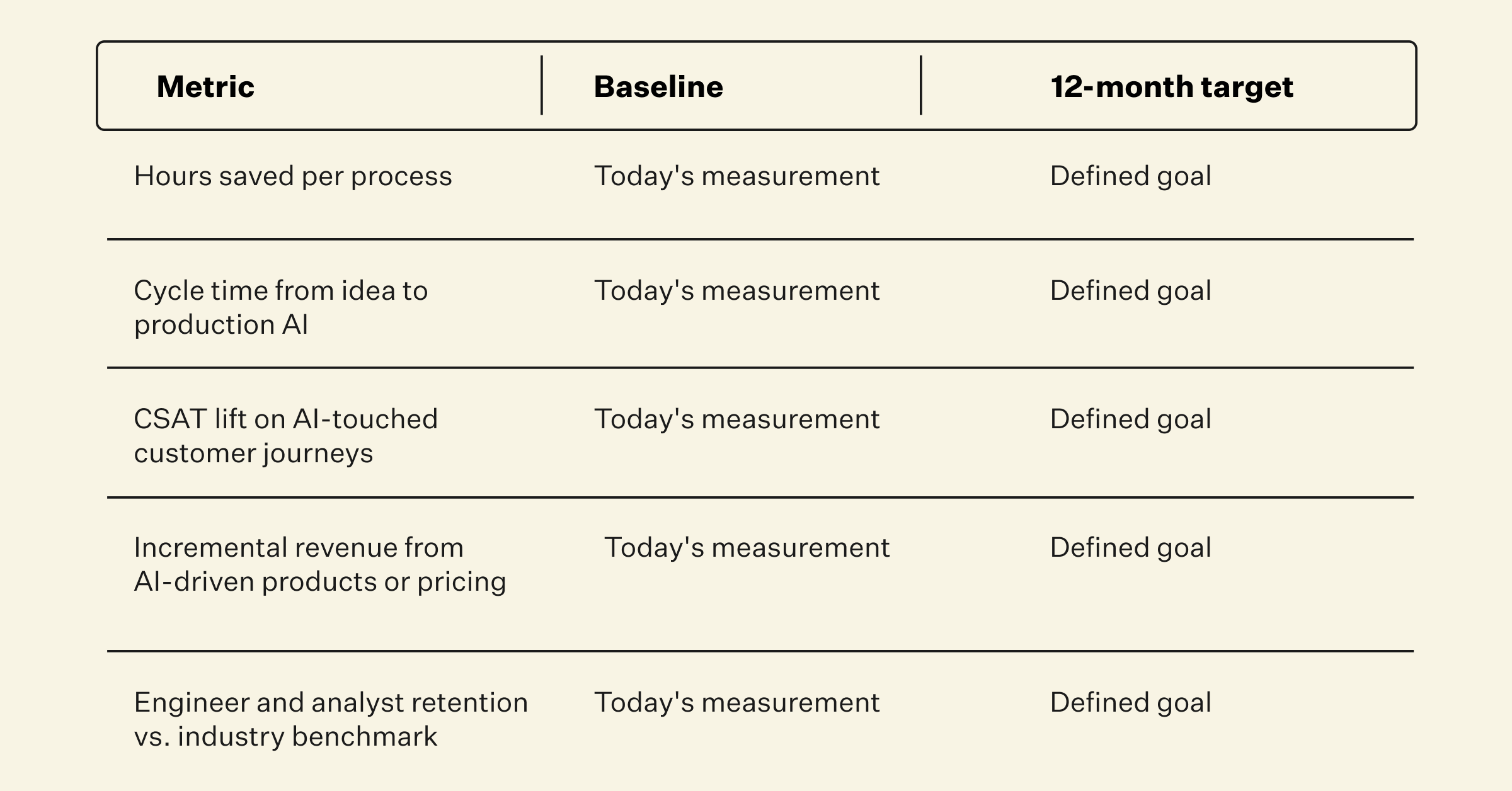
Review the portfolio quarterly. Retire underperforming use cases and reinvest the budget. Do not defend them politically.
Enterprise AI transformation breaks down at the handoffs: between teams, between data and models, and between governance and execution. Dataiku is the orchestration layer that connects all three, with governance embedded at every step so transformation compounds instead of stalling.
Plan in tiers. Foundational readiness, covering data, governance, and platform setup, takes three to six months. First production pilots ship in six to 12 months. Enterprise-wide scale takes 18 to 36 months. Apply the eight-week pilot rule: If a pilot cannot ship in eight weeks, it is not yet scoped as a pilot.
Treat it as a sequencing question, not a fixed ratio. Early on, data foundations consume more budget through catalog, quality, and lineage work. As model and agent deployment scales, platform spend rises in step. A clear sign that sequencing is working is that the second use case costs noticeably less than the first to build and deploy.
Pick first use cases that satisfy two criteria: a measurable near-term outcome and infrastructure that the next two or three workflows can reuse. The impact-versus-feasibility quadrant in Phase 2 forces that discipline. Short-term wins built on throwaway infrastructure pay once and cost you twice.
Agentic AI augments rather than replaces. Agents take on repetitive reasoning steps, such as triage, drafting, and routing, while humans focus on exceptions and judgment calls. New roles emerge alongside them: agent owners who manage individual workflows, agent reviewers who evaluate outputs before they reach production, and AI governance leads who own the registry and lifecycle across the enterprise. The operating-model shift matters more than the agent technology itself.
Start with productivity use cases that do not require proprietary historical data: knowledge retrieval, internal Q&A, and document summarization. Use external data where appropriate. Visual and AI-assisted development tools keep headcount requirements low. Build governance into the first deployment, not the third. It is always cheaper that way.
Tags