CIO confession 3 of 6: Your next AI incident could start with a green dashboard
October 22, 2026/5 min read/Julia Berman
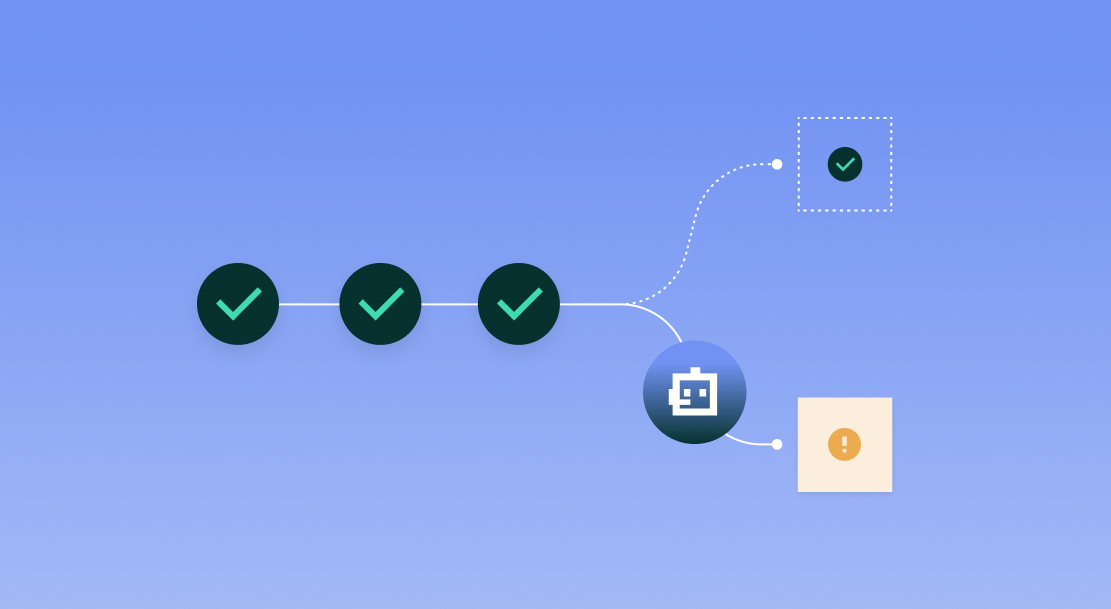
A procurement agent reorders supplies whenever inventory dips below a set threshold. It runs thousands of times a week without a single error. Then a key supplier raises prices sharply, and the agent keeps ordering on schedule, exactly as designed. Every dashboard stays green while margins shrink.
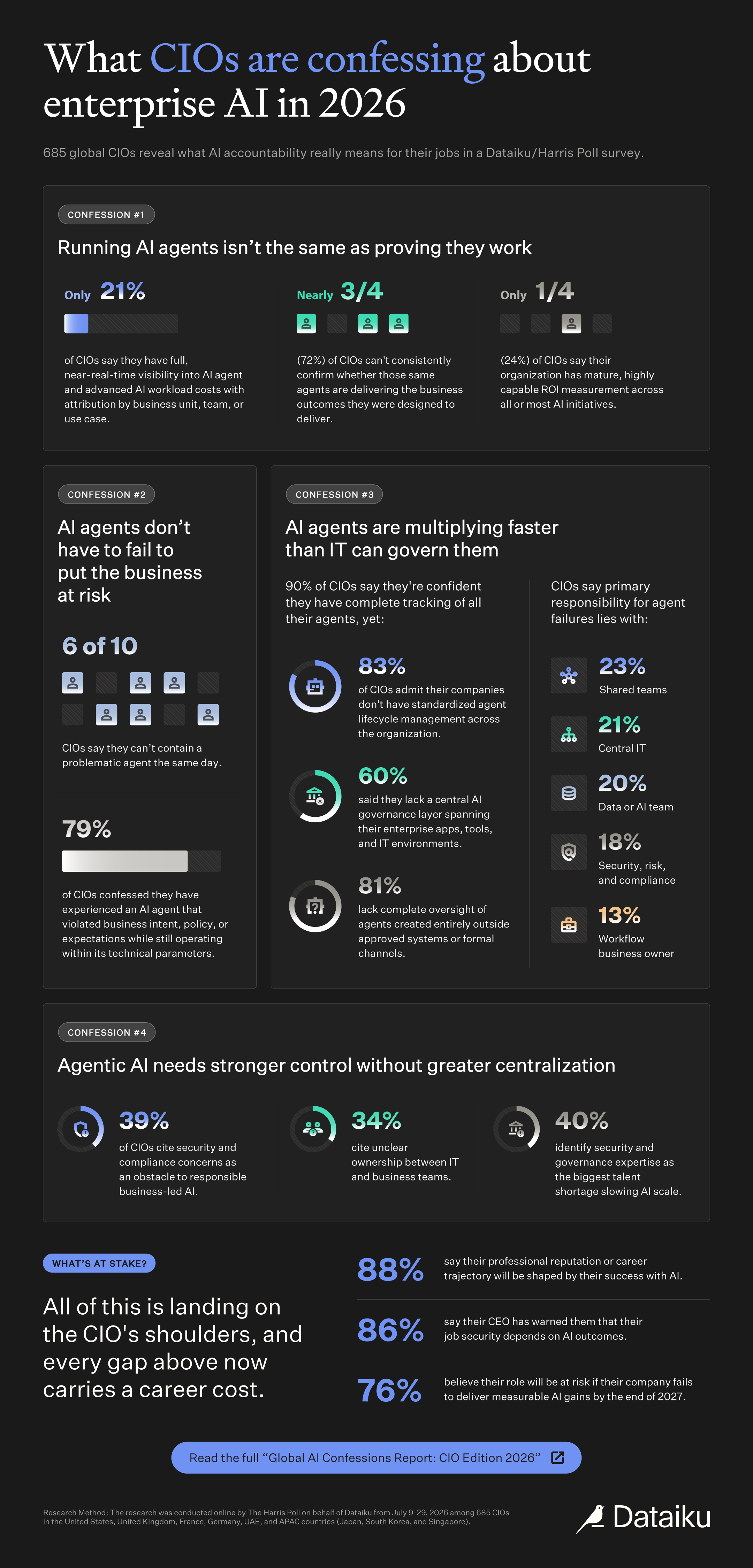
Most CIOs have lived a version of this story. In fact, 79% confessed they have experienced an AI agent that violated business intent, policy, or expectations while still operating within its technical parameters.
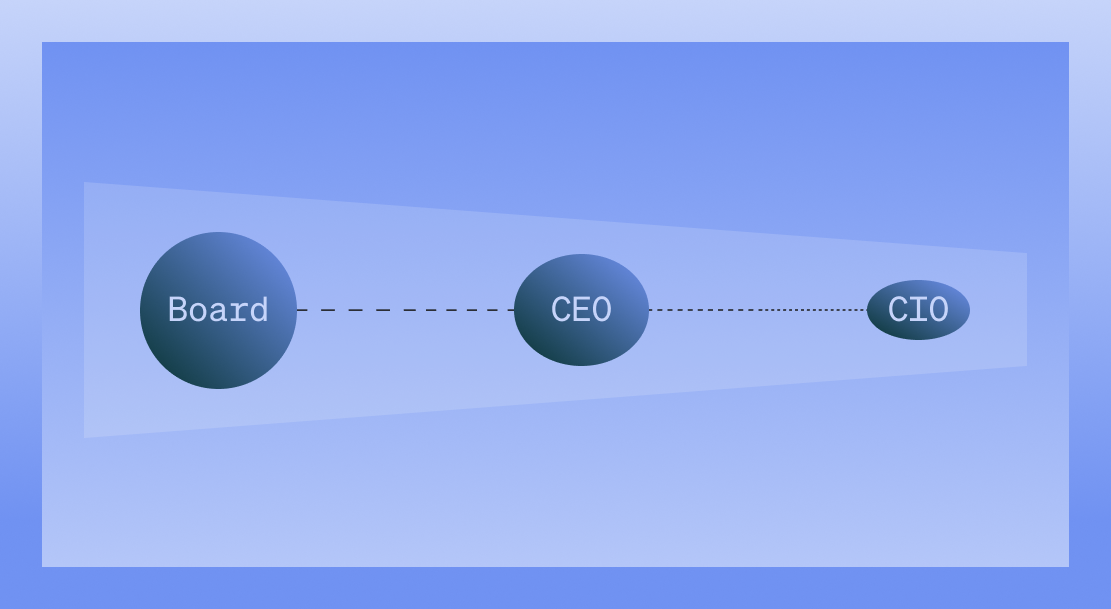
This post is part 3 of Dataiku's six-part series on the “Global AI Confessions Report: CIO Edition, 2026,” a survey of 685 enterprise CIOs conducted with The Harris Poll. Part 1 traced how pressure to prove AI ROI travels from the board to the CEO to the CIO. Part 2 laid out four questions that show whether an agent is actually working. Now we turn to the report's second confession: AI agents don't have to fail to put the business at risk.
We'll look at why scale makes agent behavior harder to track, where technical monitoring reaches its limit, and how the speed of intervention shapes the size of the damage.
AI agents do more than generate ideas or recommendations. They execute workflows, interact with systems, make decisions, and complete tasks with varying degrees of autonomy. And they're doing it in volume.
Two-thirds of CIOs (67%) estimate that 51 or more agents are running in production. In the U.S., that figure rises to 45%. Roughly one in 10 CIOs globally put the number above 500.
A handful of agents built by one team can be understood individually. Hundreds of agents spread across teams, platforms, models, and use cases call for a different level of oversight. At that scale, CIOs need to know more than what's running. They need to know what each agent is doing once it's deployed.
Technical monitoring answers important questions. Is the agent up? Is it responding on time? Is it staying within its parameters? When the answers come back yes, the system is operating as expected.
Monitoring stops short of a harder question, do the agent's actions align with business intent and produce the outcomes the enterprise needs? That gap is where the 79% sits. In every one of those cases, the agent stayed inside its technical parameters and still acted against what the enterprise intended.
That happens because agents act on instructions, rules, and data that capture intent at a single point in time. Then the enterprise keeps moving. Policies change, prices shift, and customers bring situations no one planned for. An agent following its original logic can drift steadily away from what the enterprise wants today.
In part 2, we outlined four questions for measuring whether an agent is working: cost, technical performance, agent effectiveness, and business impact. Traditional monitoring covers the second. The 79% shows what happens when oversight stops there.
For nearly a third of CIOs, an agent incident has already moved well past a policy concern. 31% of CIOs admitted an incident resulted in actual customer, financial, compliance, or operational impact.
Here's what each of those can look like in practice:
Customer: An agent applies a returns policy correctly to a situation the policy never anticipated, and a long-standing customer walks away.
Financial: A pricing agent stacks discounts that each fall within its limits and together erode margin.
Compliance: An agent follows its instructions and pulls customer data into a workflow where policy restricts its use.
Operational: An agent triggers downstream actions that cascade across connected systems before anyone reviews them.
Each scenario can unfold with every system running smoothly. The signal usually arrives later, through a customer complaint, an audit finding, or a quarter-end reconciliation.
A problematic agent keeps taking action until someone identifies the issue and steps in. Once it's caught, CIOs still need to contain it before the consequences spread across connected systems and workflows.
For most enterprises, that process takes too long. Roughly six in 10 CIOs can't contain a problematic agent the same day. Only 10% can do so within one to two hours.
Agents work at machine speed, so delays compound. An agent handling thousands of transactions a day can repeat the same misstep across every one of them before a team intervenes. Fast detection narrows that window, while fast containment closes it.
The report sets a clear bar. As agents take on more consequential work, CIOs need to be able to see what they're doing, recognize when they're going off course, and intervene quickly.
Each capability builds on the one before it.
See: Track the actions and decisions an agent takes, alongside its uptime and error rates.
Recognize: Define business intent in terms an agent's behavior can be checked against, such as policies, thresholds, and expected outcomes. Then compare actual behavior to that standard continuously.
Intervene: Give teams the ability to pause, adjust, or retire an agent quickly, across the environments where it runs.
The report calls this ability a core part of agent management. With all three in place, agent autonomy becomes something CIOs can stand behind, because they can step in the moment an agent drifts.
Technical health remains the foundation. It shows an agent is running. Alignment with business intent shows it's running in the right direction, and that's the standard boards and CEOs are using to judge AI.
As we covered in part 1, CIOs are putting their careers and budgets behind measurable AI outcomes. An agent that drifts from intent puts that evidence at risk, even when every technical metric looks strong. The CIOs who can spot drift early and contain it fast give their enterprises the confidence to hand agents more consequential work.
Catching one agent off course is a manageable problem.
Stay tuned for our next post in the series, which will look at the harder version: employees creating agents faster than IT can govern them.