Grounding verification in AI: LLM techniques for semantic consistency checks
October 9, 2026/10 min read time/Team Dataiku
RAG pipelines reduce hallucinations by grounding model outputs in retrieved documents. What they cannot guarantee is that the model used those documents faithfully: A response can carry citations, pass grounding checks, and still misrepresent the source it claims to support. Verification is the layer that catches the difference between a response that is sourced and one that is accurately sourced.
The gap is measurable, as Industry analysis of 847 enterprise RAG deployments, reported by AI Magicx citing a February 2026 consortium study, found that RAG reduces hallucinations by a median of 71%.Verification helps identify the failures that remain.
This guide explores the core concepts, metrics, verification methods, and implementation practices organizations can use to assess semantic consistency and improve confidence in AI-generated outputs.
Grounding connects model outputs to external sources. Grounding verification validates whether the connection holds at the claim level.
Semantic consistency checks compare generated claims against retrieved source content at the meaning level.
Three useful metrics for evaluating verification quality are support score (faithfulness), citation precision, and citation recall.
Four LLM grounding techniques provide layered verification: RAG pipelines, post-generation fact-checking APIs, claim-level scoring, and human-in-the-loop review.
According to "Global AI confessions report: data leaders edition," based on a Dataiku/Harris Poll survey, only 5% of data leaders say AI output is traceable 100% of the time. Grounding verification can help make the remaining outputs more auditable.
Grounding verification is the process of assessing whether claims in an AI-generated output are supported by the source evidence the system used to generate it. It is the validation layer on top of grounding, not grounding itself.
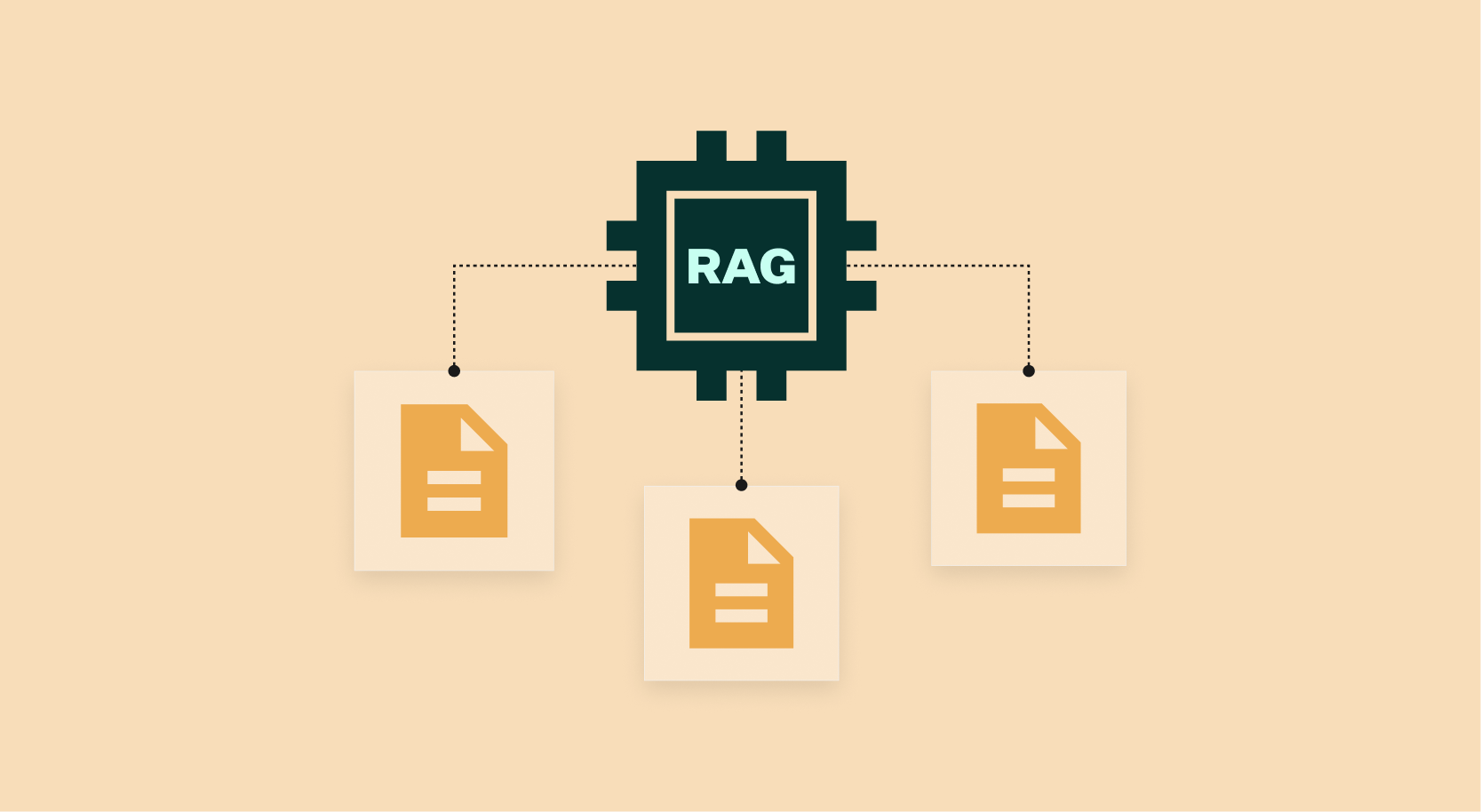
Grounding is the architectural pattern (typically RAG) that retrieves relevant documents and provides them as context to the model. Grounding verification is the quality check that evaluates whether the model's output reflects what the retrieved documents say.
A RAG system can retrieve the right documents and still produce an ungrounded response, because retrieval shows that evidence was available, not necessarily that the model used it correctly.
The model may synthesize information from two retrieved passages in a way that neither passage supports, paraphrase a source incorrectly, or fill gaps between retrieved facts with plausible but unsupported inferences. In each case, grounding did its job by putting the right evidence in front of the model; verification is what checks whether the model used that evidence faithfully.
Grounding verification assesses whether generated claims map to external facts from the retrieval corpus rather than from the model's parametric memory (training data). It connects to RAG pipelines (where verification checks retrieved document usage), tool use (where verification checks that tool outputs are accurately represented), and AI source attribution (where verification checks that cited sources actually support the claims attributed to them).
A semantic consistency check compares generated claims against retrieved source content at the meaning level, evaluating whether the generated text logically follows from and is supported by the source material.
Semantic consistency is a narrower claim than factual correctness. A response can be semantically consistent with its sources (every claim traces to a retrieved document) while still being factually wrong (the source document itself contains errors).
Verification checks alignment with sources. Factual correctness requires that the sources themselves are accurate, which is a data quality problem, not a verification problem.
The comparison basis is meaning-level alignment: Does the generated claim preserve the meaning of the source material? Verbatim matching misses valid paraphrases. Keyword overlap misses semantic divergence. Meaning-level comparison is better suited to catching both valid paraphrases and semantic divergence.
A financial advisor chatbot cites a regulatory document but paraphrases its conditions incorrectly, reversing a key restriction. The citation exists. The source is correct. The generated claim contradicts the source. Without semantic consistency checking, the response appears authoritative and cited while being substantively wrong.
Business risks of inconsistent answers:
Trust loss: Users learn to distrust AI outputs
Compliance gaps: Cited outputs that contradict their own citations create regulatory exposure
Operational waste: Downstream processes act on inconsistent information, requiring manual reconciliation
Semantic consistency checks reduce hallucinations by catching the claims that grounding alone misses and improve user satisfaction by ensuring that cited answers say what the citations support.
Three metrics define whether grounding verification is working effectively.
The support score measures the degree to which a generated answer is supported by the provided evidence, on a 0-to-1 scale. Implementations vary; Google's Check Grounding API, for example, returns a single support score per response.
One straightforward internal scoring approach is to decompose the generated response into individual claims, score each claim as supported (1), partially supported (0.5), or unsupported (0), and then average across all claims.
support_score = sum(claim_scores) / total_claims
Illustrative thresholds:
Organizations may choose higher thresholds, such as 0.90 or above, for higher-risk applications such as financial, legal, or healthcare
General enterprise applications may tolerate lower thresholds depending on the consequence of error
Lower scores can be used to trigger investigation or human review, with 0.70 as one commonly referenced starting point
Citation precision measures the percentage of cited sources that support the claims they are attached to. A response that cites five sources but only three support their respective claims has a citation precision of 0.60.
citation_precision = correctly_supporting_citations / total_citations
Target: Above 0.90 for production applications. Low precision indicates the model is citing sources for appearance rather than support.
Citation recall measures the percentage of claims in the response that have a supporting citation. A response with ten claims where only six are cited has a citation recall of 0.60, meaning four claims are unverifiable.
citation_recall = cited_claims / total_claims
Target: 1.0 for regulated environments (every claim must be traceable). Above 0.80 for general enterprise use.
Four verification techniques address different accuracy-cost trade-offs. The highest-assurance implementations combine multiple methods, using cheaper techniques as pre-filters and more expensive techniques for high-stakes validation.
RAG provides the foundational grounding layer by retrieving relevant documents and passing them as context to the model. Verification within RAG checks whether the model's output reflects the retrieved content.
Verification checkpoint: After generation, compare each claim in the output against the retrieved passages using semantic similarity or entailment scoring. Flag claims that fall below the similarity threshold as potentially ungrounded.
Latency consideration: Adding a verification pass increases end-to-end latency. For user-facing applications, evaluate the added verification latency against the experience requirements of the application.
Fact-checking APIs score a generated answer against a provided set of facts, returning a support score and citing which facts support which claims. Google's Check Grounding API is the most mature example.
The API receives three inputs:
The answer candidate: The generated response
The facts: Retrieved passages or knowledge base entries
A citation threshold: Minimum confidence for a citation to be included
It returns the support score, cited chunks with byte-offset positions in the response, and claim-level attribution.
Trigger automated rejection when the support score falls below the defined threshold. Route rejected responses to a fallback (re-generate with different retrieval, escalate to human review, or return a "cannot verify" response).
Claim-level scoring decomposes the response into individual sentences or claims and evaluates each independently against the source material. This is more granular than answer-level scoring: A response that is 80% grounded overall may contain one completely unsupported claim that answer-level scoring averages away.
Threshold tuning: Set per-claim thresholds based on the domain's risk tolerance. Higher-risk applications may use stricter thresholds, while general enterprise applications may allow lower-scoring claims to be flagged for review rather than automatically rejected.
Implementation note: Claim decomposition can produce artifacts with non-ASCII characters and inconsistent byte offsets. Validate offsets against the original response text before using them for UI highlighting or audit logging.
For high-stakes domains where automated verification alone is insufficient, expert reviewers can sample responses on a recurring basis and evaluate them against a structured rubric.
Review rubric:
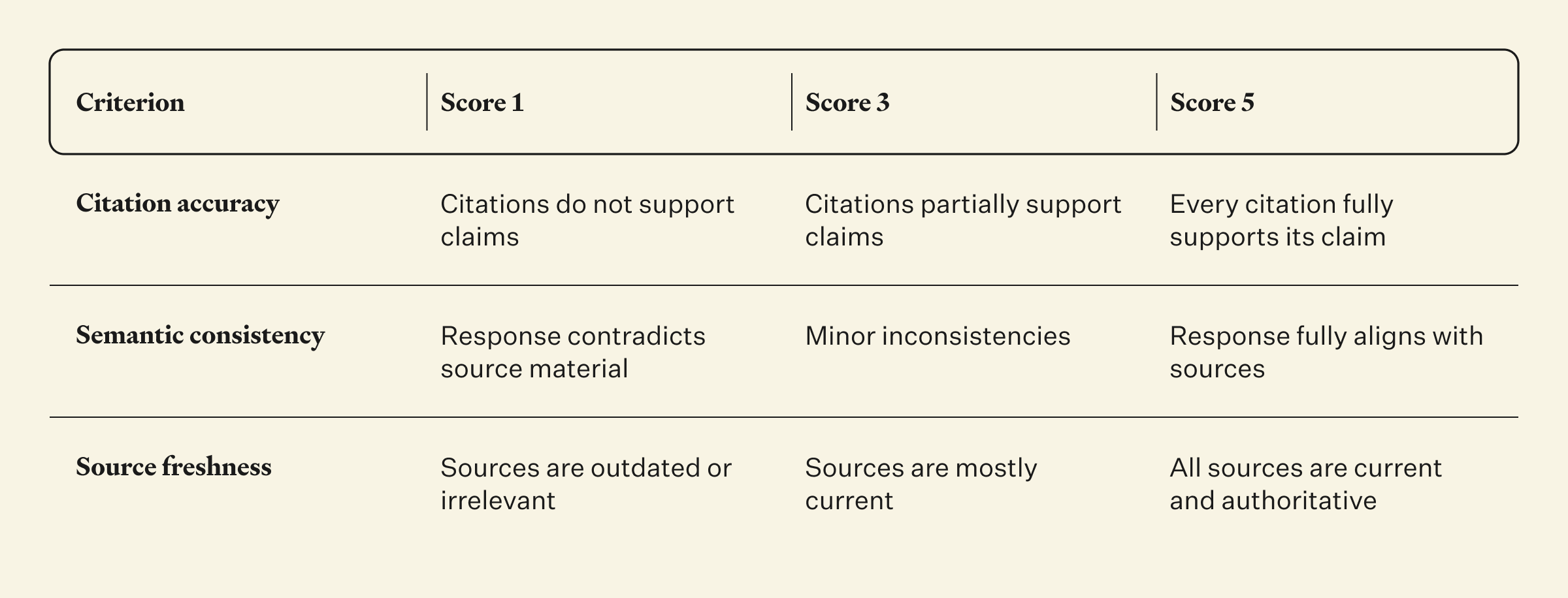
Review findings feed back into retrieval tuning: If reviewers consistently find that a particular source type produces low-quality grounding, that source is flagged for review or removal from the retrieval corpus.
A minimal implementation using a grounding verification API demonstrates the core pattern.
import requests
import json
def verify_grounding(answer: str, facts: list[str], threshold: float = 0.7):
"""Score answer against facts and return verification result."""
payload = {
"answerCandidate": answer,
"facts": [{"content": f} for f in facts],
"citationThreshold": threshold
}
response = requests.post(
"https://your-grounding-api/v1/check",
headers={"Authorization": f"Bearer {API_KEY}"},
json=payload
)
result = response.json()
return {
"support_score": result.get("supportScore", 0),
"cited_chunks": result.get("citedChunks", []),
"is_grounded": result.get("supportScore", 0) >= threshold
}
Example usage
facts = [
"The EU AI Act's high-risk obligations take effect August 2, 2026.",
"Fines for non-compliance reach 15 million euros or 3% of turnover."
]
answer = "The EU AI Act's high-risk requirements become enforceable in August 2026, with penalties up to 15 million euros."
result = verify_grounding(answer, facts)
print(f"Support score: {result['support_score']}")
print(f"Grounded: {result['is_grounded']}")
The supportScore in the response indicates how well the answer is supported by the provided facts (0.0 to 1.0). The citedChunks array shows which facts support which portions of the answer, with character offsets for UI highlighting.
Authentication prerequisites vary by API provider. Google's Check Grounding API requires a Google Cloud project with the Discovery Engine API enabled.
Six practices maintain grounding quality over time. The ranges below are practical starting points rather than universal thresholds; teams should tune them against their data, risk profile, model stack, and latency requirements:
Verification quality depends heavily on the facts the system verifies against. Schedule refresh cadences based on content volatility:
Daily for fast-changing content: Pricing, inventory, policy updates
Weekly for moderately changing content: Product documentation, FAQs
Monthly for stable content: Regulatory text, technical specifications
Target citation precision above 90% for production applications. Track precision weekly. Investigate any sustained drop: Declining precision often signals retrieval quality degradation (the system is retrieving documents that do not support the queries being asked).
Oversized facts (entire documents passed as a single fact) dilute verification accuracy because the model can claim support from a large passage that contains many claims, only some of which are relevant. Chunking source material into semantically coherent segments of roughly 200 to 500 tokens can improve verification precision.
Full claim-level verification can add roughly 200 to 500 milliseconds per response, depending on the implementation. For latency-sensitive applications, implement tiered verification: lightweight embedding-based checks on every response, full claim-level scoring on a 10% sample, and full scoring triggered automatically when lightweight checks flag a potential issue.
Configure threshold-based alerting when average support scores drop below the defined baseline. A sustained 5% decline over one week warrants investigation. A 10% decline warrants immediate review of the retrieval pipeline and source corpus.
Dataiku, the Platform for AI Success, provides grounded enterprise Q&A capabilities built on governed data infrastructure built on governed data. Answers can be generated from enterprise knowledge bases with source attribution, and the platform's governance capabilities help teams curate, maintain, and control access to those knowledge sources.
Here are five pitfalls with paired mitigations.
When the source corpus contains outdated or contradictory information, verification confirms alignment with the wrong facts.
Mitigation: Implement freshness metadata on every source document. Flag or exclude sources beyond their defined expiry date.
Passing too many retrieved passages into the model's context dilutes the signal. The model may synthesize from less relevant passages rather than the most relevant ones, producing responses that are technically grounded in retrieved content but not grounded in the best available evidence.
Mitigation: Limit context to the top three to five most relevant passages. Use re-ranking to ensure quality over quantity.
Source material presented as current when it reflects a previous state. A policy document that was accurate six months ago but has since been superseded produces grounded but incorrect responses.
Mitigation:
Timestamp source document where appropriate.
Display source dates alongside citations.
Alert when a verification pass relies on sources older than the defined freshness threshold.
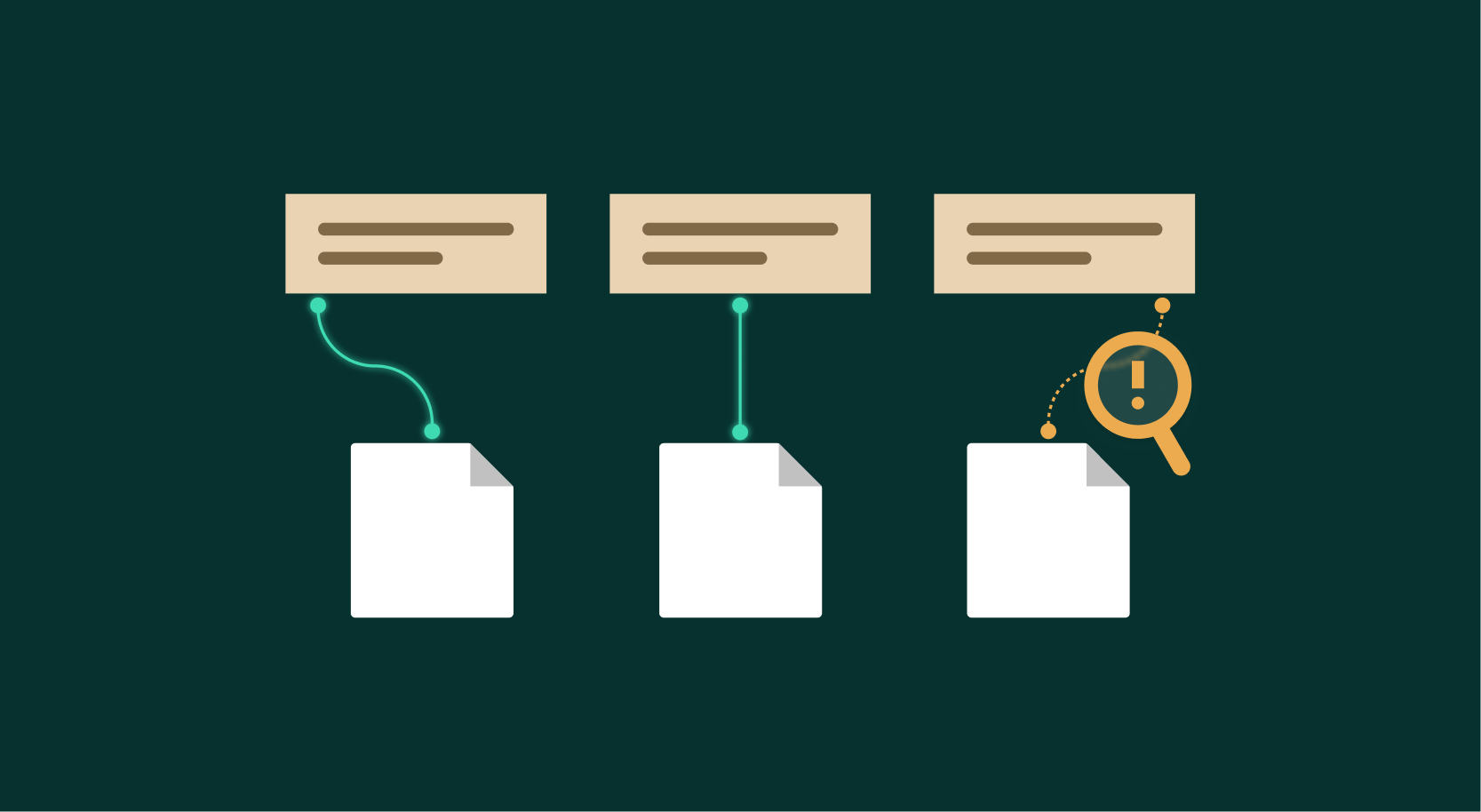
A citation that points to a source document but does not support the specific claim it is attached to. The source exists. The citation format is correct. The support relationship is not.
Mitigation: Claim-level scoring catches this by evaluating each citation-claim pair independently rather than checking only that the cited source exists.
Automated verification catches the majority of grounding failures but misses nuanced cases: paraphrases that subtly shift meaning, implications that the source does not explicitly state, and contextual misapplication of accurate information.
Mitigation: Layer human review on top of automated verification for high-stakes domains.
Grounding verification is a quality-control layer for assessing whether AI-generated answers are accurately supported by their cited evidence. At the claim level, it can make unsupported statements easier to identify and improve traceability between answers and source material. Organizations can establish target support scores, citation precision, and citation recall based on the risk and audit requirements of each application.
The concrete next step: Pick one production RAG application, run the verification code example against 100 responses, and measure the support score distribution. That baseline tells you how much of your AI output is grounded versus how much merely appears to be.
Dataiku grounds AI applications in governed data with evaluation and oversight built in, so every answer is traceable to evidence, and every evidence source is traceable to its governance record.
Before production deployment for any application where users act on AI-generated answers. Post-deployment verification catches issues reactively. Pre-deployment verification prevents them from reaching users in the first place.
Yes. Verification evaluates the relationship between generated claims and provided facts regardless of the facts' source. Enterprise knowledge bases, internal wikis, policy documents, and proprietary databases all serve as the fact layer.
By making every claim auditable: users and reviewers can see which source supports each claim, verify the support relationship, and identify claims that lack support. Trust shifts from "the AI said so" to "the AI said so, and here is the evidence."
Yes, moderately. Full claim-level verification may add roughly 200 to 500 milliseconds and an additional API call per response, depending on the implementation. Tiered verification (lightweight checks on every response, full scoring on a sample) manages the trade-off.
Financial services (regulatory compliance, advisory accuracy), healthcare (clinical decision support, patient-facing information), legal (case research, contract analysis), and any industry where AI-generated answers inform consequential decisions that are subject to audit.
Tags