10 best RAG tools for AI apps (2026)
August 12, 2026/8 min read/Team Dataiku
Retrieval-augmented generation (RAG) has moved from research concept to production pattern faster than most enterprises expected. Whether you are building an internal knowledge assistant, a document Q&A tool, or a multi-source reasoning pipeline, the retrieval layer is where the application either earns user trust or loses it.
This article covers the ten best RAG tools available in 2026, evaluated across retrieval speed, hybrid search capability, hosting flexibility, LLM integration, observability, pricing, and compliance controls. The tools span open-source libraries, orchestration frameworks, managed vector databases, and developer-first search engines, so there is a realistic option regardless of where you are in the build.
One thing worth knowing before you dive in: Most of these tools are well matched to prototyping and early production. As RAG applications scale across teams and regulated workflows, the retrieval layer is rarely what creates problems.
Gartner® states, "Over 40% of agentic AI projects will be canceled by the end of 2027, due to escalating costs, unclear business value or inadequate risk controls, according to Gartner, Inc."*
Retrieval speed and hybrid search are table stakes for enterprise RAG in 2026. The differentiating question is what surrounds the retrieval layer: access controls, audit logging, pipeline governance, and continuous monitoring.
Most RAG tools leave compliance entirely to the developer. For financial services, healthcare, and legal deployments, that gap is architectural, not a configuration problem.
Picking the right retrieval tool is only the first step. Moving an RAG application from working prototype to governed production requires a separate orchestration and governance layer built around the retrieval tool, not inside it.
Retrieval-augmented generation is a pattern that grounds language model responses in retrieved documents rather than relying solely on the model's training data. The system fetches relevant information from a knowledge base, augments the prompt with that context, and generates a response anchored in specific, retrievable sources. This fetch-augment-generate loop reduces hallucinations and makes model outputs traceable to the documents they were derived from.
For enterprise teams, the appeal is practical: proprietary documents, internal knowledge bases, and frequently-updated data are never in a model's training set. RAG closes that gap without the cost and complexity of fine-tuning. Organizations that successfully govern their AI applications report significantly higher confidence in production deployments than those that treat governance as an afterthought.
Seven criteria structure the evaluation below. Assess each against your team's document types, query patterns, and compliance requirements before selecting a tool.
Retrieval speed: Latency at query time, particularly for user-facing applications where a sub-second response is expected
Hybrid search: The ability to combine vector similarity with lexical keyword search for better recall on mixed query types
Hosting model: Managed cloud, self-hosted, or both, depending on data residency requirements and infrastructure preferences
LLM integration: How easily the tool connects to the language models already in use, whether OpenAI, Anthropic, Google, or open-weight models
Observability: Whether retrieval quality, latency, and failure modes are surfaced in a usable way rather than buried in logs
Pricing: Free tier generosity and the cost curve at production scale, where per-query or per-vector charges can escalate quickly
Compliance and access controls: Audit logging, role-based access to document sets, and data residency support
Criteria one through six are well served by most tools on this list. Criterion seven is where enterprise teams consistently hit a wall. Most retrieval tools leave compliance entirely to the developer. For financial services, healthcare, and legal RAG deployments, that gap is not a configuration problem but an architectural one.
The table below compares all ten tools across the factors that matter most when building a RAG application.
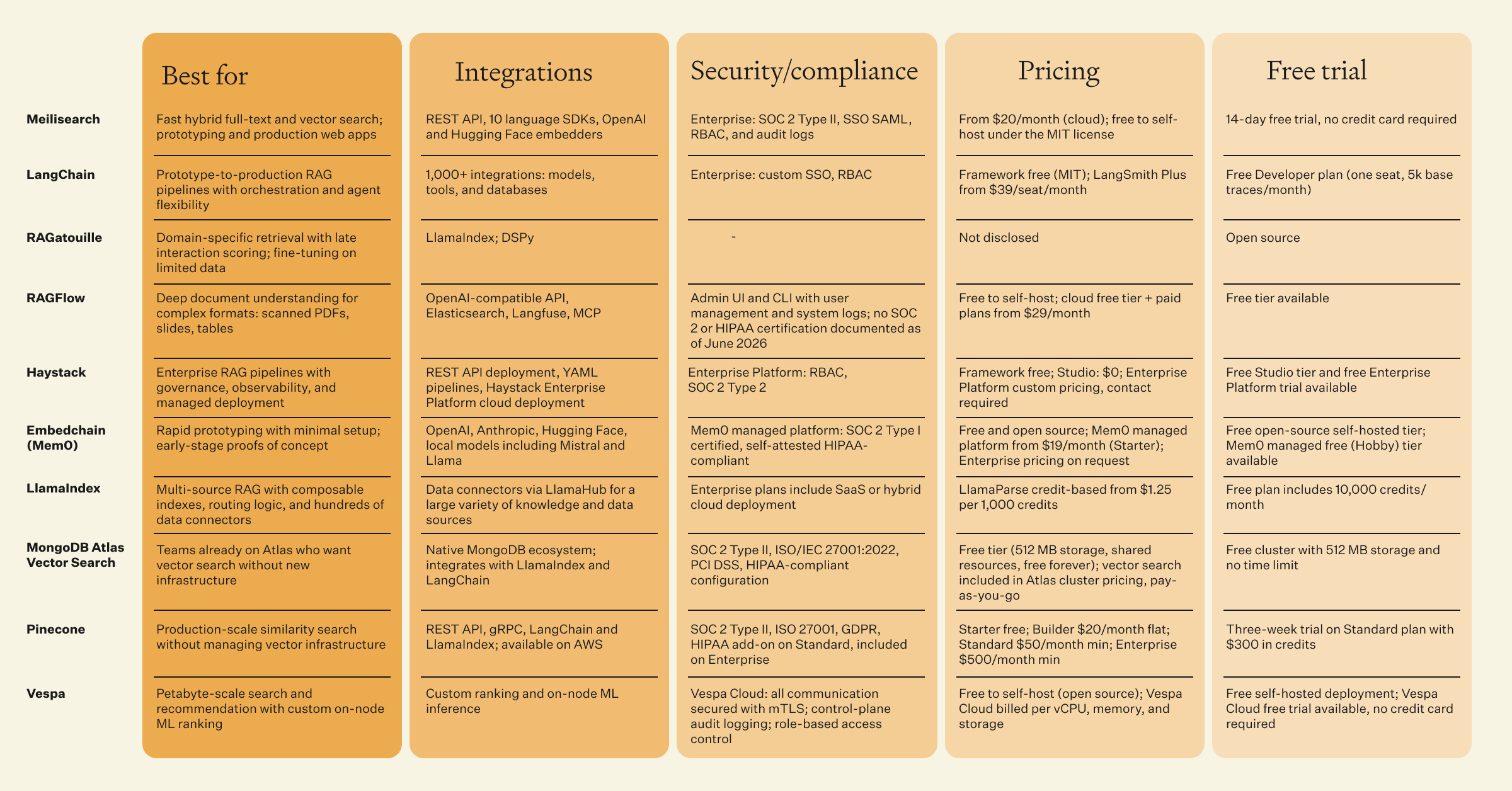
Click on the image above to zoom into full PDF
Sources dated June 2026
*RAGatouille is an open-source project maintained by researcher Benjamin Clavié under Answer.AI; it has no dedicated commercial or product website. Sourcing for RAGatouille references the project's own documentation (ben.clavie.eu/ragatouille) as the primary source.
Most open-source tools require developers to supply their own governance and compliance layer. Managed services like Pinecone and MongoDB Atlas provide strong certifications but limited infrastructure control. Dataiku, the Platform for AI Success, occupies a different position: Itconnects to any retrieval tool already in use and adds the governance layer that makes those tools production-ready in regulated environments.
These tools were selected based on community adoption, retrieval performance, and cost across the full range from open-source experimentation to production deployment. Each review covers what the tool does, its ideal use case, its specific limitations, and a full pricing breakdown.
Meilisearch is an open-source search engine with hybrid full-text and vector search and sub-50ms query latency. Built-in embedders support OpenAI, Hugging Face, and Ollama, so vector embeddings work directly inside the search engine without additional infrastructure. Self-hosting is free under the MIT license.
Ideal fit
Development teams that need fast full-text and semantic search with minimal setup time and flexible deployment options
Limitations
The Cloud plan includes a base allocation of searches and documents per month, with usage billing applying beyond that threshold.
Pricing
Free to self-host
Cloud: From $20/month, with a 14-day free trial and no credit card required
Enterprise: Custom pricing with SOC 2 Type II, dedicated Slack support, and up to 99.999% uptime SLA
LangChain is an open source framework with pre-built agent architectures and more than 1,000 integrations for models, tools, and databases. LangSmith adds observability for tracing agent behavior and debugging failures on paid plans.
Ideal fit
Development teams building RAG pipelines that need orchestration flexibility, a wide library of LLM and tool integrations, and an upgrade path to production-grade observability
Limitations
Deployment, sandboxes, and Engine features require a paid LangSmith tier; the Plus plan starts at $39 per seat per month.
The open-source framework includes no native access controls for document-level permissions
Pricing
LangChain framework: Free (MIT license)
Developer: Free (one seat, 5,000 base traces per month)
Plus: $39 per seat per month, plus pay-as-you-go traces and access to Deployment, Sandboxes, and Engine
Enterprise: Custom pricing with self-hosted or hybrid deployment, custom SSO, and RBAC
RAGatouille implements ColBERT-style late interaction retrieval, representing documents as bags of contextualised units of information rather than a single vector, enabling more precise matching across diverse query phrasings at retrieval time.
Models are easy to adapt to new domains due to their bag-of-embeddings approach, a meaningful advantage for organizations with specialized vocabularies or domain-specific retrieval needs.
RAGatouille is free and open source, with LlamaIndex integration.
Ideal fit
Research and ML teams working on domain-specific retrieval problems where precision matters more than raw speed, and where adapting to new domains with limited data is a priority
Pricing
Not disclosed
RAGFlow is an open-source RAG engine built on deep document understanding, designed to parse complex document formats including PDFs, Word documents, spreadsheets, slides, and scanned images with high fidelity.
It integrates with OpenAI-compatible APIs, Elasticsearch, Langfuse, and MCP, and provides an admin interface for user management and access controls.
RAGFlow is backed by InfiniFlow and actively maintained with frequent releases.
Ideal fit
Teams dealing with complex, multi-format document sets, including scanned documents, slides, and structured tables, where standard PDF chunkers miss important structure
Limitations
Self-hosting RAGFlow requires meaningful infrastructure: a minimum of four CPU cores, 16 GB RAM, and 50 GB disk.
Pricing
Free to self-host
Free tier available at $0/month
Paid plans start at $59/month (Starter) and $259/month (Pro); enterprise pricing available on contact
Haystack is a modular Python framework with REST API deployment and hybrid retrieval combining dense and sparse search, plus serializable YAML pipelines for versioning and reproducibility.
The deepset Haystack Enterprise Platform adds cloud or custom deployment, role-based access controls, SOC 2 Type 2 certification, and ISO 27001 certification alongside commercial support, on top of the open-source framework. It is well suited to enterprises that need governance controls alongside structured pipeline management.
Ideal fit
Enterprise teams that need a structured pipeline framework with observability, compliance controls, and the option of commercial support and managed infrastructure
Limitations
The open-source framework provides community support only; enterprise RBAC and SSO are available exclusively through the paid Haystack Enterprise Platform.
Pricing
Haystack open source: free
Haystack Enterprise Starter: includes four hours per month of technical consultation and priority support; pricing on request
Haystack Enterprise Platform: custom pricing; includes RBAC, SOC 2 Type 2 certification
Embedchain is an open-source Python framework that makes it easy to create and deploy personalized AI applications. It follows a "Conventional but Configurable" design principle, allowing beginners to build LLM-powered applications in as few as four lines of code while offering experienced developers full control over LLMs, vector databases, chunking strategies, retrieval strategies, and re-ranking.
The framework automatically handles data type detection, embedding creation, and vector database storage. It supports open-source models including Mistral and Llama as well as paid models including GPT-4 and Claude, accessible via API. A full-stack template with a FastAPI backend, Next.js frontend, and built-in chat UI is included out of the box.
For deployment, Embedchain integrates natively with Fly.io, Modal.com, Render.com, Railway.app, Streamlit, Gradio, and Hugging Face Spaces.
Ideal fit
Software engineers and machine learning engineers who want a fast path from prototype to a deployed personalized AI application, with the option to configure every layer of the RAG pipeline as needs grow
Pricing
Free and open source
LlamaIndex is an open-source framework for building context-aware AI agents that connects LLMs to external data sources, with data connectors available through LlamaHub covering a large variety of knowledge and data sources.
LlamaParse provides end-to-end document understanding with AI-powered parsing, extraction, and indexing, with Enterprise plans offering SaaS or hybrid cloud deployment.
Ideal fit
Teams building complex multi-source RAG pipelines with custom routing logic and a wide range of data source integrations
Limitations
LlamaCloud operates on a credit-based pricing system where 1,000 credits cost $1.25, making costs variable by usage volume and plan tier.
Pay-as-you-go credits are available on Starter and Pro plans up to set limits, meaning costs can scale with document volume.
Pricing
Open source: Free
Free: $0/month, includes 10,000 credits
Starter: $50/month, includes 40,000 credits; pay-as-you-go up to 400,000 credits at $1.25 per 1,000 credits
Pro: $500/month, includes 400,000 credits; pay-as-you-go up to 4,000,000 credits
Enterprise: custom pricing with SaaS or hybrid cloud deployment; volume discounts on credits
MongoDB Atlas Vector Search adds native vector database capabilities directly into existing MongoDB Atlas clusters, so teams already running Atlas can extend to semantic search and generative AI without introducing new infrastructure.
The Atlas platform is certified against ISO/IEC 27001:2022, SOC 2 Type II, PCI DSS, and can be configured for HIPAA-compliant applications, with role-based access controls, field-level encryption, and audit logging retained for at least six years.
Ideal fit
Backend teams whose primary data store is already MongoDB Atlas and who want to add vector search without migrating to a dedicated vector database
Limitations
Vector index memory requirements and cross-region data egress can drive costs up on large, frequently-queried collections.
Pricing
Free tier: 512 MB of storage, shared resources, no time limit
Flex: $0.011/hour
Dedicated: From $0.08/hour ($56.94/month)
Pinecone is a fully managed vector database built for AI, with serverless scaling, dense and sparse vector indexes, and queries that stay fast at any scale. It is SOC 2 Type II and ISO 27001 certified, with RBAC, encryption at rest and in transit, SSO, and private networking available on higher plans.
HIPAA compliance is available as an add-on on the Standard plan and is included by default on the Enterprise plan.
Ideal fit
Teams that need production-scale similarity search without managing vector infrastructure, particularly those building on AWS, GCP, or Azure
Limitations
Read-unit consumption scales linearly with namespace size, meaning query costs can grow quickly at high data volumes and query rates on the Standard plan.
Pricing
Starter: Free
Builder: $20/month flat, with increased usage limits and multi-user support
Standard: $50/month minimum, then pay-as-you-go; three-week free trial with $300 in credits
Enterprise: $500/month minimum; includes audit logs, customer-managed encryption keys, and private networking
Vespa is an AI search platform for developing and operating large-scale applications combining big data, vector search, machine-learned ranking, and real-time inference. It supports vector, text, and structured search in a single engine, with native tensor support for complex ranking and decisioning.
Vespa Cloud provides a managed deployment option billed per vCPU, memory, and disk, with all operational costs included and control plane resources provided at no additional charge.
Ideal fit
Engineering teams building large-scale, latency-sensitive search or recommendation systems that require custom ranking models and tensor-based ML ranking
Limitations
Determining optimal cluster configurations, designing efficient ranking expressions, and implementing proper monitoring and alerting require experience with Vespa's operational characteristics, making production deployments more demanding than with managed alternatives.
Pricing
Startup plan: $0.05/vCPU per hour, $0.005/GB memory per hour, $0.0002/GB disk per hour; community support only
Basic plan: $0.1/vCPU per hour; next-business-day support
Commercial plan: $0.145/vCPU per hour; 24/7 operational support
Enterprise plan: $0.18/vCPU per hour; minimum monthly spend of $20,000; 15-minute 24/7 production response SLA
Moving a RAG application from prototype to production typically takes eight to twelve weeks, depending on document volume, infrastructure complexity, and compliance requirements. The five phases below describe a realistic path for enterprise teams.
Identify all document sources, formats, and update cadences. Determine access requirements and map document ownership to business teams.
Deliverable: A source inventory that defines what gets indexed and who can retrieve it
Select the retrieval tool that matches your document types and query patterns. Configure embedding models, chunking strategies, and hybrid search parameters. Test retrieval quality against a representative sample.
Deliverable: A retrieval configuration with documented precision and recall metrics
Build the full RAG pipeline connecting retrieval to your LLM. Define prompt templates, context window management, and citation handling.
Deliverable: An end-to-end pipeline with documented latency and accuracy benchmarks
Implement RBAC on document sets. Configure audit logging for queries and retrieved documents. Define approval workflows for pipeline promotion to production.
Deliverable: A governed pipeline with access controls and an audit trail
Deploy to production with continuous monitoring of retrieval quality, latency, and failure rates. Establish alerting thresholds for quality degradation. Document rollback procedures.
Deliverable: A production-ready RAG application with operational runbooks
You have picked a retrieval tool from the list above. It works in your prototype. Now the harder question: How do you move it from a working demo to a governed, production-grade RAG application?
The ten tools above handle retrieval. But none of them governs who approved the pipeline, which users can access which document sets, or whether retrieval quality is degrading as the underlying documents change. Those are the problems that stall enterprise RAG deployments.
Dataiku, the Platform for AI Success, unifies data preparation, machine learning, generative AI, agents, and governance in one environment, and acts as the orchestration and governance layer that wraps around these retrieval tools rather than replacing them. Dataiku connects to vector stores and frameworks such as Pinecone, MongoDB Atlas, Weaviate, LangChain, and LlamaIndex through the Dataiku LLM Mesh, so teams do not abandon the retrieval tool they have already built on.
What Dataiku adds is the infrastructure around the retrieval layer:
Pipeline approval workflows that ensure no RAG pipeline reaches production without documented review and sign-off
Role-based access controls on document retrieval that restrict which users and agents can reach which document sets, enforced at the platform level rather than in application code
Audit logging for every query and retrieved document, creating the compliance trail that regulated industries require
Continuous monitoring of retrieval quality over time, catching degradation as document sets grow, change, or go stale before users notice
For RAG applications in financial services, healthcare, and legal environments where data residency, access controls, and audit trails are regulatory requirements, retrieval-only tools cannot meet the brief. Dataiku provides SOC 2 and GDPR-aligned infrastructure as part of the platform, not as a third-party add-on.
Dataiku is not a vector database or a retrieval library. It is what enterprise RAG looks like once the retrieval problem has been solved and the production problem has not.
The fastest way to narrow the list is to start from the application you are building rather than the tool. Four common scenarios map cleanly to the options above.
Fast prototyping and hackathon use: Embedchain or Meilisearch; both get you from zero to a working RAG prototype in hours rather than days.
Custom production pipelines with complex orchestration: LangChain or LlamaIndex; both offer the flexibility and agent support needed for multi-source, multi-step retrieval workflows.
Teams already on a major cloud or database platform: MongoDB Atlas Vector Search or Pinecone; both minimize new infrastructure by building on existing data platforms.
Regulated enterprise RAG in financial services, healthcare, or legal: Dataiku. When the application involves sensitive documents, multi-department access controls, and regulatory audit requirements, the retrieval tool choice matters less than the governance layer around it. Dataiku provides that layer while remaining compatible with whichever vector store the team has already chosen.
Pilot at least two tools against a representative sample of your document set before committing. Retrieval quality varies significantly by content type, query distribution, and indexing configuration.
A vector database stores embeddings and serves similarity-search queries. A RAG tool is the broader pipeline that orchestrates the full retrieval-augmented generation cycle: query processing, document retrieval, context assembly, and LLM generation. Vector databases are one component within a RAG pipeline, not the pipeline itself.
In most cases, no. RAG reduces the need for fine-tuning by grounding model responses in retrieved documents at inference time rather than baking knowledge into model weights during training. Fine-tuning still makes sense for consistent output formatting, domain-specific language patterns, or performance gains that retrieval alone cannot achieve.
A small RAG application using open-source tools, such as LangChain or LlamaIndex for orchestration and a self-hosted Meilisearch instance for retrieval, can run at near-zero infrastructure cost. The primary expense is the LLM API: at typical volumes for an internal knowledge assistant of 1,000 to 5,000 queries per day, expect roughly $50 to $300 per month in API costs depending on the model and prompt length.
Meilisearch (MIT), LangChain (MIT), RAGatouille (Apache 2.0), Haystack (Apache 2.0), Embedchain (Apache 2.0), LlamaIndex (MIT), and Vespa (Apache 2.0) are open source and free to self-host, while RAGFlow is largely open source (Apache 2.0) but may include additional components or services depending on deployment.
Enterprise RAG requires four capabilities that retrieval tools do not provide: pipeline governance through approval workflows before production deployment, access controls that restrict which users can query which document sets, audit logging that records every query and retrieved document, and continuous monitoring that detects retrieval-quality degradation over time. These capabilities sit in the orchestration and governance layer above the retrieval tool.
Dataiku connects to vector stores and frameworks, including Pinecone, MongoDB Atlas, Weaviate, LangChain, and LlamaIndex, through the Dataiku LLM Mesh. Teams keep the retrieval tool they have already built on and use Dataiku to add pipeline governance, access controls, audit logging, and continuous monitoring as the production layer around it.
Trademark disclaimers
Meilisearch is a trademark of Meilisearch SAS. Dataiku is not affiliated with or endorsed by Meilisearch SAS.
LangChain and LangSmith are trademarks of LangChain, Inc. Dataiku is not affiliated with or endorsed by LangChain, Inc.
LlamaIndex is a trademark of LlamaIndex, Inc. Dataiku is not affiliated with or endorsed by LlamaIndex, Inc.
Haystack is a product of deepset GmbH. Dataiku is not affiliated with or endorsed by deepset GmbH.
MongoDB and MongoDB Atlas are trademarks of MongoDB, Inc. Dataiku is not affiliated with or endorsed by MongoDB, Inc.
Pinecone is a registered trademark of Pinecone Systems, Inc. Dataiku is not affiliated with or endorsed by Pinecone Systems, Inc.
Vespa is a trademark of Yahoo. Dataiku is not affiliated with or endorsed by Yahoo.
RAGFlow is a product of InfiniFlow Inc. Dataiku is not affiliated with or endorsed by InfiniFlow Inc.
Mem0 and Embedchain are products of Mem0 AI, Inc. Dataiku is not affiliated with or endorsed by Mem0 AI, Inc.
All product capabilities, pricing, and features referenced in this article are sourced from publicly available information. Sources are dated June 2026.
Tags