Decision intelligence platforms: what they are and how enterprises use them
July 9, 2026/5 min read/Team Dataiku
Your demand planners run scenario analyses in spreadsheets. Your risk analysts build forecasts that take two weeks to refresh. Your pricing team applies a policy that lives in a shared document no one is fully certain is current.
The problem is not that your organization lacks data or AI. It is that the layer between insight and decision: the infrastructure that turns a model output into a governed, auditable action, has not kept up.
According to "7 career-making AI decisions for CIOs in 2026," based on a Dataiku/Harris Poll survey of 600 enterprise CIOs worldwide, 85% say gaps in traceability or explainability have delayed or stopped AI projects from reaching production. Theintelligence exists. The decision infrastructure to act on it consistently and at scale does not. For a closer look at how enterprises automate individual decisions at the workflow level, the AI decision automation guide covers that ground in depth.
A decision intelligence platform connects data, AI/ML models, business rules, and human judgment into one governed system, turning insight into consistent, auditable action rather than leaving it in a dashboard.
The shift from BI and analytics to decision intelligence follows the Levels of AI Success maturity progression: from delivering production AI in one domain all the way to the Reasoning Enterprise, where AI runs operations, not just informs them.
Four capabilities define effective decision intelligence platforms: decision modeling, composite AI, decision orchestration and actioning, and explainability and governance.
Implementation follows a maturity path, not a linear project. Assess high-value decisions, connect your data, pilot in one domain, and scale with governance embedded from the start, with continuous monitoring and retraining as a permanent operating discipline throughout.
A decision intelligence platform is a governed system that connects data, AI models, business rules, and human oversight so that recurring, high-stakes decisions are made consistently, at speed, and with a complete audit trail.
Decision intelligence is both a methodology and a technology layer. As a methodology, it applies analytics, AI, and structured reasoning to improve how organizations make decisions. As a platform, it connects components most enterprises already have: data pipelines, predictive models, business rules, and human review workflows, and runs them as one system rather than a chain of disconnected handoffs.
Four core ingredients make it work:
Data layer: Connects structured and unstructured enterprise data in real time, so decisions are based on current information rather than a weekly export or a manually refreshed spreadsheet.
AI/ML layer: Produces predictions, anomaly scores, or ranked recommendations, forming the analytical signal behind each decision.
Rules engine: Encodes business logic, compliance constraints, and thresholds that no ML model should override, including regulatory minimums, approval limits, and domain-specific policies.
Feedback loop: Captures decision outcomes and uses them to retrain models and recalibrate rules, so the system improves with use rather than degrading over time.
What separates this from conventional analytics is action. BI platforms give analysts an answer. A decision intelligence platform routes that answer into an approved decision workflow, triggers a downstream action, and records the outcome for review.
In practice, most enterprises have pieces of this architecture scattered across their stack: ML models in one environment, business rules in another, reporting in a third, and human review in email threads. Decision intelligence is what you get when those layers communicate under a common governance framework.
Effective decision intelligence platforms have four core capabilities: decision modeling, composite AI, decision orchestration and actioning, and explainability and governance. Each addresses a failure mode that conventional analytics and standalone AI cannot solve on their own.
Decision modeling
Decision modeling gives your team a structured, formal way to map the logic behind a high-stakes decision before it is automated. The Decision Model and Notation (DMN) standard, published by the Object Management Group, provides an open specification for modeling decision tables and requirement diagrams that non-technical stakeholders can read and approve. Without a formal model, business rules live in someone's head or in a spreadsheet. With decision modeling, they are inspectable, version-controlled, and auditable.
Composite AI
No single AI technique handles all enterprise decision requirements. A supply chain decision might need time-series forecasting, a constraint-satisfaction algorithm for capacity, and an optimization layer for routing, all coordinated together.
Composite AI is the capability to orchestrate multiple AI approaches within a single decision flow. It lets organizations match the right technique to each subproblem, rather than forcing every decision through one model type.
Decision orchestration and action
Insight without action is just reporting. Decision orchestration connects the output of your models and rules engine to the downstream system that needs to act: an ERP, a CRM, a fraud case management system, or an operational workflow.
When that connection is missing, analysts manually carry outputs between systems, reintroducing the delay and inconsistency the AI was supposed to eliminate. The orchestration layer also handles:
Approval routing: Decisions above a defined risk or value level are sent to human reviewers automatically.
Escalation logic: Ambiguous or out-of-distribution inputs trigger a defined escalation path rather than failing silently.
Confidence-based review gates: The system acts autonomously when confidence is high and routes to humans when it is not.
You can see how Dataiku handles this in practice on the AI governance and orchestration capabilities page.
Explainability and governance
Enterprise decisions carry accountability. Which model drove this recommendation? Which rule triggered this exception? What was the confidence level, and who approved the threshold?
The NIST AI Risk Management Framework provides a structure for managing AI risk and incorporating trustworthiness into AI systems. For decision intelligence, that means every automated decision should be traceable to the data that informed it, the model that scored it, the rule that constrained it, and the human who reviewed it.
Dataiku Govern provides the audit trails, approval workflows, and rollback capabilities that make this traceability operational rather than aspirational. Governance is not a final step added after deployment. It is the layer that makes scaling safe.
These three categories are complementary, not interchangeable. BI tells you what happened. Standalone AI tells you what might happen. A decision intelligence platform determines what should happen next, executes it, and improves the decision from the outcome.
The table below shows how they differ across the dimensions that matter in production:
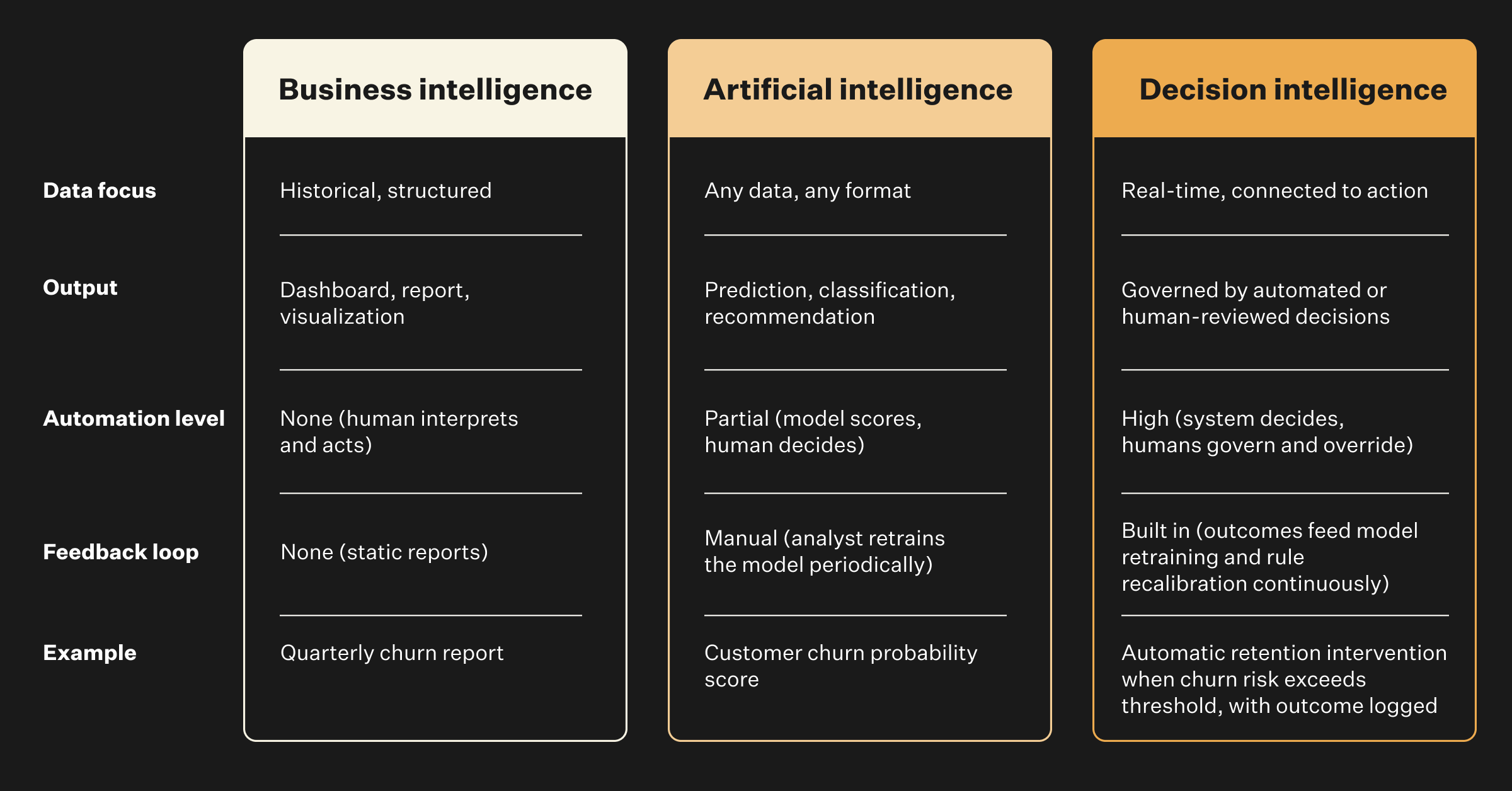
The maturity path from analytics and AI to decision intelligence maps directly to the Levels of AI Success. The Levels of AI Success is Dataiku's maturity framework for enterprise AI adoption.
Here is what each level looks like in practice:
Level 1 (Deliver):One team, one use case, one successful deployment, with project-level controls.
Level 2 (Reuse):Repeatable capability built on shared datasets, models, and agent tools that compound value across teams.
Level 3 (Scale):The platform becomes the enterprise standard, with agents in production, cross-organizational orchestration, and a unified governance framework.
Level 4 (Transcend):The Reasoning Enterprise, a human-agent operating model where AI runs operations rather than merely informing them, and systems improve continuously through use.
Most enterprises entering decision intelligence are operating at Level 1 or 2. The goal is to build toward Level 3 with architectural decisions that do not foreclose Level 4.
Decision intelligence platforms deliver measurable value across four dimensions: decision quality, cycle time, risk reduction, and analyst capacity.
The most durable of these is quality. Consistent policy application across teams and geographies, fewer wrong decisions at scale, and a system that gets more accurate over time because the feedback loop exists.
The four key benefits, in order of when they typically become measurable:
Faster cycle times: Decisions that take days in a siloed process compress to hours, or seconds for fully automated cases, because no manual handoffs separate each step.
Consistency at scale: The same logic applies to every instance of a recurring decision, regardless of which team, geography, or shift is executing it. This matters most in regulated environments where differential treatment creates compliance risk.
Lower costs and analyst capacity: Analysts spend less time gathering data, reconciling outputs, and moving decisions between systems, and more time on judgment-intensive work.
Accountability that satisfies regulators: Every automated decision is traceable to its data inputs, model version, rule set, and approver, with rollback capability built in.
According to "7 career-making AI decisions for CIOs in 2026," based on a Dataiku/Harris Poll survey, 74% of CIOs regret at least one major AI vendor or platform selection made in the past 18 months, a signal that disconnected point tools are not delivering the coordination enterprises need.
The accountability benefit also compounds over time. Every decision the system processes feeds the next cycle: model retraining, rules recalibration, and escalation pattern analysis. A static analytics model cannot do this. The ROI case for decision intelligence strengthens as the system matures, not just at launch.
Decision intelligence performs best in decisions that are recurring, high-frequency, high-stakes, and dependent on multiple data inputs. The three use cases below illustrate not just what gets automated, but what a platform-level capability adds that a single automated workflow cannot deliver.
The decision is whether to rebalance inventory across warehouses in response to a demand disruption signal, a choice that involves 12-week procurement lead times, supplier capacity constraints, minimum stock requirements, and logistics trade-offs that change daily.
What a single automation does: reorders inventory when a threshold is crossed.
What a decision intelligence platform adds:
Connects the demand signal, supplier risk model, logistics constraints, and escalation rules into one governed loop
Each decision cycle produces an outcome that feeds back into the next forecast.
Lead-time visibility improvements that directly reduce working capital requirements, because the system learns from every decision, not just every model run.
The decision is whether to approve, flag, or escalate a credit application, consistently across thousands of cases per day, with a traceable record of the exact model version and rule set that governed each one.
What a single automation does: scores one application.
What a decision intelligence platform adds:
Governs policy consistency across the entire portfolio, not just individual cases
Detects model output drift as macroeconomic conditions shift and retrains the model on updated data
Routes exceptions to the right underwriter with full decision context attached, and maintains the audit trail that turns a regulatory inquiry from months into days
The decision is how to sequence maintenance work orders when competing priorities: equipment health, parts availability, production targets, and crew schedules, all change simultaneously.
What a single automation does: flags equipment likely to fail based on a predictive maintenance model.
What a decision intelligence platform adds:
Connects sensor data, predictive maintenance outputs, parts availability, production schedule requirements, and crew capacity into a single governed recommendation
Balances cost, risk, and throughput simultaneously rather than optimizing one variable at a time
This is the domain where Dataiku, the Platform for AI Success, offers pre-built Reasoning Systems for Manufacturing Operations, connecting the four layers: data, model, agent, and decision,into one governed production system that domain experts can extend and own.
Implementation follows a maturity adoption path, not a linear project with a fixed end date. Decision intelligence systems are inherently iterative: they improve through use, not through a single deployment.
Thefour steps below define the progression. The continuous monitoring and retraining loop is not a fifth step. It is a permanent operating discipline that runs across all of them.
Identify the recurring decisions that are high-stakes, high-frequency, and currently bottlenecked by manual processing or institutional knowledge living in spreadsheets. Rank candidates by:
Time currently lost to manual handoffs and data retrieval.
Error rate and cost of a wrong or delayed decision.
Availability and quality of the data the decision depends on.
Start with one use case where you can demonstrate measurable ROI quickly and establish the governance pattern before scaling. Avoid starting with your most complex decision.
Decision intelligence requires the right data to reach the model at the time of the decision, not in a weekly batch. Map the data dependencies for your target decision and close the latency gaps.
This step surfaces hidden data quality issues before they reach production decisions, where the cost of a wrong input is measured in business outcomes, not model metrics. Building semantic models at this stage, so agents and models understand what data means in context rather than just where it sits, pays forward into every subsequent decision domain.
Build the decision model, connect the analytics and AI layer, configure the rules engine, and deploy to one team. Measure decision outcomes: not just model accuracy, but the downstream business metric the decision is supposed to move.
A successful pilot creates the organizational proof point that domain leaders in other functions need before committing. Change management and executive sponsorship from the CDAO, in partnership with the Chief Risk Officer, VP of Supply Chain, or VP of Manufacturing Operations, determine whether the platform gets adopted or stalls at the pilot stage.
Governance is not a final step. It is the layer you establish during the pilot that makes scaling safe. The tooling checklist should cover:
Lineage at the data level.
Approval workflows for rule changes.
Confidence thresholds for automated actions.
Monitoring dashboards and scheduled model retraining.
Integration points into systems of record.
Continuous monitoring and retraining loop: a decision intelligence system is not deployed and done. Every decision outcome feeds back into the system: model retraining when performance drifts, rules recalibration when business conditions shift, and escalation pattern analysis to catch edge cases before they become material problems. Treat it as ongoing operational discipline, not a periodic maintenance task.
Dataiku's Reasoning Systems are the production-grade implementation of this architecture. Four layers — data, models, agent, and decision — connect enterprise data, analytics and AI models, agent outputs, and business decision logic into one governed system with feedback loops built in. Manufacturing Operations is available now, with Supply Chain and Financial Risk following in 2026.
You can explore how Dataiku, the Platform for AI Success,connects these layers into a governed, enterprise-wide system.
Most enterprise AI initiatives stall not because the technology fails, but because the organizational conditions for scaling were never built. A successful decision intelligence pilot is only half the work. The other half is making it repeatable.
The organizations that scale decision intelligence successfully treat it as an operating model, not a project. They embed governance before they scale, not after. They measure decision quality, not just model performance. And they build the feedback loop into the architecture from day one, so the system gets better with every cycle rather than degrading quietly.
Start with one high-value decision, run a time-boxed pilot with clear KPIs, and scale from results rather than ambition. The infrastructure you build for the first decision becomes the foundation for every decision that follows.
Move from reactive analytics to governed decision intelligence with Dataiku
Move from reactive analytics to governed decision intelligence with Dataiku
See how Dataiku drives operational efficiency in enterprises
No. An AI platform helps teams build, deploy, and monitor models or agents. A decision intelligence platform connects those outputs to decision models, business rules, workflows, governance, and feedback loops so the business can act on them consistently. The AI platform provides the signal; the decision intelligence platform governs what happens next.
A narrow pilot can begin in eight to 12 weeks if the decision owner, data sources, success metric, and governance requirements are clearly defined. A first production deployment typically takes longer because security review, workflow integration, and monitoring must be in place before decisions run autonomously.
The core team should include a domain owner, a data engineer, an ML or AI practitioner, a risk or governance lead, and an operations owner who understands the workflow. Business skills matter as much as technical skills: process mapping, policy definition, KPI measurement, and change management determine whether the platform is adopted.
Yes. BI dashboards remain the visibility layer while the decision intelligence platform connects model outputs, rules, and actions. BI surfaces the signal; decision intelligence governs what happens next. The two layers are designed to coexist, not replace each other.
They should apply the same controls expected of enterprise data and AI systems: role-based access, lineage, approval workflows, audit logs, model monitoring, and policy enforcement. For regulated decisions, the platform should also preserve the data, model, rule, and human review history behind each outcome.
Tags