Process mining as a starting point for operational improvement
October 21, 2026/5 min read/Marie Merveilleux du Vignaux
Enterprise processes rarely fail in obvious ways. More often, they slow down for one region, one product line, or one type of customer, and the delay disappears inside the averages. Without process mining, problems usually surface only once they are big enough to show up in a KPI. Or, teams focus on individual performance and miss the process issue underneath.
Process mining makes organizations more proactive, more granular, and able to implement impactful changes to processes. Teams get a clearer view of how work actually happens across systems, teams, and regions, rather than how it was designed to happen. With it, teams can catch small delays before they grow, look at performance segment by segment, and fix the process itself instead of focusing on individuals. In an environment shaped by operational complexity, that visibility is essential.
Process mining is more than workflow visualization. It’s a practical way to understand where processes diverge, where inefficiencies build up, and where a fix will have a measurable impact. The goal is not just to observe operations more clearly. It’s to make better decisions and improve how work gets orchestrated over time. Let’s demonstrate this using the Dataiku Process Mining Business Application as an example.
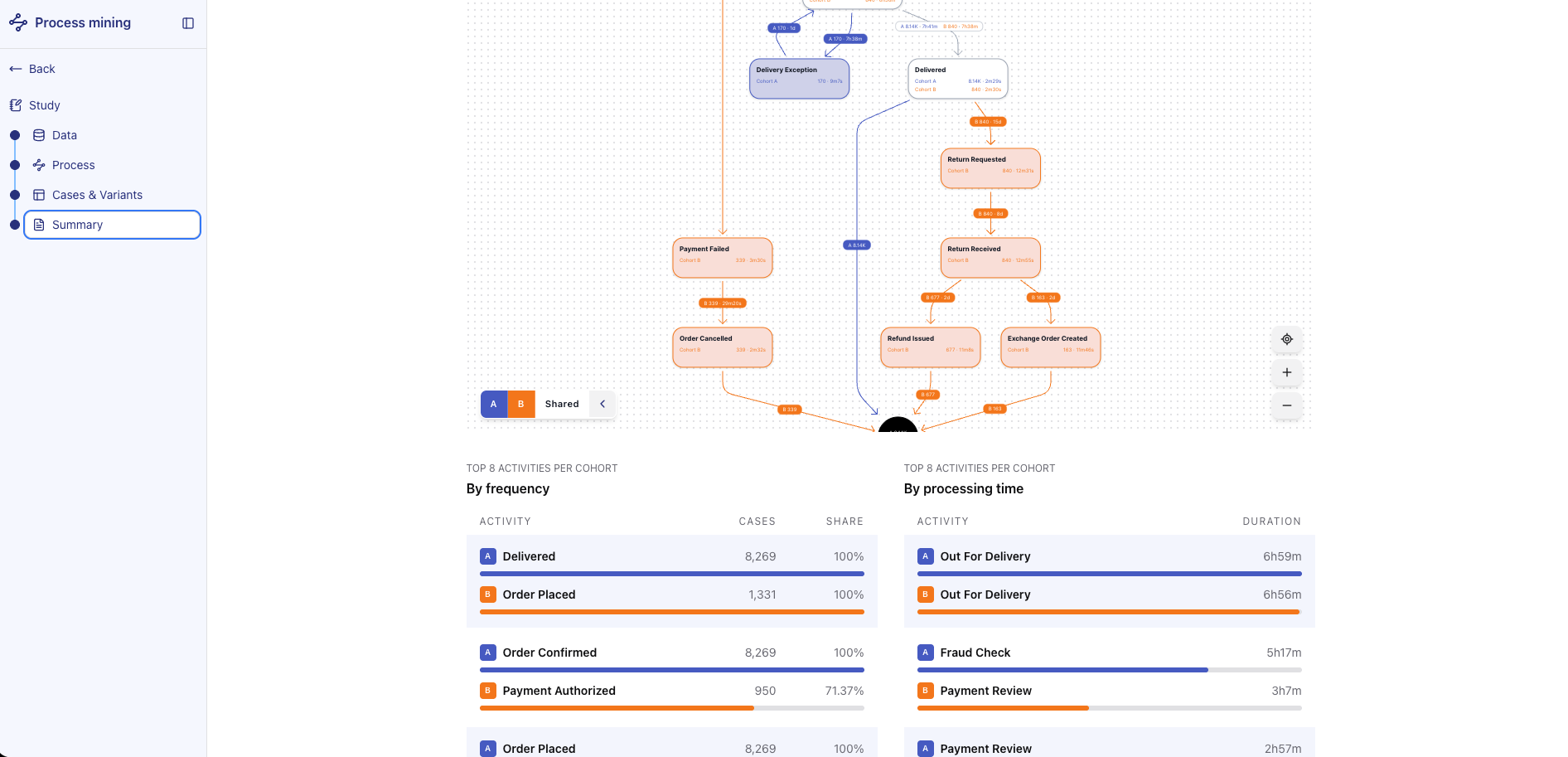
The first value of process mining is visibility. Bottlenecks, variants, and conformance gaps become easy to spot.
What teams really need from there is detailed understanding: whether delays are isolated or systemic, whether they hit one segment harder than another, and whether they point to a design problem.
In practice, that means asking questions like these:
Do cycle times vary meaningfully by region, product line, or customer segment?
Which paths cause the most delay, and where do deviations cluster?
Which workflows are stable, and which are becoming harder to manage?
Are exceptions normal variation, or signs of a design problem?
Where would intervention have the clearest impact?
Answering them means comparing one part of a process against another.
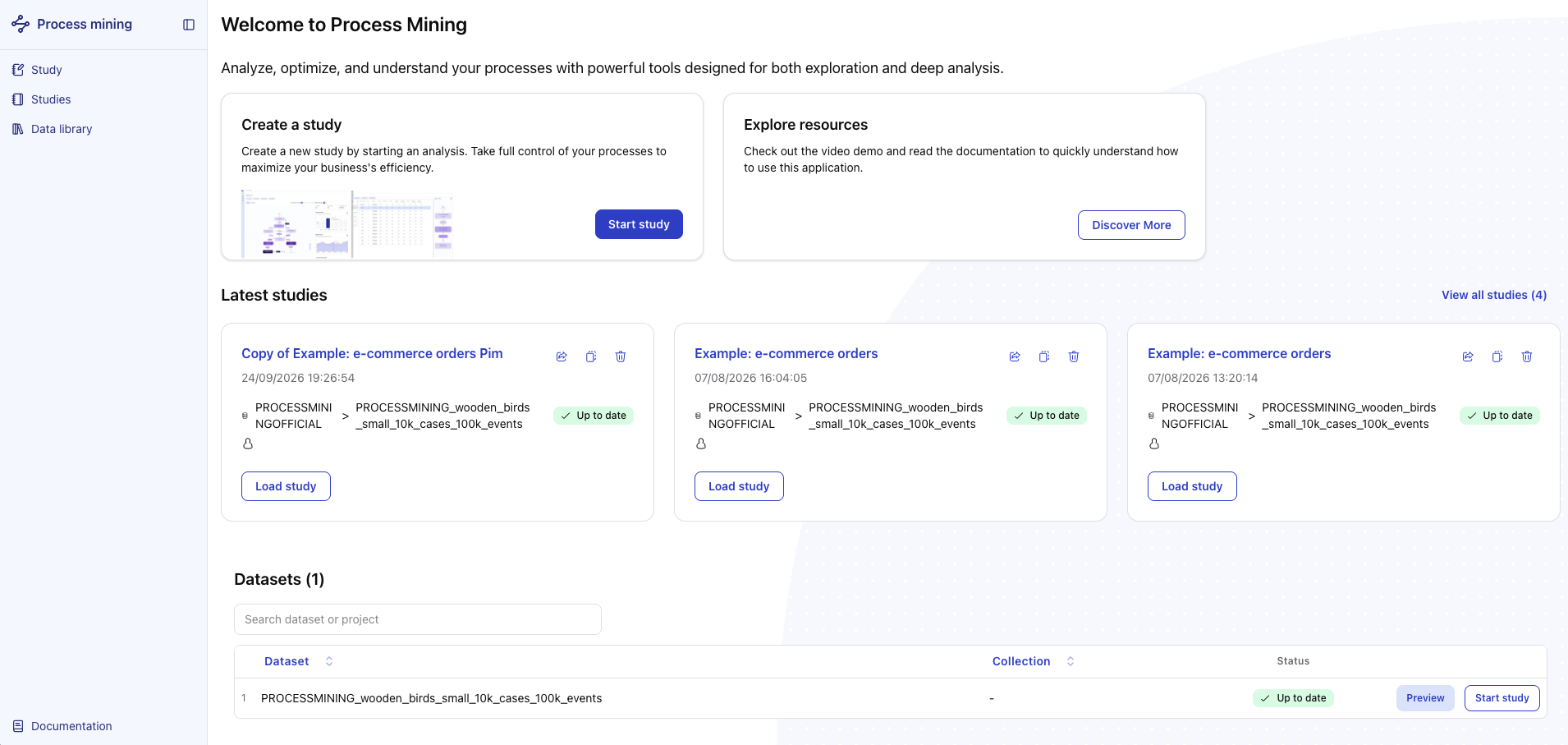
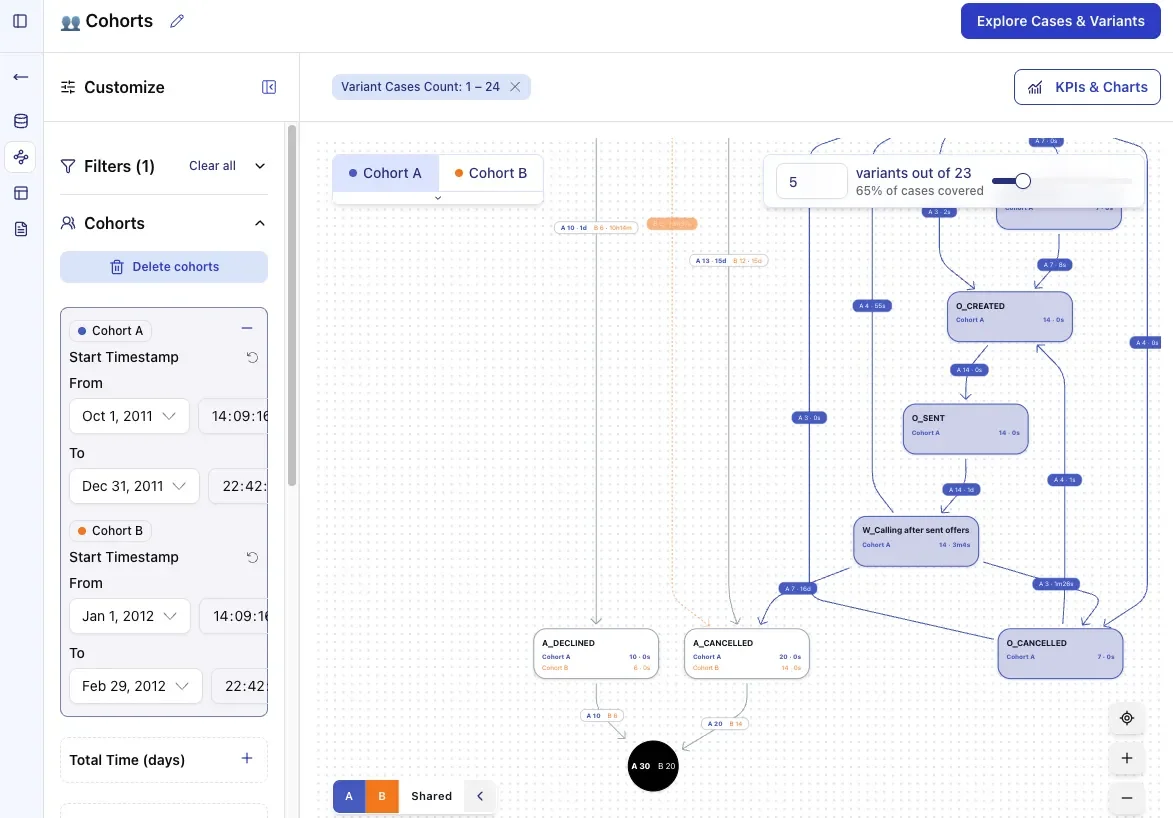
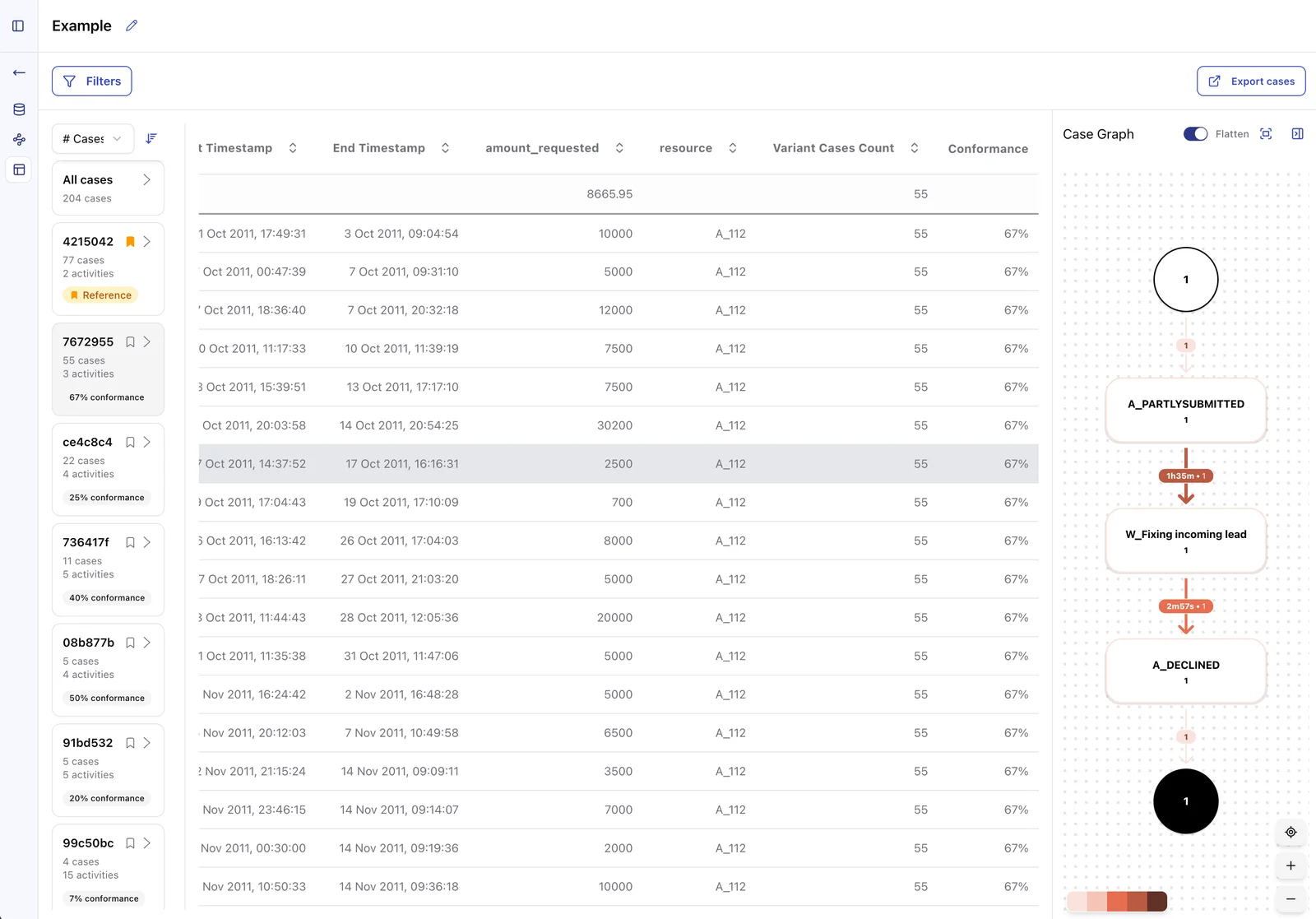
In the Dataiku Process Mining Business Application, teams define process subsets with filters, for example by region, business unit, or customer type, and compare performance, cycle times, and path deviations across them. This matters because a workflow can look healthy in aggregate while performing poorly for a specific geography, business unit, product category, or customer type. Subsets can be saved as reference processes, making it easy for users to compare conformance against them.
The market is moving in a clear direction. Process mining is increasingly tied to a larger operational story. Organizations are not looking for isolated process insight for its own sake. They want a better way to connect operational understanding to better decisions, better orchestration, and, where it makes sense, automation and AI.
Process mining grounds those decisions in evidence instead of assumption, and it gives teams a shared view of how work flows.
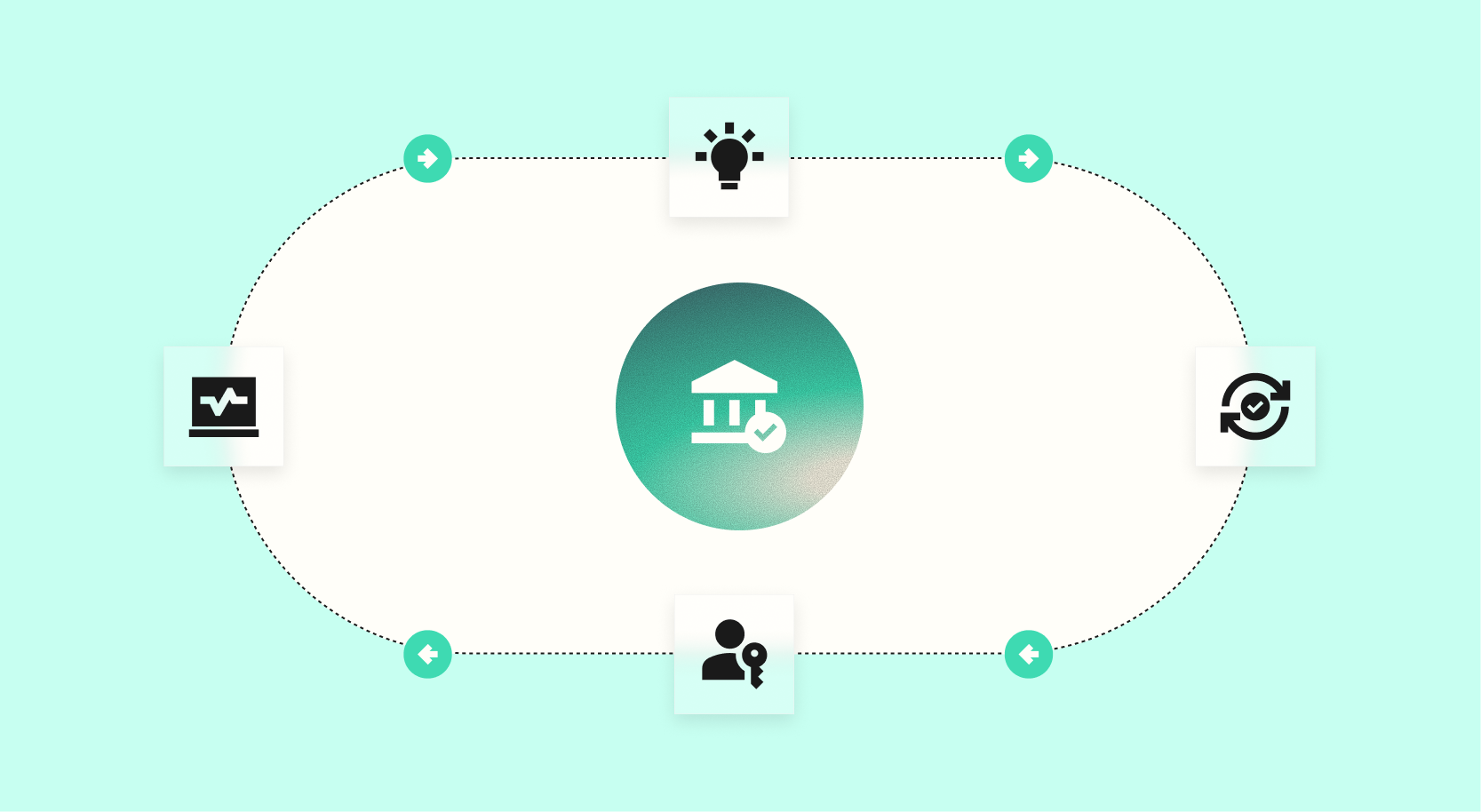
This aligns with a broader shift many enterprises are navigating right now: moving from fragmented experimentation to coordinated improvement. This is fundamentally an orchestration challenge: better outcomes depend not only on insight, but on the ability to connect people, decisions, workflows, and technologies at enterprise scale.
Process mining and Process Flows address that orchestration challenge from two sides. Process Flows is about orchestrated agentic process automation: helping organizations transform their processes so that agents and people work together across systems.
Process mining tells them where to start. The same segment-level view that shows a workflow underperforming in one region or for one customer type also shows which parts of the process are worth transforming first. In that sense, process mining turns visibility into a reason to act: it feeds the need for process transformation.
The relationship also runs the other way. As a process is transformed with agents over time, teams can keep comparing performance across regions, product lines, and customer segments to see whether things improved, where, and what to improve next. Process mining points to where change is needed, Process Flows helps carry it out, and each round of analysis sets up the next round of improvement.
Process Flows are part of a forward-looking vision for more adaptive operations. Not just processes that are documented more clearly, but processes that can be understood more dynamically, improved more deliberately, and connected more effectively to the systems and intelligence around them.
Most organizations are just starting on that journey as the direction is becoming clearer. For enterprise operations to be more orchestrated and more adaptive, a deep, data-based understanding of today’s processes is the necessary first step.
Enterprises are managing more systems, more handoffs, more local variation, and more pressure to improve efficiency without losing control. That raises the bar for process mining. Organizations need ways to compare process behavior across meaningful business segments, investigate deviations with more context, and connect what they learn to the way their processes are transformed, increasingly with agents and people working together across systems.
The Dataiku Process Mining Business Application makes it easier to compare process performance, cycle times, and path deviations across custom business segments, pushing process mining in a more practical, decision-oriented direction.
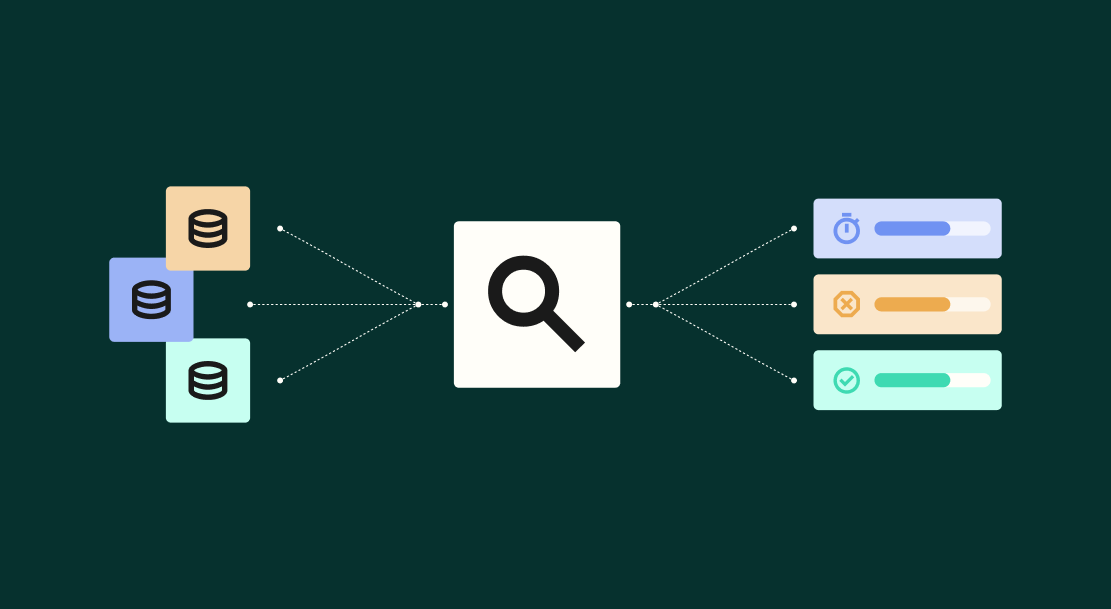
Because the application runs inside the Dataiku platform, process mining doesn’t require a separate tool. Large, messy event logs pulled from systems such as SAP or Salesforce can be prepared in Dataiku, with help from Cobuild, and fed into process mining through automated, live data pipelines. Teams collaborate in one place, and the results can feed agents and downstream analytics.
The issues that cost the most rarely show up in the averages. Process mining brings them to the surface, segment by segment, and gives teams the evidence to decide what to change. Once the change is made, it shows whether it worked and what to improve next. That is what makes process mining a starting point for operational improvement.