Agentic system archetypes for core manufacturing operations
September 10, 2026/4 min read/Henry Ekwaro-Osire
Implementing agentic reasoning in industrial environments presents a complex choice for data leaders. The technology promises to streamline operations, yet identifying a viable starting point remains a challenge. If a team picks a trivial task, the project fails to show meaningful return on investment. If they target real-time control loops or edge telemetry without the proper infrastructure, they risk operational disruption and safety issues.
To generate material value while managing technical and operational risks, data teams should avoid treating manufacturing as a uniform landscape. Instead, the path forward involves evaluating specific functional domains based on data readiness and organizational priorities. Success relies on deploying these systems where data can be successfully contextualized across aftermarket service logs, product design repositories, and multi-system root cause investigations.

Industrial operations operate across a spectrum of systems that create a paradox for data contextualization. At the production line, SCADA and automation systems generate a high volume of data but offer little business context.
Aggregating this information into an MES provides operational context, yet often strips away granular data. At the top layer, an ERP contains business context and cost metrics but lacks the real-time data required to change shop-floor outcomes. Consequently, ERP systems typically report on what happened rather than helping teams act on what is currently happening.
When a process shift or asset anomaly occurs, engineers face a fragmented landscape. Resolving a single issue often requires manually cross-referencing machine flags, supplier manifests, material lot logs, LIMS quality records, and CMMS histories.
Because these systems use incompatible formats, identifying a root cause can require days of searching through technical PDFs and service records . Data teams frequently build custom pipelines for isolated production lines, which can lead to maintenance overhead rather than scalable operational visibility.
"The manufacturing data paradox is clear: SCADA gives you raw data without context, while ERP gives you context without the data to act. Finding the root cause means manually bridging this chasm."
For many enterprise data teams, the main hurdle is determining where to apply agentic reasoning effectively. The transition from traditional analytics to agentic AI can feel sudden, but it connects directly to this data contextualization paradox.
Because the gap between SCADA, MES, and ERP data is currently bridged by humans manually cross-referencing files, this labor-intensive synthesis is the natural entry point for agentic systems.
Rather than trying to use agents for real-time physical control — which introduces severe latency challenges and carries a low tolerance for error — teams can position agents to resolve this context gap. By focusing agentic workflows on navigating these mismatched data layers, organizations can find use cases that are technically feasible, operationally safe, and highly valuable.
Based on our recent customer discussions and industry observations, we suggest manufacturers focus agentic initiatives on data synthesis rather than machine control. Agentic systems generally show strength in navigating unstructured text, mapping complex rules, and conducting cross-system investigations.
However, enabling an agent to bridge the gap between SCADA, MES, and ERP data requires a solid foundation of semantic models. A semantic layer gives the agent a map of how a raw sensor tag relates to a specific product batch or supplier record.
By focusing on areas where data is already accessible and using semantic maps to assist human operators, organizations can deploy practical AI applications that provide reliable insights without compromising physical infrastructure.
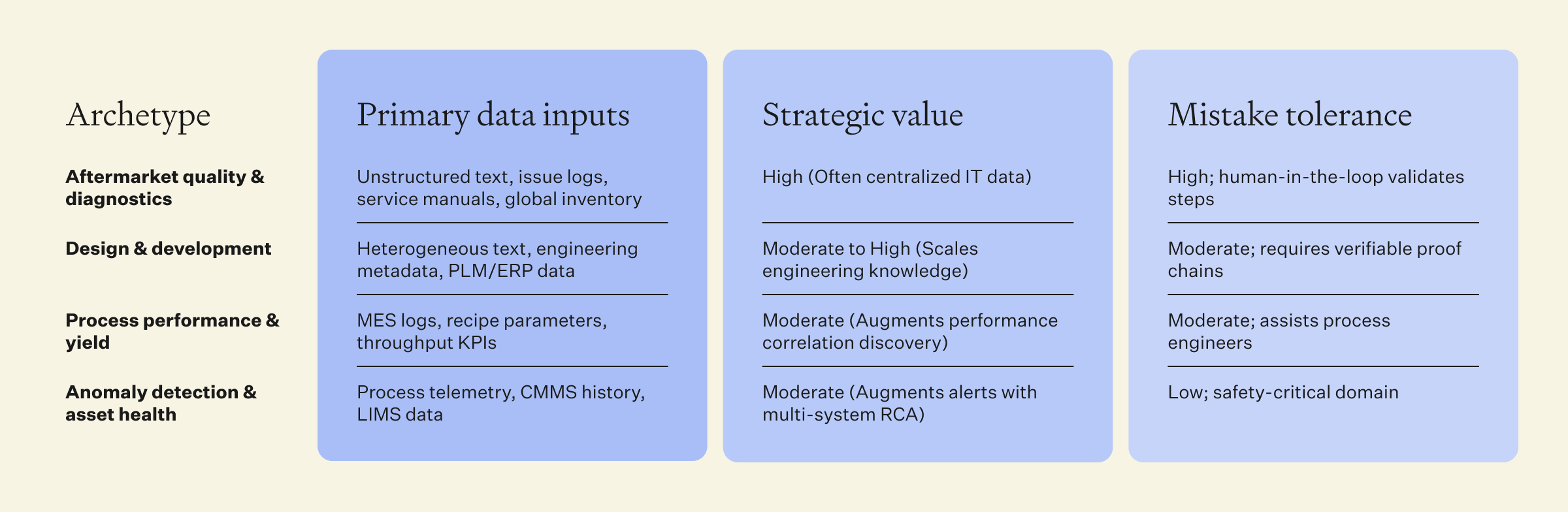
Instead of looking for a single, overarching manufacturing AI project, data leaders can evaluate distinct functional archetypes as candidates for early deployment. The right choice depends on company priorities, existing data availability, and specific business models.
*Click on the image to see the full PDF
For organizations where customer support and warranty costs are a priority, aftermarket data is a viable option . Because records like technician notes and repair histories usually live in centralized IT systems, they avoid factory-floor connectivity bottlenecks . Agents can parse these text fields to match field failure signatures with historical trends, reducing warranty cycles and unneeded service trips .
If accelerating product lifecycles is the main goal, the design domain offers a clear path . Using semantic models, agents can map engineering processes and connect dark data within PLM frameworks . This helps teams learn from past experiments and historical testing records while providing clear proof chains to satisfy safety regulations .
When focusing directly on production lines or asset reliability, teams can choose to complement existing automation systems rather than replace them.
When an alert occurs in an existing monitoring system (e.g. SCADA flagging crossed temperature threshold or MES alerting for excessive batch duration), an agent backed by a semantic model can automatically cross-reference historical data streams like supplier manifests or LIMS logs. This provides process engineers with a diagnostic summary, turning a basic alert into an actionable investigation.
A global industrial equipment manufacturer is working with Dataiku to deploy an agentic reasoning system for aftermarket field service. Built on a foundation of data harmonization and contextualization, the platform unifies unstructured service logs, repair histories, technical manuals, and inventory records.
An AI agent cross-references incoming defects with historical patterns to suggest root causes, enabling field engineers to query complex operational data via natural language while keeping a human-in-the-loop. In addition to accelerating time-to-resolution — historically taking 100+ days — by over 50%, the system enables better repair prioritization and directly improves customer satisfaction.
This translates to measurable bottom-line value: driving down overall warranty expenses, lowering field service operating costs through higher First-Time Fix Rates, and protecting recurring contract revenue
Successfully adopting agentic reasoning in manufacturing involves balancing the desire for operational impact with technical readiness. Rather than searching for a universal AI application, data leaders can find success by aligning projects with their current data architecture and operational tolerances. Assessing your pipeline to choose between aftermarket analysis, design optimization, or multi-system root cause investigations helps ensure that early deployments deliver measurable results.
Start with a business problem that requires employees to gather and interpret information across multiple systems. Then evaluate whether the necessary data is accessible, whether the agent’s findings can be verified, and where human review should remain mandatory.
Dataiku supports this process by providing a governed platform where teams can integrate unstructured IT data with operational telemetry and semantic models, allowing organizations to scale agentic applications effectively as their requirements evolve.
Discover reasoning systems at work in manufacturing
Watch the webinar: "Reasoning systems: Closing the asset performance gap"