Understanding AI agents & agentic workflows
12 min read/Catie Grasso

As generative AI continues to transform industries, AI agents are moving from niche experiments to practical, scalable tools shaping modern workflows. With AI agents stepping in to handle everything from repetitive, routine tasks or code development to reinventing advanced business processes, these systems are becoming increasingly integral to enterprise operations and innovation. Yet, behind the scenes lies a sophisticated interplay of components and workflows that can be challenging to grasp.
In this article, we'll cut through the complexity to explore:
The fundamentals of AI agents and some common use cases.
The building blocks of agentic workflows and systems.
The landscape of agent-builder tooling — and how platforms like Dataiku are bridging the gap between AI aspirations and real-world applications.
At their core, AI agents are large language model (LLM)-powered systems designed to achieve objectives across multiple steps, leveraging tools autonomously as needed — that is, without requiring user prompts for every action. This ability to independently and dynamically navigate diverse and complex series of tasks makes AI agents distinct from deterministic, single-task systems.
Expanding on this, AI agents are capable of making decisions and taking actions within set boundaries. They interact with their environment — whether through APIs, databases, or other tools — and adapt to shifting inputs or goals, in order to perform tasks that range from routine automation to complex problem-solving.
These systems excel in handling open-ended tasks within dynamic environments — particularly when directives are provided in natural language, as is the case with conversational applications like virtual assistants or in-app helpers. With limited or no human supervision, AI agents can orchestrate actions, manage workflows, and access external resources to accomplish their goals.
Agentic AI represents a specialized subdomain of AI, similar to how computer vision focuses on the use of AI technologies for image analysis. Applications such as agent AI assistants are a byproduct of agentic AI, which encompasses the broader frameworks and techniques that enable such systems to function. This field is central to creating systems that display higher-order behaviors resembling human agency.
Agents in AI can be broadly categorized into two primary modalities, each tailored to distinct operational needs and user experiences:
Back-end AI agents operate behind the scenes without direct user interaction, focusing on process automation, decision-making, and optimization tasks. These "headless" systems are often embedded within enterprise workflows, handling complex processes with minimal human intervention.
Exposed to end users, these agents offer a conversational or interactive interface, providing hands-on assistance and streamlining everyday tasks. These agentive AI systems are responsive and tailored for human usability and experience.
Organizations can build both single-agent and multi-agent systems. While both approaches have their strengths, understanding the distinction can help clarify how AI agents are applied to solve real-world problems, as well as which agent frameworks might be appropriate for your use case.
A single-agent system is designed to handle specific tasks autonomously within a constrained scope. These agents operate independently and are suited for tasks requiring limited decision making.
In multi-agent systems, several specialized agents work together to solve complex problems. Each agent performs a distinct function, contributing to a shared goal. These agents may act in sequence or in parallel, depending on what the situation calls for.
What is an AI agent, then, when even single-agent frameworks can leverage multiple agents by integrating them as tools? This flexibility means the difference between single and multi-agent systems often lies in how the system is developed, rather than its inherent capabilities.
Although AI agents are the tangible outputs of the systems we've been describing, they are supported by components and workflows that are part of the broader agent AI field. Agent AI is the set of technologies and capabilities that enables autonomous systems that excel in adaptive decision making, task execution, and long-term goal management. Next, let's walk through some of the core components and technical methods used inside a typical agentic workflow.
A defining feature of an intelligent agent in AI is its ability to choose and then effectively use tools to accomplish tasks. In the context of generative AI, tools are functions or systems that enable agents to execute tasks, solve problems, or automate processes. These tools interact with internal data systems like databases and data lakes, enterprise software such as CRM or ERP systems, APIs for external data, and even other agents. What makes tools so versatile is their schema — a standardized description that outlines what the tool does, when to use it, and how to interact with it. This schema enables autonomous AI agents to operate in a non-directed way, while integrating with a wide range of technologies.
The real underlying challenge for AI agents lies in how they make decisions. While an agent’s capabilities are undeniably tied to the range and quality of the tools available, its effectiveness hinges on how well it selects and uses the right tool for the job.
Building a high-performing agent today still requires a significant amount of business rules and flow management to guide its decision-making processes and ensure it consistently chooses the correct tool at the right moment. This highlights the importance of robust design and thoughtful configuration to bridge current limitations in autonomous reasoning.
An AI agent begins by interpreting user input or environmental signals, proceeds to logical reasoning or decision-making, and executes actions using its tools. The process then generates feedback which the agent can use to refine its subsequent actions.
This dynamic flow enables agents to handle complex, multi-step tasks and supports interactive or adaptive workflows.
Developers rely on specialized frameworks to implement and scale agent systems. Popular open-source Python frameworks like LangGraph, LlamaIndex, AutoGen, and CrewAI offer tools for building single or multi-agent systems, supporting diverse execution logic, human-in-the-loop features, and compatibility with multiple APIs and LLMs. These frameworks enable developers to model agents’ actions as sequential or collaborative processes, ensuring flexibility and scalability in real-world applications.
Beyond tool integration as discussed above, agentic AI may require other specialized elements to manage the dynamic and collaborative workflows of AI agents. Because of agents’ adaptive execution flow, agentic architectures often require more flexible pipelines than traditional LLM-powered applications. Execution flow in agentic systems must be dynamic, supporting non-linear paths such as loops, branching logic, and multi-agent interactions. This can necessitate more advanced orchestration tools or specialized middleware.
Furthermore, agentic systems often involve higher-order autonomy, where agents manage goals or environments that evolve over time. This can require persistent memory architectures or access to stateful environments, which may not always be essential for simpler LLM-based applications.
Finally, for multi-agent systems, the architecture must also accommodate interactions between agents, such as message passing, task delegation, and collaborative decision-making. To ensure smooth operation at scale, this may require additional layers for communication protocols or shared memory systems that synchronize tasks effectively while preventing conflicts.


With the rising prominence of AI agents, enterprises have an abundance of tools to choose from, each catering to different needs and levels of expertise. This section explores the landscape of agent-builder tooling, from DIY open-source frameworks to integrated platforms.
Open source frameworks like LangChain, LlamaIndex, and AutoGen have emerged as popular choices for building AI agents. These frameworks provide modular, customizable components that developers can use to construct sophisticated agentic systems. While powerful and flexible, they often require significant technical expertise and development effort to implement effectively at enterprise scale.
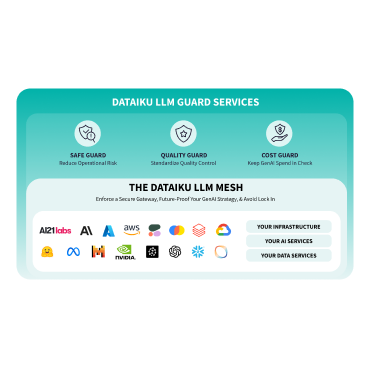
Enterprise AI platforms like Dataiku offer a more accessible path to building and deploying AI agents. By abstracting away much of the underlying complexity, these platforms allow a broader range of users — from data scientists to business analysts — to participate in agent development. With the Dataiku LLM Mesh, teams can access, evaluate, and orchestrate LLMs from any provider within a single, governed environment.
When selecting agent-builder tooling for enterprise use, organizations should consider governance and compliance requirements, scalability needs, integration with existing data infrastructure, security controls, and the ability to monitor and audit agent behavior in production.
Tags