How enterprise analytics platforms are evolving in the AI agent era
June 11, 2026/9 min read/Team Dataiku
The enterprise analytics platforms of 2023 were dashboard factories. The ones built for 2026 are decision engines where AI agents, machine learning (ML) models, and business rules operate alongside traditional reporting. But many enterprises still cannot route model outputs into decisions, approvals, and operational systems because their platform was built for historical reporting.
According to "7 career-making AI decisions for CIOs in 2026," based on a Dataiku/Harris Poll survey, 74% of data leaders say their organizations struggle to move AI from experimentation into production at scale. The gap is rarely a data problem. More often, it is a platform problem.
This guide covers the forces driving that evolution, what modern platforms look like, and how to evaluate your options.
Enterprise analytics platforms have evolved beyond business intelligence (BI) into AI-driven decision workflows across four distinct capability stages.
Platform selection now determines AI return on investment (ROI). The wrong architecture limits what teams can deploy and govern.
Governance, deployment flexibility, and AI readiness are the three differentiators that separate platforms built for dashboards from those built for decisions.
A six-point evaluation checklist covers the criteria that separate platforms built for governed decision workflows from those built mainly for reporting.
An enterprise analytics platform is the governed foundation enterprises use to collect, store, process, analyze, and visualize business data across teams. It connects data ingestion, storage, ETL/ELT processing, governance controls, semantic definitions, dashboards, and advanced analytics in one scalable environment, so teams work from a shared source of truth instead of separate departmental tools.
Traditional BI tools mainly visualize prepared data. An enterprise analytics platform also manages the data, governance, and model workflows that feed those visualizations and downstream decisions.
An enterprise analytics platform operates across the entire chain. Your data team accesses and transforms raw data inside the same environment where data scientists build models and business teams consume model recommendations. Governance, access controls, lineage, and explainability run throughout, not just at the edges.
That means the platform your organization chooses today does more than determine which charts you can produce. It determines whether your analytics and model projects can move from pilots to production.
Enterprise analytics has not always worked the way it does today. Understanding how the category evolved explains why so many organizations are still running on platforms built for a different era, and why decisions keep lagging behind the data that should drive them.
The first generation centered on reporting. IT teams built dashboards from structured data warehouse queries. Outputs were static, backward-looking, and required developer or IT support to modify. Business leaders could see what happened last quarter, not why, not what came next, and not what to do about it.
Self-service BI shifted report creation to business users. Drag-and-drop interfaces reduced IT dependency and let analysts produce more dashboards faster. The underlying limitation stayed intact: The data was still descriptive, the output was still a chart, and the analyst still made every judgment call manually.
Data science teams began embedding ML models into analytics workflows. Platforms added model training environments, feature engineering tools, and experiment tracking. This introduced prediction capabilities: demand forecasting, churn risk scoring, fraud detection, and supply chain optimization. But it created a structural problem in the process. The model lived in one tool, the business decision lived in another, and the handoff between them was manual and slow.
Stage 4 platforms address that handoff. Models are embedded directly in business workflows. Approved decisions run in real time or near-real time. Governance is built into the deployment architecture, not layered on afterward. The analytics platform stops being a reporting environment and becomes the operational decision layer.
Dataiku, the Platform for AI Success, addresses Stage 4 requirements with capabilities available today and a full Cobuild experience launching in June 2026. Cobuild lets teams describe a business objective in plain language and generates a complete, governed AI workflow, covering data pipelines, ML models, agents, and web apps, without rebuilding infrastructure from scratch. The output is a visual, inspectable Flow; users review each step and approve before anything deploys.
Three forces are pushing enterprises toward Stage 4: lower cloud infrastructure costs, fast-growing data volumes, and enterprise-grade large language models (LLMs) that can work inside governed workflows.
Consider a retailer using AI-assisted demand sensing to detect a regional supply disruption and reallocate inventory within hours instead of waiting for the next planning cycle. Organizations that invest in Stage 3 and Stage 4 platforms today can compound their analytics advantage through 2027 and beyond.
This shift makes platform selection a business decision, not just a tooling decision. Knowing the evolution sets the context for what Stage 4 platforms do differently, and what to look for when evaluating whether a platform supports governed decision workflows.
Modern enterprise analytics platforms combine eight capabilities: data connectors, ETL/ELT processing, cloud deployment flexibility, a semantic layer, real-time dashboards, ML and AI modules, embedded governance, and API integrations. Not every platform delivers all eight natively, and those gaps determine whether your analytics program can reach Stage 4.
1. Data connectors: Connect cloud data warehouses, operational databases, data lakes, and streaming feeds; reduce reconciliation time by bringing all sources into a single governed environment
2. ETL/ELT processing: Prepares and transforms data in governed workflows; improves data quality before analysis reaches any model or dashboard
3. Cloud storage and deployment flexibility: Runs on AWS, Azure, Google Cloud, on-premises, or in hybrid configurations; avoids data migration and shadow systems by connecting to data wherever it lives
4. Semantic layer: Standardizes business metrics across teams; enables self-service access with consistent definitions so that different teams report the same number from the same underlying data
5. Real-time dashboards: Monitor live operational signals; shorten decision cycles by surfacing the data leaders need in near-real time rather than in the next reporting cycle
6. ML and AI modules: Support ML, GenAI, and agents in one governed flow; move analytics from prediction to action within a single platform, without separate tools for each capability
7. Governance and security: Applies role-based access, lineage, model risk scoring, and approvals; reduces compliance risk at every stage of the analytics lifecycle
8. APIs and workflow integration: Connects outputs to operational systems; turns insights into approved actions rather than letting recommendations sit in a dashboard
Those capability differences translate directly into measurable operational outcomes, not just product features.
The shift from Stage 3 to Stage 4 is not primarily a technology upgrade but a business operations upgrade. The benefits below are what that shift makes possible when a platform is selected and implemented well.
Faster decisions: When models are embedded in workflows and outputs flow directly into operational systems, decisions that took days now take hours. Teams stop routing recommendations through email threads and manual sign-off chains.
Productivity gains: A platform that supports visual development and guided workflow creation expands who can build and maintain analytics workflows. Finance analysts, operations leaders, and supply chain teams can modify AI workflows without waiting on a data science backlog.
Consistent governance and compliance at scale: When governance is embedded at every stage, from data access to model deployment, your organization avoids the audit risk that comes from shadow analytics and undocumented decision logic.
Improved customer experience: When analytics workflows connect customer signals to recommended actions, teams can respond to churn risk, service delays, or demand changes before they become account-level problems.
Compounding ROI: Each workflow built on a governed platform becomes a reusable asset. Teams inherit models, features, and data pipelines rather than rebuilding from scratch for every new use case. The value compounds as the program scales.
Mitsubishi Electric, running Dataiku as its analytics and AI platform, reported a 60% acceleration in analytics delivery after connecting data preparation, ML models, and governance in one platform rather than managing them separately across point tools.
"By linking the data stored in Snowflake with Dataiku, we are creating a system that allows a wide range of people at our company to analyze the data."
Susumu Koseki, DX Innovation Center, Mitsubishi Electric
Selecting the right enterprise analytics platform does not guarantee a successful deployment. Based on deployment patterns across Dataiku's global customer base, these are the implementation challenges that appear most consistently.
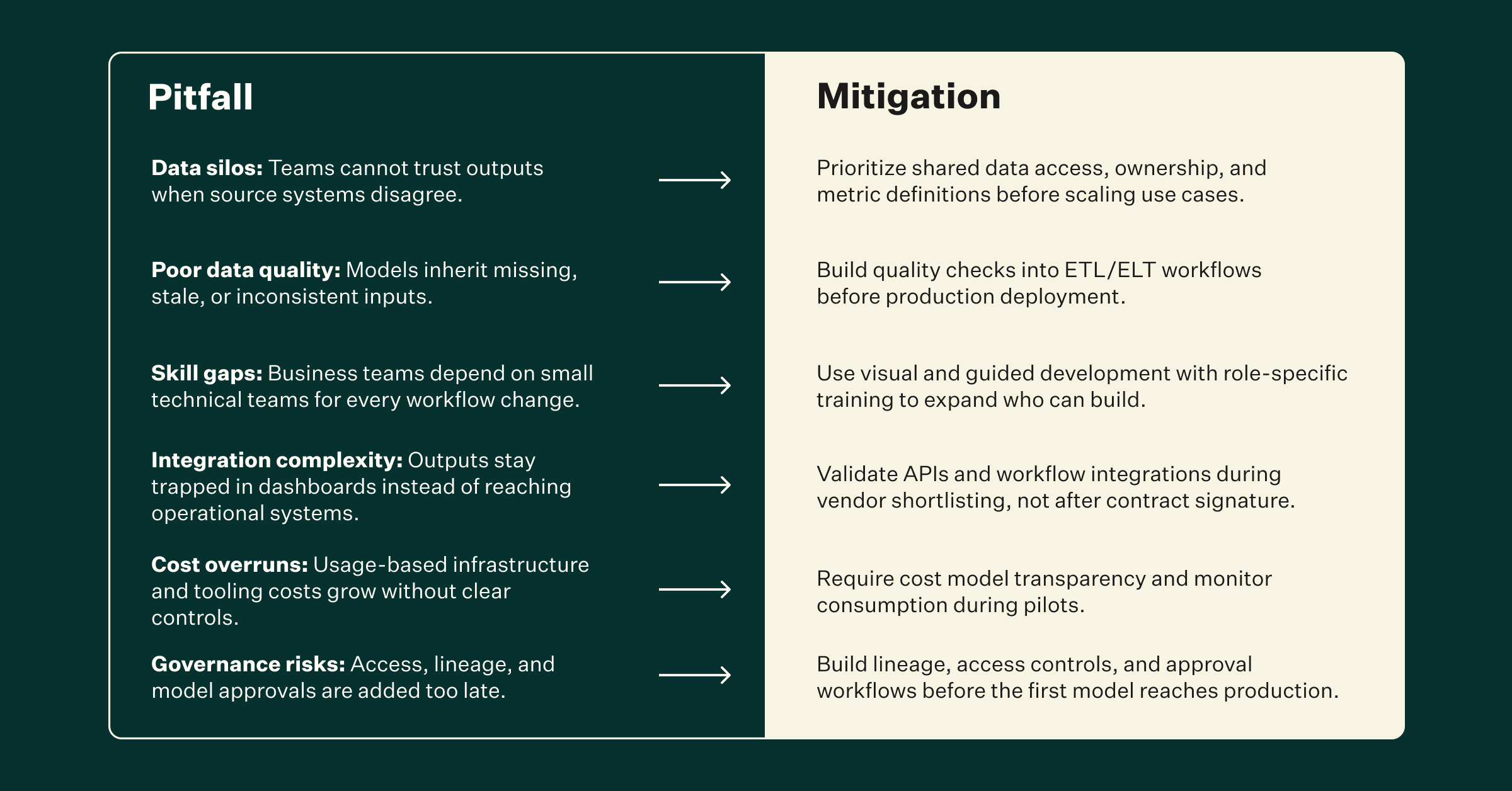
Avoiding those pitfalls requires evaluating platforms against criteria that go beyond feature lists. The six-point checklist below makes those criteria explicit.
When you evaluate enterprise analytics platforms, the following six criteria separate platforms built for governed decision workflows from platforms built mainly for reporting. Use this list when shortlisting vendors.
1. Scalability for future data volumes: Can the platform handle expected growth in users, sources, and data volume without rebuilding pipelines? Ask vendors to demonstrate performance with data volumes two to three times your current scale.
2. AI readiness and native ML capabilities: Does the platform support analytics, ML, GenAI, and agents in a single governed flow, or only classical reporting? This is the criterion that separates Stage 3 platforms from Stage 4 ones. Dataiku supports all four capability types within one governed environment. Its AI-assisted building capabilities are available today, with the full Cobuild experience (launching in June 2026), which lets teams describe workflow changes in plain language and generate implementation steps for review under the same governance controls.
3. Data governance and compliance features: Are access controls, data lineage, and model explainability native to the platform, rather than add-ons configured after deployment? Both the NIST AI Risk Management Framework and ISO/IEC 42001:2023 treat AI governance as a lifecycle discipline, not a post-deployment audit activity. Your platform should reflect that.
4. Integration ease with your existing tech stack: Can the platform run on-premises, on any major cloud, or in hybrid configurations without requiring data migration or shadow systems? Dataiku is purpose-built for enterprises, replacing desktop and legacy analytics tools such as Alteryx, SAS, SPSS, and Excel with governed, platform-based workflows on the customer's own infrastructure. No rearchitecting, no data migration.
5. Cost model transparency: Can the vendor explain licensing, compute, storage, and scaling costs clearly enough for finance and IT to forecast the total cost of ownership? Platforms with opaque consumption-based pricing frequently exceed budget projections in the first year of enterprise rollout.
6. Vendor roadmap alignment: Does the vendor roadmap match where your analytics program is going, especially if you plan to extend existing analytics and AI workflows to new use cases? For teams that have already built analytics and AI workflows and need to extend them to new use cases, Cobuild is designed to reduce manual rework. Instead of rearchitecting workflows from scratch every time requirements shift, teams describe what needs to change in plain language and review the implementation steps under the same governance controls already in place.
Enterprise analytics requirements are shifting toward governed agents, multimodal data, stricter regulation, and composable architecture. The platform you choose today determines whether those capabilities can run on your existing data and governance controls.
Natural language BI interfaces Natural language query layers are moving from prototype to production. Business users ask questions in plain language and receive structured answers drawn from governed data sources, without navigating a fixed report. The platform must maintain semantic consistency and audit trails behind every answer, not just surface an output.
Agent-assisted analytics Platforms that identify exceptions and route recommended actions, without waiting for a human to run a report, are moving from pilot to production. This requires model deployment, agent orchestration, and governance to operate as one integrated system.
Multimodal data inputs Text, images, sensor feeds, and unstructured data are becoming standard inputs to enterprise analytics workflows. Platforms designed only for tabular data will struggle with use cases that rely on these inputs.
Edge analytics Processing analytics and model inference closer to the data source, such as factory floors, field equipment, or retail locations, reduces latency and addresses data sovereignty requirements in regulated environments.
Open semantic layers Shared business metric definitions that work across tools reduce reconciliation effort when different teams report different numbers from the same underlying data. Platforms that support open semantic standards make cross-team consistency tractable at enterprise scale.
Responsible AI mandates Regulatory pressure is accelerating. The EU AI Act places specific governance and transparency obligations on high-risk AI systems. Platform governance is no longer a best practice. For many organizations, it is a compliance requirement.
Composable architecture Enterprises are moving away from monolithic analytics environments toward composable architectures that connect specialized capabilities. Platforms that work across existing infrastructure, rather than requiring data migration into a proprietary layer, reduce migration cost and lock-in risk.
The most practical next step is a small AI pilot that tests the platform's data access, governance, deployment, and workflow integration capabilities before expanding to higher-risk decisions. Run the pilot against checklist criteria two through five above. The results will tell you whether the platform can scale with your program, not just demonstrate a demo.
Dataiku is built for exactly this progression: connecting analytics, ML, GenAI, and agents in one governed environment so each capability you add runs on the foundation you already have, rather than requiring a new architecture every time your requirements shift.
A BI tool takes structured data in and produces visualizations out. An enterprise analytics platform, on the other hand, manages the full analytics-to-decision lifecycle: ingestion, transformation, ML model development, deployment, and governance in one environment. The practical difference is that a BI tool tells you what happened; an enterprise analytics platform builds systems that recommend, route, or automate defined decisions.
Before enterprise analytics adoption, you need data accessible from at least one source system, basic access controls in place, and clear ownership of data domains. Full governance maturity is not a prerequisite, but access controls and ownership should be defined before the first production workflow.
Timelines vary by organization size and stack complexity, but most enterprises reach initial go-live within weeks, with broader rollout over one to three quarters. The factor that slows implementation most consistently is governance setup. Organizations that invest in access controls and approval workflows from day one move faster on every subsequent rollout.
Tie ROI metrics to operational outcomes: decision cycle time before and after AI deployment, headcount required to maintain analytics workflows, error rates in forecasting or routing decisions, and revenue or cost impact from specific model-driven changes.
Infrastructure preference should not drive platform selection. The right enterprise analytics platform runs on AWS, Azure, or Google Cloud, on-premises, or in hybrid configurations, without requiring you to rearchitect data flows when your infrastructure strategy changes.