Alteryx data analytics in 2026: strengths and alternatives
June 4, 2026/10 min read/Team Dataiku
In our view, Alteryx built its reputation on a simple promise: Let business analysts do data work that used to require SQL, Python, or a request to IT. For years, that promise held. Drag-and-drop workflows replaced manual spreadsheet processes. Teams that waited weeks for data engineering support started delivering their own analyses in hours.
But the environment Alteryx was built for has changed. In our assessment, enterprise data now lives across cloud warehouses, SaaS platforms, and on-premises systems simultaneously, generative AI (GenAI) agents are reshaping how analysts interact with data, and governance and compliance mandates — including the EU AI Act and sector-specific regulations — now require audit trails, lineage tracking, and role-based controls that were not on most analytics teams' radar five years ago.
This article evaluates Alteryx data analytics on its merits in 2026, identifies where it still delivers value, where it faces structural limitations, and how modern alternatives compare across the criteria that enterprise analytics teams actually evaluate on.
Alteryx remains a strong platform for drag-and-drop data preparation and workflow automation, particularly for analyst teams with established desktop-based processes.
Structural limitations in cloud-native architecture, AI-native capabilities, and licensing flexibility are driving enterprise re-evaluation in 2026.
Governance mandates, multi-cloud data estates, and generative AI integration have shifted what "enterprise-ready" means for analytics platforms.
Six alternatives (Dataiku, Power BI, Tableau, Qlik, ThoughtSpot, Looker) each address different gaps, and the right choice depends on where an organization sits on the analytics maturity curve.
Enterprises are re-evaluating self-service analytics platforms in 2026 because the requirements have expanded beyond data preparation into AI, governance, and multi-cloud architecture that most tools built five years ago were not designed to handle.
1. AI agents and generative AI (GenAI) agents are reshaping workflows. Analysts increasingly expect to interact with data through natural language, generate transformations from prompts, and embed AI-derived insights directly into automated workflows — the same shift driving enterprises to evaluate whether their platforms can support agentic AI, not just static dashboards. Platforms that treat AI as an add-on module rather than a native capability may fall behind.
2. Hybrid and multi-cloud data estates are now the norm. Enterprise data lives in Snowflake, Databricks, BigQuery, legacy on-premises systems, and SaaS applications simultaneously. Platforms that require data to be moved into their own environment for processing create latency, cost, and governance overhead.
3. Governance and compliance mandates have teeth. The EU AI Act, evolving SEC disclosure requirements, and sector-specific regulations mean that analytics outputs increasingly need audit trails, data lineage, and documented approval workflows. Self-service and governance are now requirements that have to coexist.
4. Cost scrutiny and platform consolidation are intensifying. According to "7 career-making AI decisions for CIOs in 2026," based on a Dataiku/Harris Poll survey of 600 enterprise CIOs, 74% regret at least one major AI vendor or platform selection made in the past 18 months, reflecting broader pressure to consolidate overlapping tools rather than add new ones.
Four dimensions define whether an analytics platform is enterprise-ready in 2026: data connectivity, self-service depth, governance, and advanced analytics and AI capabilities.
A modern analytics platform must connect natively to cloud warehouses (Snowflake, Databricks, BigQuery), SaaS data sources, on-premises databases, and modern table formats like Apache Iceberg and Delta Lake. In-database processing, where computation happens where the data lives rather than requiring extraction, is no longer optional. Across a large enterprise, it is the baseline for cost efficiency and governance compliance.
Self-service in 2026 means more than drag-and-drop workflows. It includes AI agents that generate transformation steps from natural language, code-friendly environments for advanced users, and visual interfaces that non-technical business users can operate without training. The learning curve still matters. A platform that is powerful but takes months to become productive is a platform that may never reach full adoption.
Enterprise-grade governance requires SSO integration, role-based access controls, full data lineage tracking, audit logs, and approval workflows that prevent ungoverned outputs from reaching production. For organizations operating under the EU AI Act or sector-specific regulations, these features are compliance requirements.
The 2026 evaluation includes AutoML for model building, explainability tools, generative AI augmentation for data exploration and insight generation, and the ability to deploy and monitor models in production. Enterprise budgets in 2026 are increasingly weighted toward platforms that extend beyond data preparation and visualization into AI and governance capabilities.
Alteryx performs well in three areas: drag-and-drop data preparation, prebuilt analytics tools, and an active user community with deep workflow adoption across enterprise analytics teams.
Alteryx Designer uses a drag-and-drop interface for building repeatable data workflows. Analysts can blend data from multiple sources, apply transformations, and automate recurring processes without writing code. The platform's core use case remains replacing manual Excel-based work with repeatable workflows.
Alteryx Designer includes 300+ tools, with 50+ prebuilt code-free analytics tools covering spatial analytics, predictive modeling, and statistical functions. These tools allow analysts to handle basic predictive work within the same environment as data preparation, though the depth of these capabilities does not match platforms purpose-built for machine learning, as the platform's focus on data preparation rather than full data science lifecycle management reflects.
Alteryx has an active user community. According to Alteryx's March 2026 press release, customers executed more than 380 million automated workflows in 2025, up from more than 260 million in 2023, and the platform serves more than 8,000 customers globally. For organizations with established Alteryx workflows, switching costs may be real and may factor into any platform evaluation.
In enterprise evaluations, Alteryx's limitations tend to appear less as missing capabilities and more as trade-offs tied to its original design as a desktop-first analytics platform. Three areas come up consistently: cost structure, workflow scalability, and depth across the full analytics-to-AI lifecycle.
Alteryx's per-user licensing model can become a constraint as deployments scale. Alteryx does not publish pricing directly on its website; exact figures require a sales quote.Third-party benchmarks suggest Designer licensing runs in the thousands of dollars per user per year, with total cost of ownership rising further when server infrastructure, advanced add-ons, and support tiers are included.Server infrastructure, advanced add-ons (Intelligence Suite, spatial analytics, premium connectors), and support tiers push total cost of ownership higher as adoption expands beyond a core analyst group. G2 reviewers flag cost as the top negative tag, appearing in 88 of the platform's verified reviews.
Alteryx's workflow model is highly effective for individual analysts building repeatable pipelines. As usage scales, however, organizations may encounter challenges standardizing and governing workflows across teams. Workflows built in Alteryx use proprietary file formats (.yxmd, .yxmc) that are native to the Alteryx environment, which organizations should factor into any platform migration planning.
While Alteryx Server and cloud offerings introduce shared environments, many deployments still rely on workflows owned and maintained by individual users. For enterprises prioritizing cross-functional collaboration — where data engineers, analysts, and data scientists contribute to shared pipelines — this model can introduce coordination overhead compared to platforms designed around centralized, collaborative workspaces.
Alteryx includes a wide range of analytics and AI capabilities. Alteryx launched Copilot and GenAI tools in December 2025, embedded within the Alteryx One platform. For many analyst-driven use cases, these capabilities are sufficient. The trade-off appears when organizations look to standardize on a single platform for the full lifecycle: from data preparation through model deployment, monitoring, and governance.
In these scenarios, enterprises often evaluate whether extending Alteryx with additional tools is required to meet production AI, MLOps, and governance requirements at scale. Alteryx's own product blog acknowledged that certain tools "didn't perform in Designer Cloud the way you'd expect them to in Designer," and a PeerSpot reviewer notes that "when you load workflows onto the cloud, the same connections don't translate due to firewall issues."
Each alternative addresses different gaps. The right choice depends on what the organization needs most.
A common inflection point for organizations using Alteryx is the transition from data preparation to production AI and governed analytics at scale.
Dataiku, the Platform for AI Success, is designed around that transition. Rather than focusing primarily on individual workflow creation, it provides a shared environment where data preparation, machine learning, and AI development happen within the same platform. Teams can move from no-code to code-based workflows on the same pipelines, enabling collaboration across roles — from analysts to data scientists to engineers — without handing work off between disconnected tools.
The platform supports in-database processing across major cloud data platforms and includes built-in capabilities for model deployment, monitoring, and governance, including native AutoML, generative AI, AI agents, and approval workflows that help satisfy EU AI Act and sector-specific compliance requirements. This allows organizations to extend beyond workflow automation into production-ready AI systems without introducing additional platforms.
Best fit: Enterprises that need a unified platform spanning analytics, ML, generative AI, and governance
Microsoft Power BI is a cost-effective choice for organizations already embedded in the Microsoft ecosystem. Its per-user pricing is $14 per user per month for Pro as of April 2025.
While a direct per-user cost comparison with Alteryx is difficult, given the platforms serve different primary functions — BI reporting versus data preparation and analytics automation — Power BI's licensing model is significantly more accessible for organizations whose primary need is dashboarding and reporting.
Power BI's advanced data preparation capabilities are delivered through Power Query and dataflows, which are separate tools from the core reporting environment and carry their own learning curve and limitations for complex, multi-step transformation.
G2 reviewers consistently flag a steep learning curve for advanced features and complex data modeling, which extends to these data preparation tools for users working beyond basic reporting needs.
Best fit: Microsoft-centric organizations whose primary need is BI reporting and dashboards
Tableau's product design centers on visualization as its primary capability, with the platform built around interactive dashboarding and visual data exploration for enterprise BI teams.
Tableau Prep Builder handles basic data preparation, but Tableau's core design centers on visualization rather than complex multi-step data blending workflows or advanced analytics, a positioning reflected in its product architecture and Tableau's own product documentation, which positions Tableau Prep Builder as the data preparation companion rather than a core platform capability.
Post-Salesforce acquisition, Tableau's product direction has deepened its integration with Salesforce Customer 360 and Einstein AI, reflecting Salesforce's stated strategy of building a unified CRM and analytics platform.
Best fit: Organizations that prioritize visual storytelling and executive-facing dashboards over data preparation or ML
Qlik combines an associative analytics engine (which lets users explore data relationships without predefined queries) with strong governance features.
Qlik Sense provides both self-service analytics and centralized governance, but users note that the platform's interface carries a meaningful learning curve, which can slow adoption across less technical teams.
Best fit: Organizations that value exploratory, ad-hoc analytics with strong governance controls
ThoughtSpot takes a search-first approach, letting users query data using natural language. Its generative AI layer (Spotter) is designed specifically for non-technical users, offering natural language querying without requiring SQL or data modeling skills.
The limitation is depth: ThoughtSpot is optimized for ad-hoc questions and dashboard generation. ThoughtSpot's core strength remains search-first analytics and natural language querying.
The platform added agentic data prep capabilities via Analyst Studio in February 2026, though these are focused on AI readiness workflows rather than the complex multi-step data blending and ML model building that enterprise data science teams require.
Best fit: Organizations whose primary need is enabling business users to self-serve answers from governed data
Looker (part of Google Cloud) is built around LookML, a semantic modeling layer that enforces consistent metric definitions across the organization. The semantic layer makes Looker strong for governed, consistent BI in Google Cloud environments.
Looker's limitation is in advanced analytics and ML, which Google's documentation positions as dependent on Google Cloud AI services rather than native to the platform.
Best fit: Google Cloud-native organizations that prioritize metric consistency and governed self-service BI
The following comparison maps each platform against the four evaluation criteria established earlier in this article.
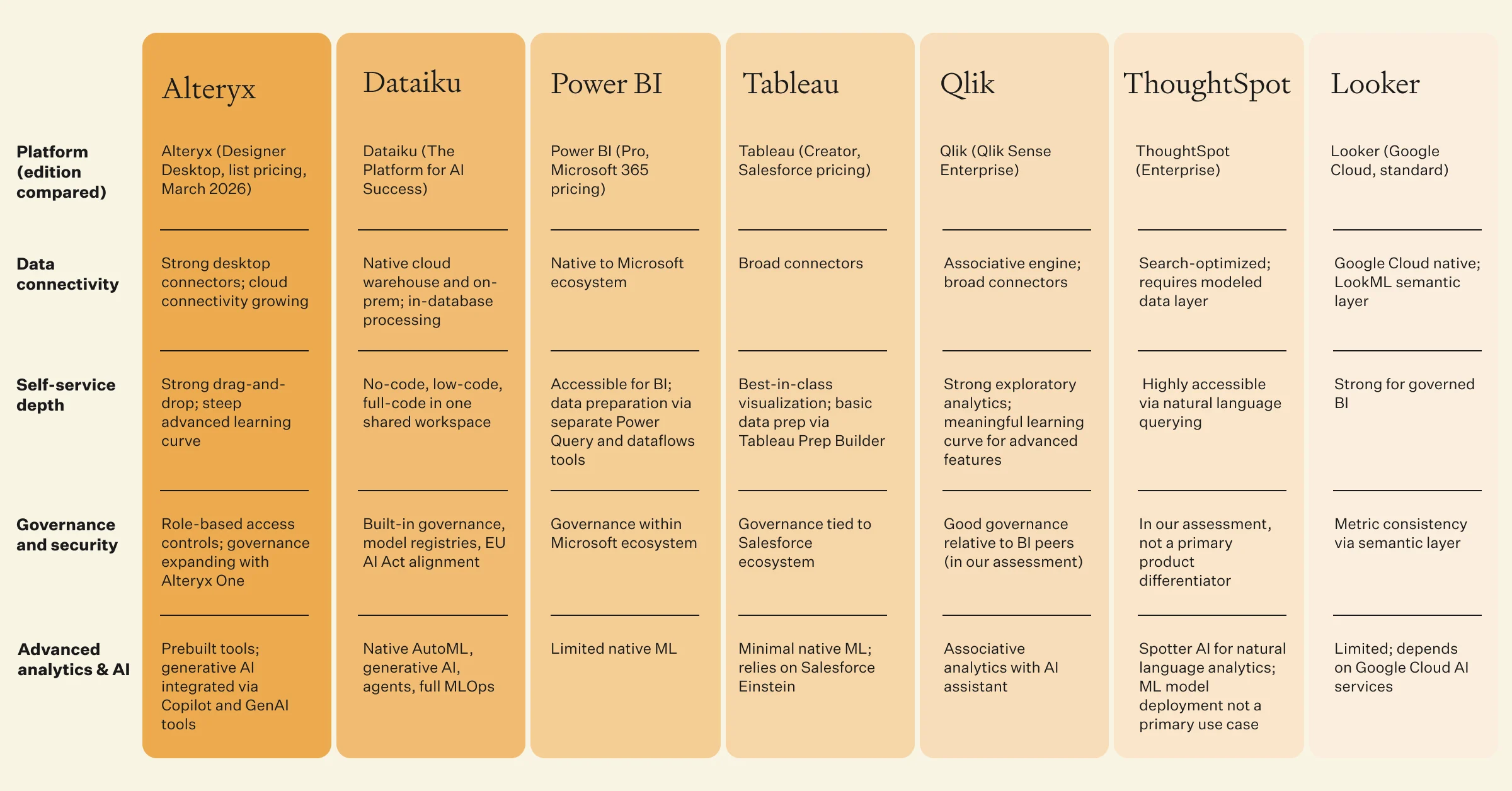
Comparison accurate as of May 2026. Reviewed quarterly. Each platform evaluated against the edition listed. Capabilities may vary by tier.
The comparison reveals a structural divide. Alteryx, Power BI, Tableau, Qlik, ThoughtSpot, and Looker each perform well in a specific dimension but require additional tools to cover the full analytics-to-AI lifecycle.
Based on the criteria evaluated in this article, Dataiku is the platform in this comparison most comprehensively designed to span data preparation, advanced analytics, ML, generative AI, agents, and governance in a single environment.
The right analytics platform for 2026 depends on your organization's current maturity and where its AI and governance requirements are heading in the next 18 months.
If the primary need is replacing Excel-based workflows with repeatable automation and the team is already proficient in Alteryx, the switching costs may not justify migration. Alteryx's core data preparation capabilities remain competitive for that specific use case.
If the organization is consolidating tools, scaling AI adoption, or facing governance mandates that require audit-ready model management, the evaluation shifts toward platforms built for the full lifecycle. The finding from "7 career-making AI decisions for CIOs in 2026" that 74% of CIOs regret a recent platform selection underscores the cost of choosing a tool that fits today's requirements but not tomorrow's.
The most common mistake in platform evaluation is optimizing for current workflows rather than future requirements.
Alteryx remains effective for analyst-led data preparation and workflow automation. As organizations expand into AI, governance, and cross-functional collaboration, the evaluation criteria change. Choosing a platform that can support the full lifecycle — from data to decision to production AI — in a way that remains scalable, governed, and cost-effective over time will be key to AI success.
Alteryx's core differentiator is its visual workflow builder for data preparation and blending. Where most BI tools focus on the visualization and reporting layer, Alteryx focuses on the data transformation layer that feeds those reports.
The drag-and-drop canvas, combined with 300+ tools, including 50+ prebuilt code-free analytics tools for spatial, predictive, and statistical analytics, makes it possible for analysts to handle complex data work without writing code.
The trade-off is that Alteryx's product positioning focuses on data preparation, analytics automation, and generative AI workflows rather than full ML lifecycle management, model registries, and governed AI deployment of the kind offered by end-to-end platforms.
Re-evaluation usually starts when licensing costs are scaling faster than the value delivered, when teams need capabilities beyond data preparation that Alteryx for data analytics does not natively cover, or when governance mandates require audit trails and model registries that exceed what the platform offers out of the box.
Alteryx has invested significantly in cloud capabilities through Alteryx One and Designer Cloud, and the trajectory is clear. However, the platform's desktop-first heritage shows in the transition: users consistently report challenges with the desktop-to-cloud transition.
Alteryx's own product blog acknowledged that "certain tools didn't perform in Designer Cloud the way you'd expect them to in Designer," confirming that feature parity between the desktop and cloud versions remained an ongoing effort as of that date.
A PeerSpot reviewer separately notes that "when you load workflows onto the cloud, the same connections don't translate due to firewall issues." For organizations building new analytics infrastructure on cloud-native foundations (Snowflake, Databricks, BigQuery), evaluating platforms that were designed cloud-first is worth the comparison.
Timelines vary widely by scope. A focused deployment for a single team (50 to 100 users, defined use cases, existing data infrastructure) can be production-ready in 8 to 12 weeks. Enterprise-wide rollouts across multiple business units, with governance frameworks, SSO integration, and training programs, typically take 6 to 12 months. The biggest variable is change management, specifically getting teams to adopt new workflows and retire the tools they are already comfortable with.
Alteryx is a trademark of Alteryx, Inc. Microsoft Power BI is a trademark of Microsoft Corporation. Tableau is a trademark of Salesforce, Inc. Qlik is a trademark of Qlik Technologies, Inc. ThoughtSpot is a trademark of ThoughtSpot, Inc. Looker is a trademark of Google LLC. Dataiku is not affiliated with or endorsed by any of the above companies. All product capabilities, pricing, and limitations referenced in this article are sourced from publicly available information and verified user reviews. Sources are dated March 2026.