Discover Dataiku Agent Management: every agent on the record
September 24, 2026/4 min read/Julia Tran
Congratulations. You now own every AI agent in the company.
Not that you built them.
Marketing built one to draft campaign briefs. Finance stood up another to reconcile invoices. Operations has three more in production. Somewhere, someone connected an agent to company data last week. And tomorrow there will be more.
That's the new reality for enterprises: the ability to build AI has spread across the enterprise faster than the ability to manage it. The building isn't the problem. What is missing is everything that turns a growing collection of agents into a portfolio you can actually manage.
Which agents are running? Who owns them? Is anyone using them? Are they still doing what they were built to do? What do they cost? And across hundreds and eventually thousands of agents, which ones are worth scaling and which ones need your attention?
Yet when the board, risk team, or auditor starts asking those questions, responsibility still lands on one person: you.
Dataiku Agent Management gives you one place to discover agents across your connected platforms, monitor how they're performing, and manage the risk across your agent portfolio wherever those agents were built.
You can't manage an agent you don't know exists. Agents are being built by different teams, against different models and data sources, on different platforms like Microsoft Copilot Studio and Azure Foundry, Salesforce Agentforce, AWS Bedrock, Google Gemini Enterprise, Databricks, Snowflake Cortex, or even coded agents on Open Telemetry.
Agent Management scans connected platforms and brings those agents into one inventory. Every entry carries the basics: who owns it, what it connects to, when it last ran, and what it was built to do. Now those answers live in one place.
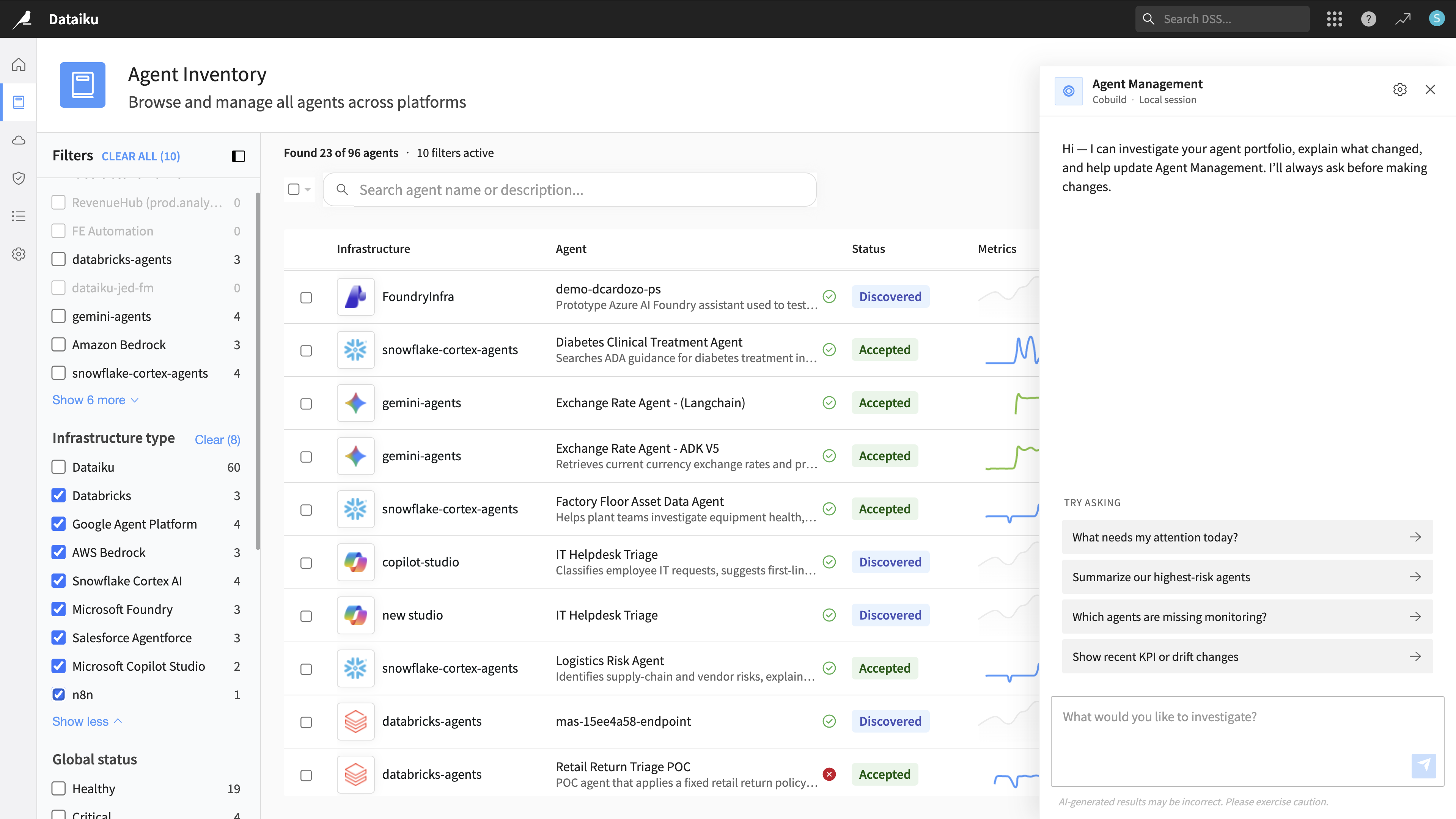
So when the board asks "What agents are actually running here?", answering doesn't require an investigation (or a scramble).
An inventory is the starting point. Now you need to understand it. The agent with three users and the agent with 3,000 shouldn't look the same. Neither should an agent working exactly as intended and one quietly drifting away from its original purpose.
Agent Management monitors each agent's health, usage, cost, quality, and behavior over time. When one drifts from its normal pattern, the system raises its hand so a person can take a look.
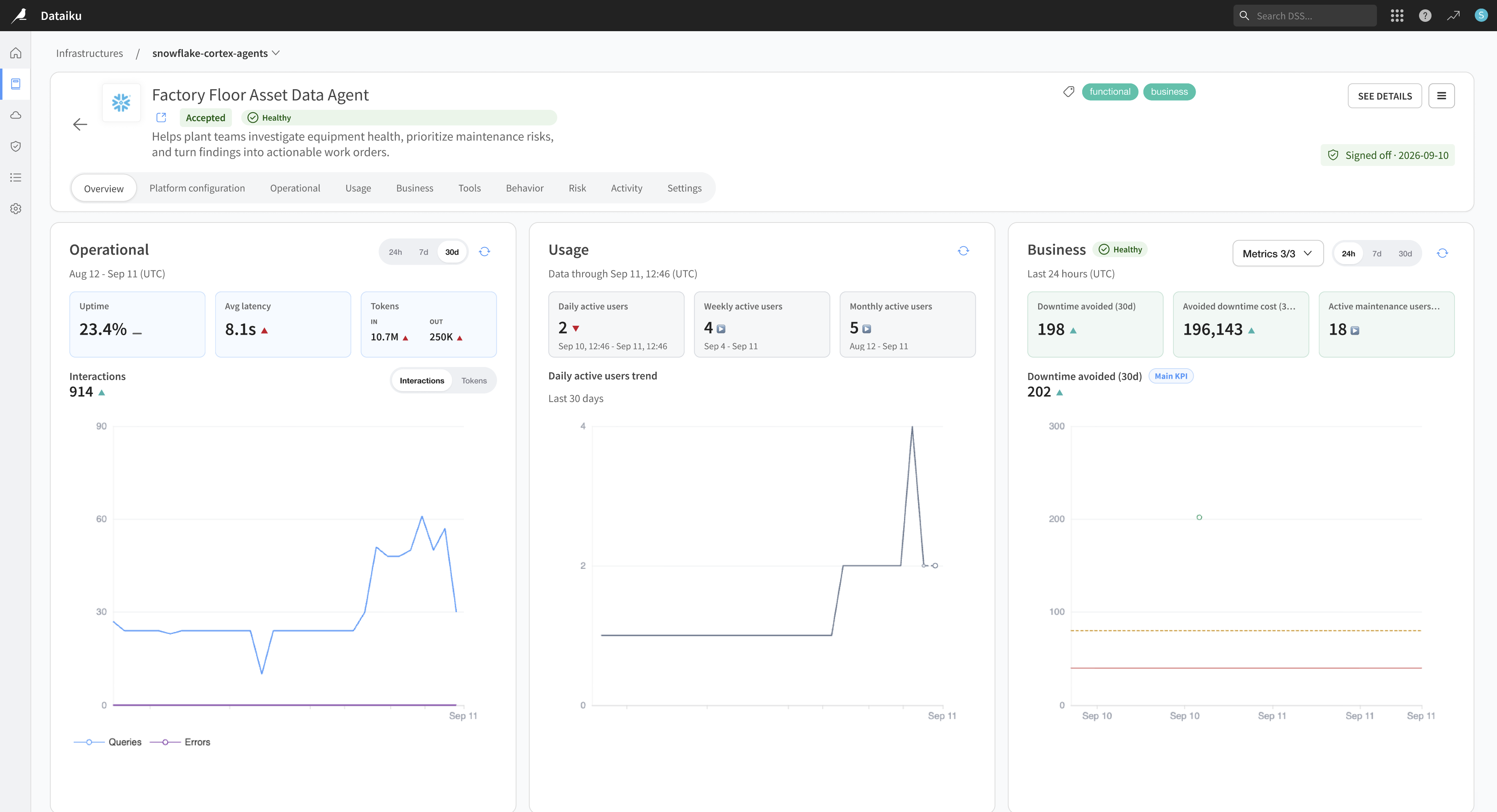
You don't need to rewrite or redeploy anything: Agent Management connects to the platforms they already run on and keeps a faithful record of what they do. It does not operate your agents or step into their decisions, so they keep running exactly as your teams built them. What you gain is a steady, trustworthy account of their behavior, so oversight comes from seeing clearly, without slowing anyone down.
An inventory and monitoring show you what's happening. Someone still has to decide what's acceptable and be ready to answer for it. That's the step that turns a list of agents into a portfolio you can stand behind.
Agent Management assesses the risk each agent carries and keeps that picture current as agents change, so your exposure across the whole portfolio stays visible in one place. Agents that carry more risk can be certified against a documented set of checks before they go live, so there's evidence they met the bar.
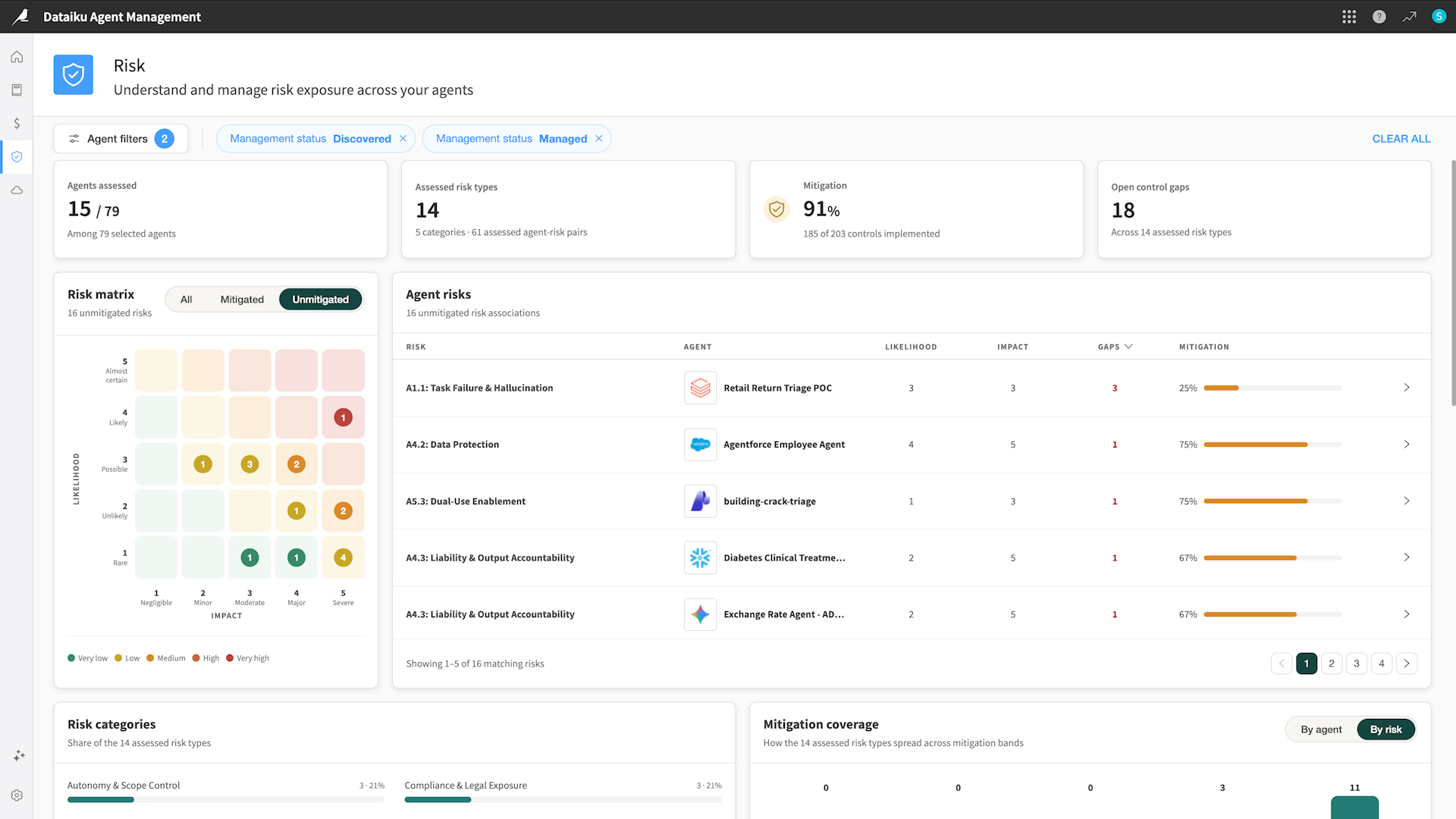
This is the control you're actually accountable for: knowing which agents are allowed to run, what each one is allowed to do, whether it still behaves that way, and having the record when it doesn't.
When someone asks how many agents are in production, you answer in seconds. When an agent starts behaving oddly, you hear about it from your own system first.
Your teams keep building and deploying agents wherever the work happens. The difference is that each one joins the record the moment it goes live, so the number of agents can grow without your certainty shrinking.
An inventory tells you what you have. Monitoring tells you what's changing. Risk management tells you where your exposure is. Together, that's what turns a list of agents into a trusted portfolio.
Responsibility stops feeling like a liability you inherited and starts feeling like a system you run. With that handled, your attention goes where it should: getting more agents into production and driving agentic AI forward across the company.
Join our AI experts on October 1st for a live demo of Agent Management
Sign up
Tags